

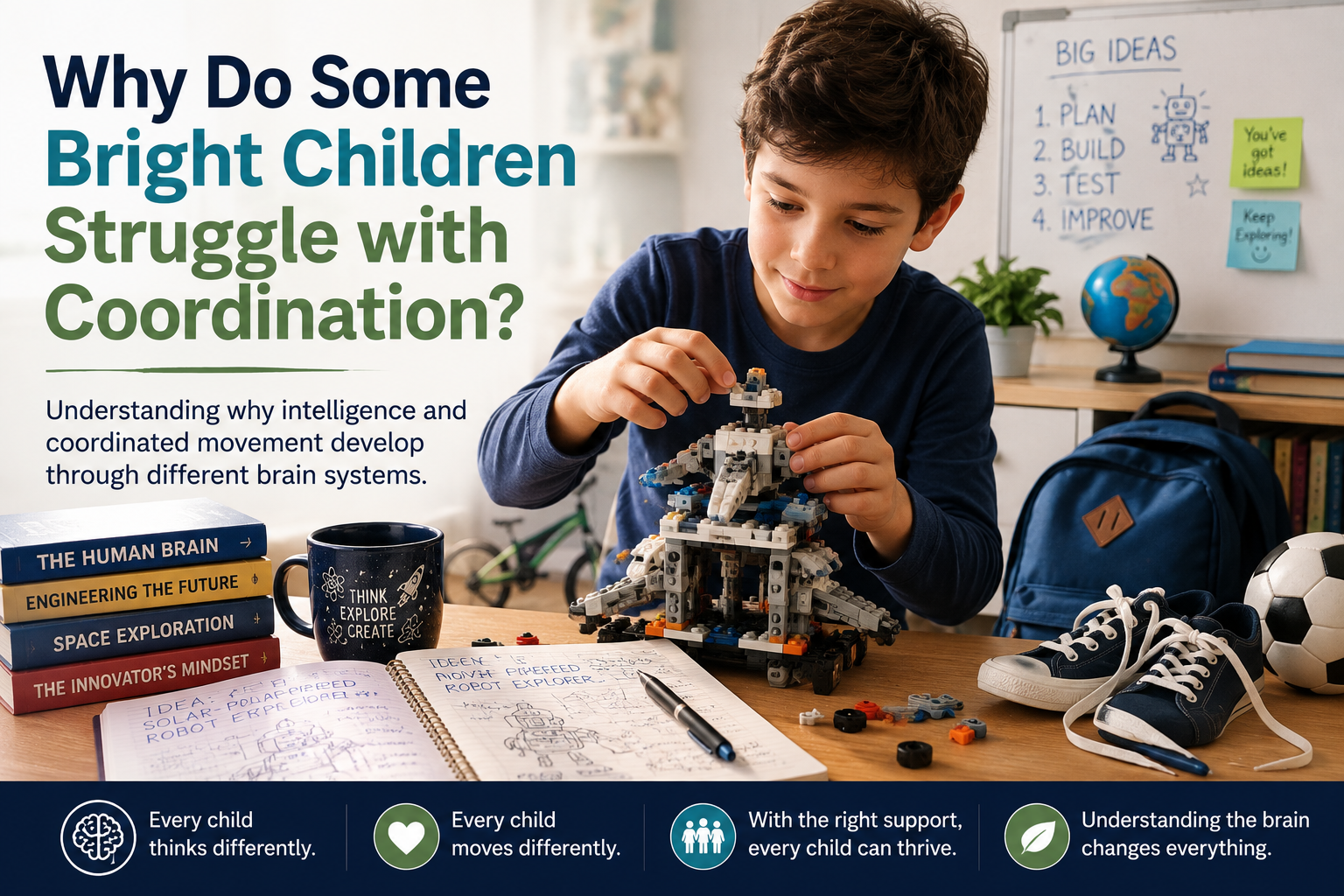
One of the most common things parents tell us is:
“My child is so smart… but they struggle with things that seem easy for everyone else.”
Perhaps they love science.
Build amazing LEGO creations.
Read well above grade level.
Memorize facts with incredible accuracy.
Solve complex puzzles.
Yet they still have difficulty tying their shoes, catching a ball, handwriting, riding a bicycle, or participating comfortably in sports.
For many parents, this feels confusing.
How can a child be so intelligent while finding everyday movement so difficult?
The answer is that intelligence and coordination are not the same thing.

Intelligence and Movement Are Different Brain Functions
The human brain performs many different jobs.
Some brain systems support:
- Language
- Memory
- Creativity
- Reasoning
- Problem-solving
Other systems are responsible for:
- Motor planning
- Balance
- Visual-motor integration
- Body awareness
- Coordination
- Timing
- Sequencing movement
Although these systems communicate with one another, they develop somewhat independently.
A child may excel in one area while needing additional support in another.
Dyspraxia Does Not Reflect Intelligence
Developmental Coordination Disorder (Dyspraxia) affects how the brain plans and coordinates movement.
It does not determine how intelligent a child is.
Many children with dyspraxia are:
🧠 Highly curious
📚 Strong readers
🎨 Creative thinkers
🧩 Excellent problem-solvers
💡 Full of imaginative ideas
🎯 Passionate learners
Their challenges simply involve a different set of brain systems than those responsible for intelligence.
Why Everyday Tasks Can Feel So Difficult
Parents are often surprised by which activities become challenging.
Children with dyspraxia may struggle with:
👟 Tying shoes
✏️ Handwriting
🍴 Using utensils
⚽ Catching or throwing a ball
🚲 Riding a bicycle
🎒 Managing school materials
🤸 Learning new motor skills
These activities appear simple because coordinated movement happens automatically for most people.
In reality, every one of these tasks depends on multiple brain systems communicating continuously.

The Emotional Side Parents Don’t Always See
Children usually notice when something feels harder for them than it does for their friends.
Over time they may begin thinking:
“I’m bad at sports.”
“Everyone else learns faster.”
“I don’t want to try.”
Those thoughts rarely reflect a lack of ability.
They often reflect repeated experiences of frustration.
Helping children understand that movement challenges are not a measure of intelligence can be incredibly empowering.
Looking Beyond Labels
Children are much more than a diagnosis.
One child with dyspraxia may become an engineer.
Another may become an artist.
Another may become a musician.
Another may become a scientist.
Another may become an entrepreneur.
Their movement challenges do not define their potential.
Understanding how their brain processes movement simply helps us provide more personalized support.
How NeuroFiT Connections Can Help
At NeuroFiT Connections, we begin with a comprehensive Brain & Body Assessment designed to better understand the neurological systems involved in coordinated movement.
Rather than assuming every child with dyspraxia has the same needs, we identify each child’s unique strengths and areas of challenge.
Using those results, we create a personalized brain training program designed to strengthen the foundational brain skills that support movement, coordination, confidence, and everyday participation.
Because every child deserves the opportunity to move, learn, play, and participate fully in life.
Looking Toward the Future
Children build confidence through successful experiences.
One successful bike ride.
One playground game.
One completed handwriting assignment.
One tied shoe.
One small victory after another.
Those moments help children discover something incredibly important:
“I can do this.”
That’s the confidence we hope every child has the opportunity to experience.
Final Thoughts
Developmental Coordination Disorder is not a measure of intelligence.
It reflects differences in how the brain plans and coordinates movement.
When parents understand that distinction, they often begin seeing their child’s challenges through an entirely new lens.
Instead of asking,
“Why can’t my child do this?”
they begin asking,
“How can I help my child build the brain skills that make this easier?”
That change in perspective can make all the difference.
Frequently Asked Questions
Can children with Dyspraxia be gifted?
Absolutely. Many children with Developmental Coordination Disorder are highly intelligent, creative, and academically successful. Dyspraxia affects movement and coordination—not intelligence.
Why is my smart child so clumsy?
Movement and intelligence rely on different brain systems. A child may have exceptional reasoning or creativity while finding coordination and motor planning more challenging.
Does Dyspraxia affect academic ability?
Not necessarily. Some children experience handwriting or organizational challenges that influence schoolwork, but many excel academically while continuing to experience coordination difficulties.
Can confidence be affected?
Yes. Repeated struggles with movement may lead children to avoid activities or doubt their abilities. Helping children experience success during everyday movement can support growing confidence.
How does NeuroFiT Connections help?
Every child begins with a comprehensive Brain & Body Assessment. We use those results to create a personalized brain training program designed to strengthen the foundational brain skills that support movement, learning, confidence, and participation.
Related Articles
- What Is Dyspraxia? Understanding Developmental Coordination Disorder
- Is My Child Just Clumsy or Could It Be Dyspraxia?
- How the Brain Coordinates Movement
- Why Handwriting, Sports & Everyday Tasks Can Be So Difficult
- Helping Children Build Confidence Through Movement
- Can Children with Dyspraxia Improve Their Coordination?