

Retained Primitive Reflexes: What They Are and How They May Affect Learning, Behavior, and Development

Understanding an Often-Overlooked Piece of Brain Development

Many parents come to NeuroFiT Connections searching for answers.

Their child may struggle with:

  • Attention and focus
  • Reading and learning
  • Emotional regulation
  • Balance and coordination
  • Sensory sensitivities
  • Anxiety
  • ADHD symptoms
  • Autism-related challenges

Despite tutoring, therapy, accommodations, or other interventions, progress may be slower than expected.

In many cases, one important piece of the puzzle may be something called retained primitive reflexes.

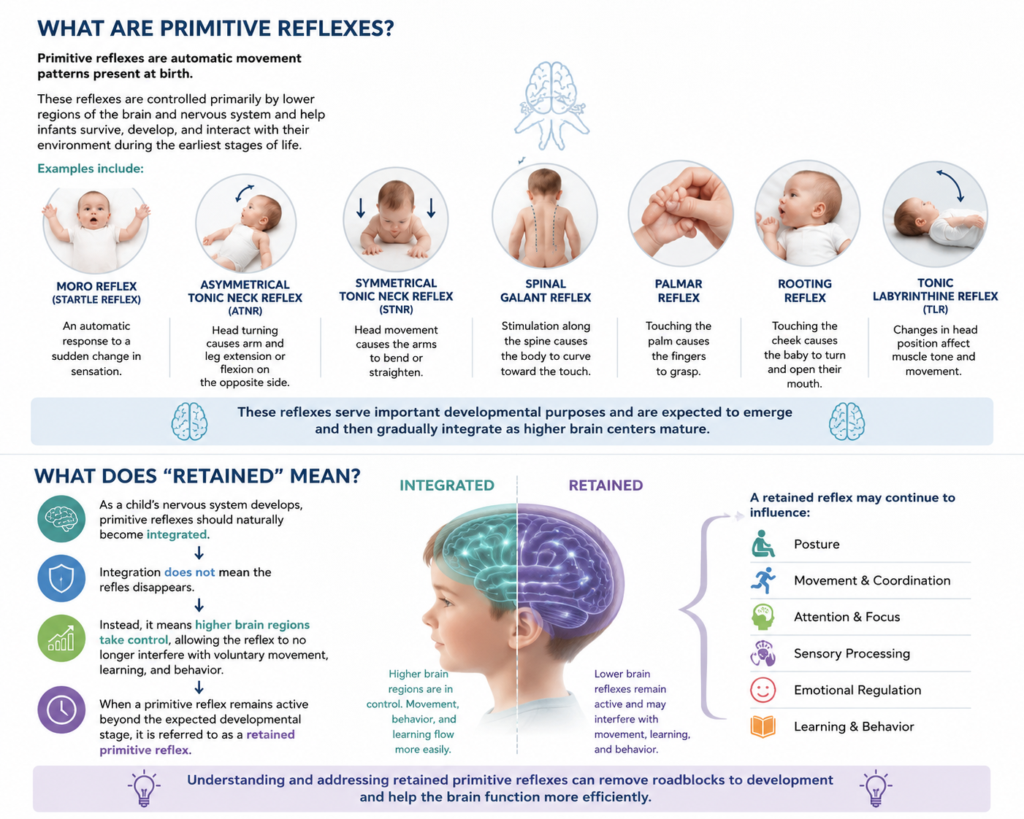
Primitive reflexes play a critical role in early brain development. When they do not fully integrate as expected, they may continue to influence learning, movement, behavior, and neurological development long after infancy.

Understanding these reflexes can provide valuable insight into challenges that may otherwise seem unrelated.

Grasping reflex
What are primitive reflexes

Why Are Primitive Reflexes Important?

Primitive reflexes help build the foundation for many higher-level skills.

These include:

  • Balance
  • Coordination
  • Posture
  • Visual tracking
  • Auditory processing
  • Reading readiness
  • Attention
  • Emotional regulation
  • Executive functioning

When these reflexes remain active, the brain may need to devote additional energy to managing basic neurological functions.

As a result, skills involving focus, learning, organization, and self-regulation may become more difficult.

Common Signs of Retained Primitive Reflexes

Every child is unique, but retained reflexes are often associated with challenges such as:

Attention and Focus Difficulties

Children may:

  • Be easily distracted
  • Have trouble sitting still
  • Struggle to maintain attention
  • Appear impulsive

Reading and Learning Challenges

Some children experience:

  • Difficulty tracking words across a page
  • Reading fatigue
  • Poor comprehension
  • Slow processing speed

Motor Coordination Problems

Signs may include:

  • Clumsiness
  • Poor balance
  • Difficulty riding a bike
  • Poor handwriting
  • Trouble with sports

Sensory Processing Challenges

Children may become:

  • Easily overwhelmed by noise
  • Sensitive to clothing textures
  • Reactive to touch
  • Overly sensitive to movement

Emotional Regulation Difficulties

Parents may notice:

  • Increased anxiety
  • Frequent meltdowns
  • Emotional overreactions
  • Difficulty adapting to change

These symptoms can occur for many reasons, but retained primitive reflexes may be one contributing factor.

Retained Primitive Reflexes and ADHD

Many children diagnosed with ADHD demonstrate signs of retained primitive reflexes.

Research has identified associations between certain retained reflexes and challenges involving:

  • Attention
  • Impulse control
  • Hyperactivity
  • Executive functioning

While retained reflexes do not cause ADHD, they may contribute to some of the symptoms commonly associated with it.

This is one reason primitive reflex assessment is often included as part of a comprehensive neurological evaluation.

Retained Primitive Reflexes and Autism

Retained primitive reflexes are also frequently observed in individuals on the autism spectrum.

These reflexes may influence:

  • Sensory processing
  • Social engagement
  • Emotional regulation
  • Motor coordination
  • Communication development

Again, retained reflexes are not considered the cause of autism, but they may affect how the nervous system processes information and responds to the environment.

Retained Primitive Reflexes and Dyslexia

Reading requires efficient communication between multiple areas of the brain.

Retained primitive reflexes may interfere with skills such as:

  • Visual tracking
  • Eye teaming
  • Coordination
  • Postural stability
  • Processing efficiency

When these foundational systems are compromised, reading and academic performance can become more challenging.

Many children struggling with dyslexia or learning disabilities demonstrate retained reflex patterns that may warrant further evaluation.

The Most Common Retained Primitive Reflexes

Moro Reflex

Often called the startle reflex.

When retained, it may be associated with:

  • Anxiety
  • Emotional sensitivity
  • Difficulty adapting to change
  • Sensory overload

ATNR (Asymmetrical Tonic Neck Reflex)

When retained, ATNR may contribute to:

  • Poor handwriting
  • Reading difficulties
  • Crossing midline challenges
  • Eye tracking problems

STNR (Symmetrical Tonic Neck Reflex)

Retention may affect:

  • Sitting posture
  • Focus
  • Coordination
  • Reading readiness

Spinal Galant Reflex

Retention may be associated with:

  • Fidgeting
  • Poor concentration
  • Bedwetting
  • Sensitivity around the waist

TLR (Tonic Labyrinthine Reflex)

Retention may contribute to:

  • Balance problems
  • Motion sensitivity
  • Poor posture
  • Coordination challenges
Common Primitive Reflexes

How Are Retained Primitive Reflexes Assessed?

At NeuroFiT Connections, primitive reflexes are evaluated as part of a broader neurological assessment.  We assess them by testing the desired reflex and looking for a reaction.  For example, to test Spinal Galant, we run the blunt end of a paint brush on either side of the spine.  If there is a reaction, the reflex is still present.

In addition to primitive reflexes, an assessment may include:

  • Balance testing
  • Coordination testing
  • Reflex screening
  • Sensory evaluation
  • Visual processing assessment
  • Auditory processing assessment
  • Cognitive measures
  • Hemispheric function analysis

The goal is not simply to identify retained reflexes but to understand how they may be affecting overall neurological function.

Can Retained Primitive Reflexes Be Integrated?

The brain remains adaptable throughout life.

Through the principle of neuroplasticity, targeted activities may help strengthen neurological pathways and support more mature patterns of movement and function.

Programs designed to address retained primitive reflexes often include:

  • Specific movement activities
  • Balance exercises
  • Coordination training
  • Sensory stimulation
  • Brain-based exercises
  • Home activities

These activities are selected based on the individual’s assessment findings and developmental needs.

The Melillo Method Holistic Approach

How the Melillo Method Addresses Primitive Reflexes

Primitive reflex assessment and integration are important components of the Melillo Method.

The Melillo Method recognizes that retained reflexes may be one sign of uneven neurological development.

Rather than focusing on reflexes in isolation, the method examines how they relate to:

  • Brain hemisphere development
  • Sensory processing
  • Motor skills
  • Learning
  • Attention
  • Emotional regulation

This broader perspective helps create a more comprehensive understanding of an individual’s strengths and challenges.

Could Retained Primitive Reflexes Be Affecting Your Child?

If your child struggles with:

  • ADHD symptoms
  • Learning difficulties
  • Reading challenges
  • Coordination problems
  • Sensory sensitivities
  • Emotional regulation
  • Autism-related concerns

retained primitive reflexes may be worth investigating.

A comprehensive assessment can help determine whether these developmental patterns are contributing to your child’s challenges and identify opportunities for growth.

Learn More About Your Child's Neurological Development

At NeuroFiT Connections, we help children and adults uncover the neurological factors that may be influencing learning, behavior, attention, and development.

Schedule an assessment to learn whether retained primitive reflexes may be playing a role and discover how a personalized, brain-based approach can support long-term success.

Ready to Get Started?

Contact NeuroFiT Connections today to schedule a comprehensive neurological assessment.

Retained Primitive Reflex FAQs


Primitive reflexes are automatic involuntary movements essential to a baby’s birth and survival in the first few weeks and months of life. They originate in the brainstem, the bottom stalk-like portion of the brain where the cerebellum connects with the spinal cord. These reflexes are normally quickly integrated as the higher centers of the brain develop and voluntary responses become dominant.

When a reflex is not integrated as expected, it inhibits part of the brain from developing normally, resulting in the disorders we know as Autism, ADHD, Dyslexia, and more.  We 

Research shows that ADHD is caused by the lack of maturation of the brain because of retained Primitive Reflexes. Further complicating the issue is the lack of physical movement of the body.


Research shows that Autism is caused by the lack of maturation of the brain because of retained Primitive Reflexes. Further complicating the issue is the lack of physical movement of the body.  Other contributing factors may be early childhood trauma or a genetic predisposition to autism.

Yes.  As Dr. Melillo often says, "reflexes don't integrate themselves".  As a result, if a reflex isn't integrated through use, it will be retained.  Additionally, trauma can bring reflexes back as their primary purpose is to keep us safe.

Reflexes are assessed by testing the desired reflex and looking for a reaction. 

For example, to test Spinal Galant, we run the blunt end of a paint brush on either side of the spine.  If there is a reaction, the reflex is still present.

To test the Rooting reflex, we run the other side of that same paintbrush from the bottom of the ear to the edge of the lips then across the lips.  If there is a reaction, the reflex is still present.

Yes.  There are several reflexes that impact reading, including ATNR, Babinski, and STNR.

It depends on the severity of the reflex.  We rate them from 0 to 4, where 0 means the reflex is integrated and 4 indicates the reflex is severe.  A severe reflex can take a few months of consistent work to integrate, where a less severe reflex may only take a few weeks.

The key to integration is to consistently perform the appropriate exercises.

The Moro reflex is part of the sympathetic nervous system and our freeze, fight or flight response to stimuli and stress.  It helps to protect the baby by communicating the need for comfort and support.

The Asymmetrical Tonic Neck Reflex (ATNR) is a primitive reflex present at birth that helps support early brain and motor development. When a baby turns their head to one side, the arm and leg on that side extend while the opposite arm and leg bend. This reflex typically integrates during infancy as the brain matures. If ATNR remains active beyond infancy, it may contribute to challenges with reading, handwriting, coordination, attention, and crossing the body's midline.

Yes. Through the brain's ability to adapt and change (known as neuroplasticity), targeted activities may help support the integration of retained primitive reflexes. Many programs use movement, balance, sensory, and coordination exercises designed to promote more mature neurological patterns and improve overall function. Results vary based on the individual and their specific developmental needs.