What Is an Underactive Hemisphere?

Understanding Brain Hemisphere Development and How It May Affect Learning, Behavior, and Development

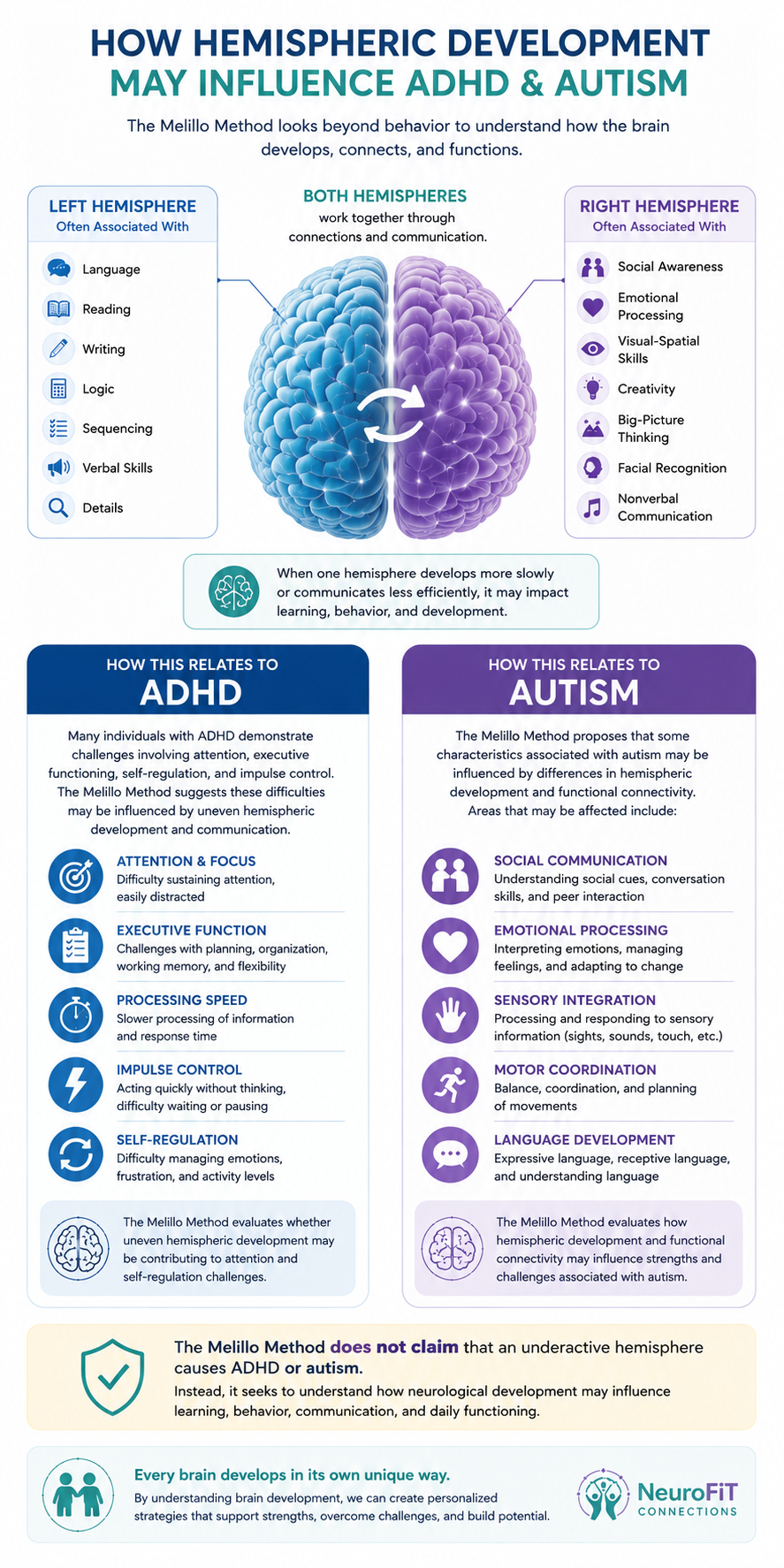
One of the foundational concepts behind the Melillo Method™ is the idea that the two hemispheres of the brain do not always develop at the same rate.

When one hemisphere develops more slowly or functions less efficiently than the other, it is sometimes referred to as an underactive hemisphere.

According to Dr. Robert Melillo’s work in functional neurology and neurodevelopment, these differences in brain development may contribute to challenges involving:

  • Attention and focus
  • Learning and academics
  • Emotional regulation
  • Social interaction
  • Communication
  • Motor coordination
  • Sensory processing
  • Executive functioning

Understanding hemispheric development can help explain why some children and adults continue to struggle despite intelligence, effort, and access to traditional interventions.

Understanding Brain Hemisphere Development

The Brain Has Two Hemispheres

The brain is divided into two halves:

  • The left hemisphere
  • The right hemisphere

These hemispheres constantly communicate with one another and work together to support everyday functioning.

While both hemispheres are involved in nearly everything we do, each hemisphere tends to specialize in certain functions.

The Left Hemisphere Is Often Associated With:

  • Language processing
  • Reading
  • Writing
  • Sequencing
  • Logic
  • Detailed analysis
  • Verbal expression

The Right Hemisphere Is Often Associated With:

  • Social awareness
  • Nonverbal communication
  • Emotional processing
  • Visual-spatial skills
  • Creativity
  • Big-picture thinking
  • Facial recognition

Healthy development depends on both hemispheres developing appropriately and communicating efficiently.

In normal development, the right hemisphere becomes active first as it is responsible for safety and attaching to mom, family, and tribe.  At about three years of age, the left hemisphere becomes active and works to catch up to the right.  This is the “why” period of a child’s life.  When this process does not happen normally, we see disorders like autism, ADHD, and dyslexia.

What Does "Underactive" Mean?

When the Melillo Method refers to an underactive hemisphere, it does not mean that part of the brain is damaged.

Instead, it refers to a hemisphere that may be:

  • Developing more slowly
  • Less efficiently connected
  • Less active during certain tasks
  • Less mature neurologically

Think of it like two teammates working together.

If one teammate is performing below their full potential, the entire team may struggle even though both teammates are present.

Similarly, when one hemisphere is underactive, communication and coordination between brain regions may become less efficient.
How Can an Underactive Hemisphere Affect Development?

The effects vary from person to person.

Because the brain controls virtually every aspect of learning and behavior, an imbalance in hemispheric development may contribute to challenges in multiple areas.

Attention and Focus

Some individuals may experience:

  • Difficulty sustaining attention
  • Distractibility
  • Impulsivity
  • Executive functioning challenges

Learning and Academics

Challenges may include:

  • Reading difficulties
  • Processing speed issues
  • Organization problems
  • Difficulty following directions

Emotional Regulation

An underactive hemisphere may influence:

  • Emotional control
  • Frustration tolerance
  • Anxiety
  • Stress responses

Social Development

Some individuals struggle with:

  • Reading social cues
  • Understanding facial expressions
  • Interpreting tone of voice
  • Building peer relationships

Sensory Processing

The brain may have difficulty organizing and responding to sensory information efficiently.

This can lead to:

  • Sensory sensitivities
  • Sensory seeking behaviors
  • Overwhelm in busy environments

How Does This Relate to ADHD?

Many individuals with ADHD demonstrate challenges involving attention, executive functioning, self-regulation, and impulse control.

The Melillo Method suggests that some of these difficulties may be influenced by uneven hemispheric development and communication.

Rather than viewing symptoms only from a behavioral perspective, the method examines whether neurological imbalances may be contributing to those challenges.

How Does This Relate to Autism?

The Melillo Method proposes that some characteristics associated with autism may be influenced by differences in hemispheric development and functional connectivity.

Areas that may be affected include:

  • Social communication
  • Emotional processing
  • Sensory integration
  • Motor coordination
  • Language development

It is important to understand that the Melillo Method does not claim that an underactive hemisphere causes autism.

Instead, it seeks to understand how neurological development may influence the individual’s strengths and challenges.

Brain Development & ADHD and Autism

What Is Functional Connectivity?

For the brain to work efficiently, different regions must communicate continuously.

This communication is often called functional connectivity.

Even if both hemispheres are healthy, challenges can arise when communication between regions is inefficient.

The Melillo Method evaluates both hemispheric development and how effectively different parts of the brain work together.

Signs That May Suggest Uneven Hemispheric Development

While only a comprehensive assessment can identify neurological patterns, some signs may include:

  • Difficulty focusing
  • Poor coordination
  • Balance problems
  • Delayed motor development
  • Learning difficulties
  • Emotional dysregulation
  • Social communication challenges
  • Sensory sensitivities
  • Auditory processing difficulties
  • Visual processing difficulties

Many of these challenges can overlap with ADHD, autism, dyslexia, and other developmental conditions.

Brain assessment and neuroplasticity

How Does the Melillo Method Assess Hemispheric Function?

At NeuroFiT Connections, hemispheric development is evaluated as part of a comprehensive neurological assessment.

This assessment may include:

  • Primitive reflex testing
  • Balance evaluation
  • Coordination testing
  • Sensory processing measures
  • Visual processing assessment
  • Auditory processing assessment
  • Cognitive testing
  • Motor function evaluation

The goal is to identify strengths and weaknesses across multiple neurological systems.

Can an Underactive Hemisphere Be Strengthened?

One of the central principles behind the Melillo Method is neuroplasticity.

Neuroplasticity refers to the brain’s ability to adapt, strengthen connections, and develop throughout life.

Because the brain remains capable of change, targeted activities may help stimulate and strengthen underactive neurological systems.

Programs may include:

  • Balance exercises
  • Coordination activities
  • Sensory stimulation
  • Cognitive exercises
  • Primitive reflex integration activities
  • Home-based activities

These interventions are selected based on each individual’s unique assessment findings.

Why Is This Concept Important?

Many interventions focus primarily on symptoms.

The Melillo Method asks a different question:

Why are these symptoms occurring in the first place?

By examining hemispheric development and brain connectivity, practitioners seek to identify underlying neurological factors that may be influencing learning, behavior, communication, attention, and development.

This broader perspective helps create a more personalized approach to supporting growth and development.

How NeuroFiT Connections Uses the Melillo Method

At NeuroFiT Connections, we use Melillo Method principles to help children and adults better understand their neurological strengths and challenges.

Our assessments and personalized programs are designed to:

  • Identify developmental imbalances
  • Strengthen underactive systems
  • Improve functional connectivity
  • Support learning and attention
  • Enhance emotional regulation
  • Promote greater independence and confidence

Every brain is unique, and every program should reflect that uniqueness.

Could an Underactive Hemisphere Be Affecting Your Child?

If your child struggles with:

  • ADHD symptoms
  • Autism-related challenges
  • Learning difficulties
  • Sensory processing issues
  • Emotional regulation
  • Social communication
  • Coordination problems

an assessment may help uncover neurological factors that could be contributing to those challenges.

Understanding how the brain is functioning is often the first step toward meaningful growth and progress.

Ready to Learn More?

Schedule an assessment with NeuroFiT Connections to learn how the Melillo Method evaluates brain development and helps create personalized plans for success.

Retained Primitive Reflex FAQs

An underactive hemisphere refers to one side of the brain developing or functioning less efficiently than the other. In the Melillo Method, this does not mean the brain is damaged. Instead, it describes a difference in neurological development that may affect learning, attention, behavior, communication, and other aspects of daily functioning.

The Melillo Method does not claim that an underactive hemisphere causes ADHD. However, it suggests that uneven hemispheric development may contribute to challenges involving attention, executive functioning, self-regulation, and impulse control that are commonly associated with ADHD.

The Melillo Method does not claim that an underactive hemisphere causes autism. Instead, it examines how differences in brain development and functional connectivity may influence social communication, sensory processing, emotional regulation, and other characteristics associated with autism.

Yes. Because the brain plays a central role in reading, writing, attention, memory, and processing information, uneven hemispheric development may contribute to learning challenges. The specific effects vary from person to person and depend on which neurological systems are involved.

Hemispheric function is evaluated through a comprehensive neurological assessment that may include primitive reflex testing, balance and coordination measures, sensory processing evaluation, visual and auditory processing assessments, cognitive testing, and motor function evaluation. The goal is to identify strengths and weaknesses across multiple neurological systems.

Potential signs may include attention difficulties, learning challenges, poor coordination, balance problems, sensory sensitivities, emotional dysregulation, social communication difficulties, auditory processing issues, or visual processing challenges. These signs can overlap with many developmental and learning disorders and should be evaluated by a qualified practitioner.

The Melillo Method is based on the principle of neuroplasticity, which is the brain's ability to adapt and develop throughout life. Targeted activities such as balance training, sensory stimulation, cognitive exercises, coordination activities, and primitive reflex integration exercises may help strengthen underactive neurological systems.

Functional connectivity refers to how effectively different regions of the brain communicate and work together. Efficient communication between brain regions supports learning, behavior, attention, emotional regulation, and other higher-level functions. The Melillo Method evaluates both hemispheric development and functional connectivity.

The Melillo Method evaluates hemispheric development through a comprehensive assessment of neurological function. This may include examining primitive reflexes, sensory processing, motor skills, balance, coordination, visual and auditory processing, and cognitive performance to identify patterns of neurological strengths and weaknesses.

Brain damage refers to physical injury or structural changes within the brain. An underactive hemisphere, as described by the Melillo Method, does not imply damage. Instead, it refers to a hemisphere that may be developing more slowly, functioning less efficiently, or communicating less effectively with other brain regions. The brain remains capable of growth and change through neuroplasticity.