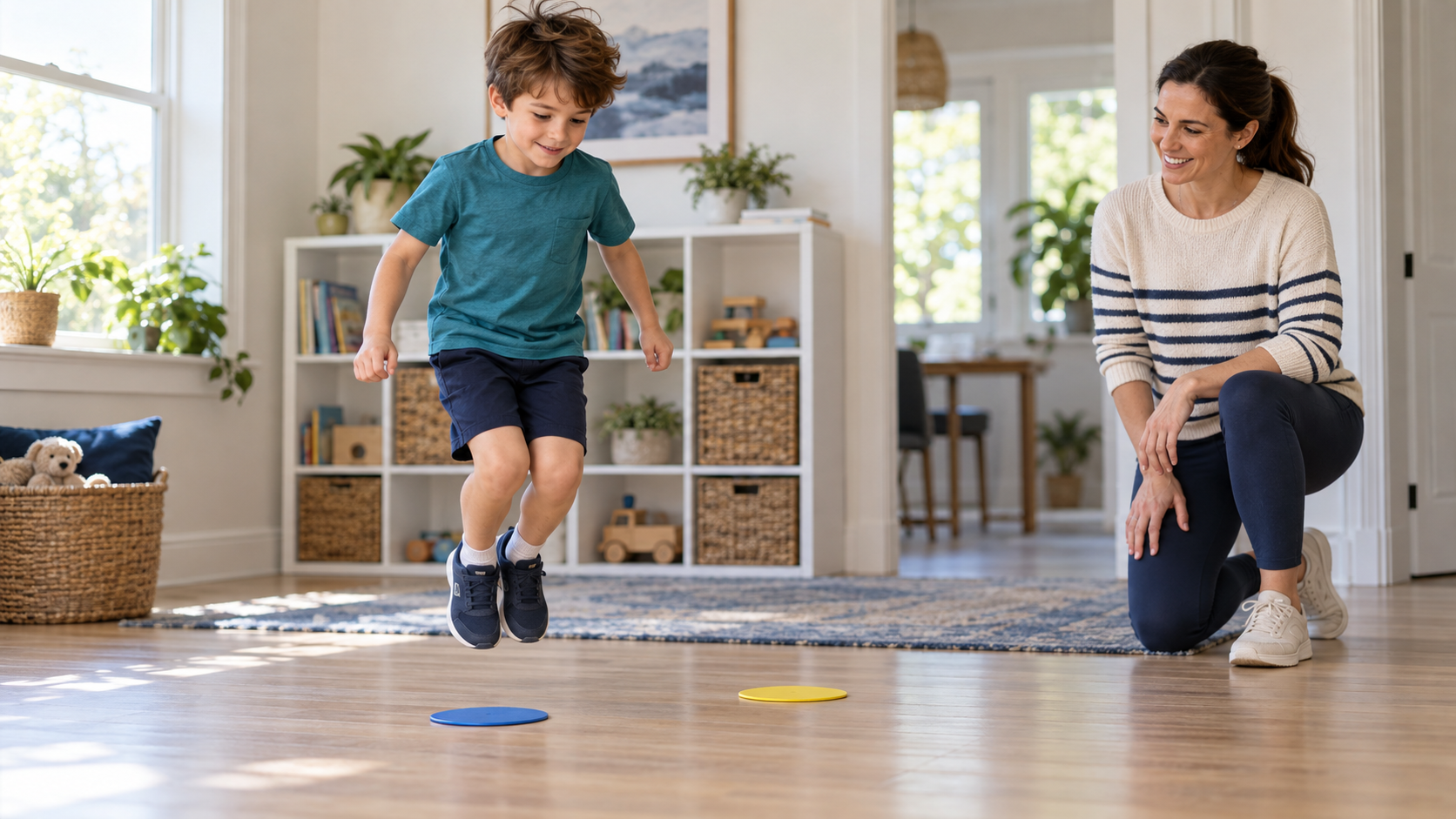


Movement can look effortless.
A child sees a ball, reaches out, catches it, adjusts their balance, and prepares to throw it back—all within seconds.
Yet behind that seemingly simple action, the brain is completing an extraordinary amount of work.
It must:
- Interpret what the eyes see.
- Determine where the body is in space.
- Predict where the ball is going.
- Plan an appropriate response.
- Activate the correct muscles.
- Coordinate both sides of the body.
- Monitor the movement as it happens.
- Make rapid corrections when necessary.
Coordinated movement does not come from one isolated “movement center.” It develops through communication among distributed brain networks involved in motor planning, sensory processing, vision, balance, attention, prediction, learning, and executive control. Research on Developmental Coordination Disorder consistently points to differences in visual-motor mapping, cognitive-motor integration, predictive control, motor learning, and the coordination of sensorimotor networks.
That complexity helps explain why a bright, capable child may understand exactly what they want to do while still struggling to make their body carry it out smoothly.
Movement Begins with a Goal
Before the body moves, the brain must understand the goal.
The goal might be:
- Pick up a pencil.
- Tie a shoe.
- Step over an obstacle.
- Catch a ball.
- Copy a shape.
- Climb onto playground equipment.
The brain then transforms that goal into a movement plan.
This process involves selecting which parts of the body to use, how much force is needed, what sequence should occur, and how the movement may need to change as the situation unfolds.
For most children, familiar movements gradually become automatic.
For children with Developmental Coordination Disorder, movement may remain slower, less accurate, more variable, or more mentally demanding than it is for their peers.
Motor Planning: Deciding How to Move
Motor planning, sometimes called praxis, is the brain’s ability to organize purposeful movement.
It helps a child decide:
- What movement is needed.
- Which body parts should be involved.
- In what order the movements should occur.
- How much speed or force to use.
- How to adjust when the situation changes.
Consider tying shoes.
A child must stabilize the foot, grasp both laces, cross them, pull with appropriate force, create loops, move each hand differently, and remember the sequence from beginning to end.
The child may understand the instructions perfectly while still struggling to organize the physical actions.
Research suggests that children with DCD may experience differences in planning, predicting, monitoring, and correcting voluntary movement.
The Brain Predicts What Will Happen Next
Smooth movement depends partly on prediction.
When reaching for a cup, the brain estimates:
- Where the cup will be.
- How far the arm must travel.
- How wide the hand should open.
- How firmly the fingers should grip.
- What the cup will feel like when lifted.
These predictions allow movement to begin before every detail has been confirmed through sensory feedback.
Researchers sometimes describe this as an internal model of movement—the brain predicts the likely outcome of an action and compares that prediction with what actually happens.
Evidence suggests that predictive motor control may be less efficient in DCD. As a result, children may rely more heavily on conscious monitoring and sensory feedback while moving. This can make actions slower, more variable, and more tiring.
Visual-Motor Integration: Connecting Sight with Action
Children constantly use vision to guide movement.
They rely on visual-motor integration when they:
- Catch a ball.
- Copy from a board.
- Write between lines.
- Use scissors.
- Build with blocks.
- Walk around obstacles.
- Reach for objects.
- Ride a bicycle.
The eyes collect information, but the brain must interpret that information and translate it into an appropriate movement.
A major systematic review found especially pronounced difficulties in DCD involving voluntary gaze control, visual-motor mapping, cognitive-motor integration, and navigation through changing environments.
This helps explain why some children may appear especially awkward during activities that require them to watch and move at the same time.
Body Awareness: Knowing Where You Are in Space
Children do not need to look at their feet every time they take a step.
That is partly because the brain receives constant information from muscles, joints, and connective tissues about body position and movement.
This internal sense is called proprioception.
It helps children know:
- Where their arms and legs are.
- How much a joint is bending.
- Whether the body is upright.
- How hard they are pushing or pulling.
- How much force a task requires.
Body awareness supports almost every coordinated activity, from fastening buttons to moving through a crowded hallway.
When this information is difficult to interpret or integrate efficiently, children may use too much or too little force, bump into things, misjudge distances, or appear uncertain during movement.
Balance: Creating a Stable Foundation
Balance depends on information from several systems, including vision, the vestibular system of the inner ear, and proprioceptive feedback from the body.
These systems help children:
- Maintain posture.
- Sit upright while writing.
- Stand on one foot.
- Walk on uneven surfaces.
- Climb stairs.
- Change direction.
- Ride a bicycle.
- Recover after losing balance.
Balance is not separate from other motor skills.
A child needs a stable trunk and posture before the hands can perform precise movements efficiently. That is one reason difficulties with balance or postural control may also influence handwriting, cutting, dressing, and classroom endurance.
Fine Motor Control: Precision in the Hands and Fingers
Fine motor control involves small, precise movements of the hands and fingers.
Children use it for:
- Handwriting.
- Drawing.
- Buttoning clothing.
- Tying shoes.
- Using utensils.
- Opening containers.
- Manipulating small objects.
- Keyboarding.
These actions require more than finger strength.
The brain must coordinate vision, touch, timing, posture, force, and movement sequencing.
Children with DCD may perform fine motor tasks more slowly or less accurately, and they may require greater concentration to maintain control. Fine and gross motor performance in DCD is often described as slower, less accurate, and more variable than that of peers.
Gross Motor Coordination: Organizing the Whole Body
Gross motor coordination involves larger movements of the trunk, arms, and legs.
It supports:
- Running.
- Jumping.
- Throwing.
- Catching.
- Kicking.
- Climbing.
- Swimming.
- Team sports.
- Playground activities.
These movements require several systems to work simultaneously.
For example, catching a ball involves tracking it visually, predicting its path, positioning the body, maintaining balance, extending both arms, opening the hands, timing the grasp, and absorbing the force of impact.
A difficulty anywhere in that chain can affect the final result.
Attention and Executive Function Guide Movement
Movement does not happen separately from thinking.
Children use attention and executive function to:
- Follow directions.
- Remember a sequence.
- Decide where to begin.
- Stay focused.
- Switch strategies.
- Notice errors.
- Adjust when something changes.
- Learn from feedback.
A child may have the physical ability to perform each step individually but struggle to organize the steps into a complete action.
DCD is also associated with increased rates of difficulties in attention, language, social communication, reading, and spelling, although these do not occur in every child. This is one reason assessment should consider the whole child rather than motor performance alone.
Timing and Rhythm Help Movements Flow
Coordinated movement depends on timing.
The brain must determine:
- When to begin.
- How quickly to move.
- When to stop.
- How movements should overlap.
- How to match movement to an external event.
Timing is essential for catching a ball, jumping rope, walking to a rhythm, speaking while gesturing, and coordinating both sides of the body.
When timing is inconsistent, movement may look hesitant, jerky, delayed, or poorly synchronized.
The Brain Monitors and Corrects Movement
Movement does not end once the brain sends a command.
As the action occurs, sensory information returns to the brain.
The brain compares:
What did I expect to happen?
with:
What actually happened?
It then makes corrections.
If a child begins reaching too far, the arm changes direction.
If the ground feels uneven, posture adjusts.
If the pencil begins slipping, grip pressure changes.
This feedback-and-correction loop happens continuously.
Research indicates that DCD can involve differences not only in movement planning but also in movement monitoring, motor learning, imitation, and adapting actions through practice.

Why Practice May Not Make Movement Automatic Quickly
Practice is important, but not all children benefit from practice in the same way.
A child with DCD may:
- Need more repetitions.
- Benefit from clearer step-by-step instruction.
- Struggle to transfer a learned skill into a new setting.
- Perform inconsistently from one attempt to the next.
- Need more time for movement to become automatic.
- Become mentally or physically fatigued more quickly.
This does not mean the child is not learning.
It may mean their brain requires a different type, intensity, or structure of practice.
Research supports the idea that motor learning in DCD may be especially dependent on how practice is organized and on the context in which a skill is learned.
How the Brain Coordinates Movement
Each foundational system contributes something different:
- Motor planning organizes the action.
- Visual-motor integration connects seeing with moving.
- Body awareness identifies where the body is in space.
- Balance provides stability.
- Fine motor control supports precision.
- Gross motor coordination organizes larger movements.
- Attention keeps the child engaged.
- Executive function sequences and adjusts the plan.
- Timing helps the movement flow.
- Sensory feedback allows correction.
Successful movement emerges when these systems communicate efficiently.

Why Dyspraxia Looks Different in Every Child
No two children with DCD have exactly the same profile.
One child may struggle primarily with handwriting.
Another may have greater difficulty with balance and sports.
Another may find self-care especially challenging.
Another may perform well during familiar activities but struggle when asked to learn something new.
Research describes DCD as heterogeneous, meaning the combination and severity of motor-control differences can vary considerably from one person to another.
That is why a diagnosis alone cannot fully explain how a particular child experiences movement
Movement Supports Everyday Participation
The same brain systems involved in sports also support:
- Getting dressed.
- Writing.
- Eating.
- Packing a backpack.
- Moving through school.
- Helping at home.
- Playing with friends.
- Exploring the community.
- Becoming more independent.
DCD can therefore influence academic productivity, self-care, physical activity, social participation, and emotional well-being—not just athletic performance.

Looking Beyond the Visible Movement
A missed catch or untied shoe is easy to see.
The brain work behind that struggle is not.
At NeuroFiT Connections, we believe it is important to look beneath the visible symptom and ask:
Which foundational brain systems are making this movement unusually difficult?
Every child begins with a comprehensive Brain & Body Assessment designed to better understand how the brain and body are supporting movement, coordination, attention, learning, and everyday participation.
Depending on the child, areas explored may include:
- Motor planning.
- Balance and postural control.
- Body awareness.
- Visual and visual-motor processing.
- Fine motor control.
- Gross motor coordination.
- Ocular motor function.
- Attention and executive function.
- Timing and rhythm.
- Primitive reflexes.
- Other foundational systems affecting movement and learning.
Using those findings, we develop a personalized brain training program based on the child’s unique profile rather than the diagnosis alone.

How NeuroFiT Connections Can Help
At NeuroFiT Connections, we look beyond the visible movement challenge to better understand the brain systems contributing to it.
Every child begins with a comprehensive Brain & Body Assessment designed to explore the foundational functions involved in movement, coordination, learning, and everyday participation. Depending on the child, this may include areas such as:
- Motor planning
- Balance and postural control
- Body awareness
- Visual and visual-motor processing
- Fine and gross motor coordination
- Ocular motor function
- Attention and executive functioning
- Timing and rhythm
- Primitive reflexes
- Other neurological systems that may influence movement and learning
Using the assessment results, we develop a personalized brain training program based on the child’s unique pattern of strengths and challenges.
Rather than building a program around the diagnosis alone, we build it around the child.
The goal is not simply to improve one isolated movement. It is to strengthen the foundational brain systems that support coordinated movement across school, self-care, play, relationships, and everyday independence.
Building Stronger Foundations for Participation
The goal is not perfect movement.
It is helping children participate more confidently in the activities that matter to them.
That might mean:
- Getting dressed with less assistance.
- Completing a classroom project.
- Joining a playground game.
- Riding a bicycle.
- Learning a recreational activity.
- Helping prepare a meal.
- Exploring new interests.
- Becoming increasingly independent.
Every child’s path is different.
Understanding how the brain coordinates movement gives families a clearer way to recognize those differences and identify meaningful areas for support.
Final Thoughts
Movement is one of the brain’s most complex achievements.
Every action requires planning, prediction, sensory processing, balance, attention, timing, execution, monitoring, and correction.
When these systems do not communicate as efficiently, movement can remain effortful even when a child is intelligent, motivated, and trying their hardest.
Understanding that complexity changes the conversation.
Instead of asking:
“Why can’t my child just do this?”
we can begin asking:
“Which parts of the movement process are making this so difficult?”
That shift replaces assumptions with understanding—and opens the door to more individualized support.
Because every child deserves the confidence to move, learn, participate, and thrive.
Frequently Asked Questions
1. Is movement controlled by one part of the brain?
No. Movement depends on distributed and interconnected brain networks involved in planning, sensation, vision, balance, attention, timing, prediction, execution, and error correction.
2. What is motor planning?
Motor planning is the brain’s ability to decide what movement is needed, organize the steps, select the appropriate muscles and force, and carry out the action toward a goal.
3. Why is visual-motor integration important?
Visual-motor integration allows children to coordinate what they see with how their hands and body move. It supports handwriting, catching, cutting, copying, navigating obstacles, and many classroom activities.
4. Why can children with DCD perform a skill one day but struggle the next?
Movement in DCD may be more variable and less automatic. Changes in attention, fatigue, environment, task complexity, and available sensory information may affect performance.
5. Does difficulty with movement mean a child has low intelligence?
No. Developmental Coordination Disorder affects movement and motor learning, not intelligence. A child can be exceptionally bright while needing significant support with coordination.
6. Can children strengthen their movement skills?
Many children can improve specific motor skills and participation with appropriate, individualized, task-relevant support and practice. The degree and pace of progress vary, and DCD may continue to affect some activities into adolescence and adulthood.
Related Articles
- What Is Dyspraxia? Understanding Developmental Coordination Disorder
- Is My Child Just Clumsy or Could It Be Dyspraxia?
- Why Do Some Bright Children Struggle with Coordination?
- Why Handwriting, Sports & Everyday Tasks Can Be So Difficult
- Helping Children Build Confidence Through Movement
- Can Children with Dyspraxia Improve Their Coordination?