

“Five more minutes.”
Your child nods.
Ten minutes later, they are still doing exactly what they were doing before.
You remind them that school starts soon.
They say:
“I know.”
Then somehow, with only minutes left before you need to leave, they still have to find their shoes, fill their water bottle, pack their backpack, and brush their teeth.
Or maybe your child consistently underestimates how long homework will take.
They believe a project will take 20 minutes.
It takes two hours.
They think they have plenty of time before soccer.
Then suddenly everyone is scrambling out the door.
Parents often describe this as:
“My child has no sense of time.”
You may also hear the popular phrase:
“Time blindness.”
While “time blindness” is not a formal diagnostic term, it is commonly used to describe difficulties noticing the passage of time, estimating how long something will take, planning around future deadlines, and adjusting behavior based on how much time remains.
For some children with ADHD, those difficulties can become part of everyday challenges with executive functioning, organization, and time management. NIMH specifically recommends working on time management and organization as part of practical ADHD support.
The problem may not simply be:
“My child doesn’t care that we’re late.”
Sometimes it may be:
“The information that we’re running out of time isn’t changing their behavior soon enough.”
What Do We Mean by “Time Blindness”?
“Time blindness” is a useful everyday phrase, but we should be careful not to treat it like a separate medical diagnosis.
What parents are usually describing is difficulty with one or more of these abilities:
⏰ noticing how much time has passed,
🧠 holding future obligations in mind,
📋 estimating how long a task will take,
▶️ starting early enough,
🔄 shifting activities when time is running out,
🎯 staying oriented toward a deadline,
and
✅ finishing with enough time to move on.
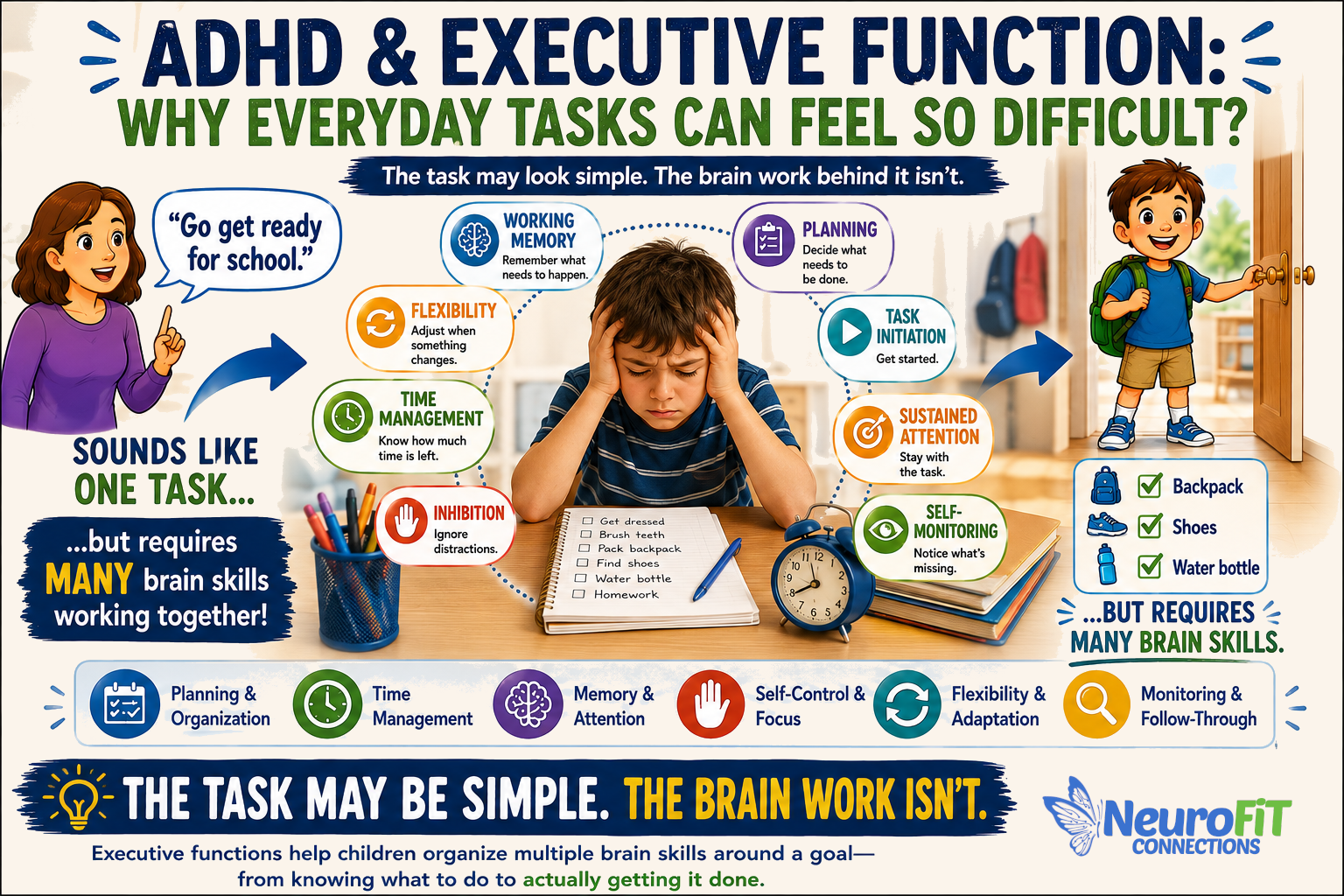
These are all closely connected to executive functioning.
A child may understand perfectly well what 10 minutes means mathematically while still struggling to organize behavior around those 10 minutes.
That distinction matters.
Knowing the Time Isn’t the Same as Managing Time
Imagine asking your child:
“What time do we have to leave?”
“7:45.”
“What time is it now?”
“7:25.”
“How long do you have?”
“Twenty minutes.”
They know all the answers.
Then 15 minutes later, they haven’t started getting ready.
That can make adults think:
“You obviously understand time, so why are you doing this?”
Because reading a clock and managing behavior across time are not the same skill.
The child still has to translate:
20 minutes remaining
into:
What do I need to do?
How long will each step take?
What should I begin now?
What can wait?
When do I need to stop what I’m doing?
Am I moving quickly enough?
That requires much more than knowing how many minutes are on the clock.

Why “Five Minutes” Can Feel So Different to a Child
Adults have years of experience with time.
We know roughly what five minutes feels like.
We know how long it takes to put on shoes.
We know that getting three people into a car rarely takes exactly 30 seconds.
Children are still building those internal estimates.
For a child who struggles with time management, “five more minutes” may remain an abstract statement until the five minutes are gone.
That is why:
“I told you five minutes ago!”
may feel very different to the adult than it does to the child.
The adult experienced a countdown.
The child may have experienced:
playing → playing → playing → sudden demand to stop.
Estimating Time Is a Skill
Let’s say your child has to complete:
📚 10 math problems
📖 20 minutes of reading
✍️ one paragraph
🎒 pack their backpack
You ask:
“How long will your homework take?”
They answer:
“Like 15 minutes.”
You know immediately that isn’t realistic.
But the child may genuinely believe it.
Estimating time requires experience and self-monitoring. The child needs to understand not just the task itself, but their own pace, how often they become distracted, whether they need breaks, how difficult the material is, and how much setup is involved.
That kind of prediction develops with practice.
The Hidden Time Demands of Everyday Life
Children are expected to manage time constantly.
🏫 Getting Ready for School
The child needs to work backward from:
We leave at 7:45
to:
get shoes,
pack backpack,
eat breakfast,
brush teeth,
get dressed,
and wake up early enough to do all of it.
That requires sequencing and time estimation.
📚 Homework
A child has to decide:
How much work do I have?
How long will it take?
When should I begin?
How much time can I spend on one problem?
Do I need a break?
When should I stop one assignment and move to another?
That’s time management layered on top of academic work.
⚽ Activities and Appointments
Practice starts at 5:00.
But that does not mean:
Start getting ready at 5:00.
The brain has to work backward:
practice at 5:00,
arrive at 4:50,
drive takes 15 minutes,
shoes and equipment take 10 minutes,
so I need to begin getting ready by…
That backward planning is an executive skill.
🛏️ Bedtime
Bedtime often looks simple:
“Go get ready for bed.”
But the child must understand that if lights-out is at 8:30, then showering, pajamas, brushing teeth, packing tomorrow’s backpack, and reading all have to happen before 8:30.
If each step is handled only when it becomes immediately necessary, bedtime can stretch indefinitely.
The “Now” Problem
One reason time management is difficult is that the future doesn’t demand attention the way the present does.
Right now:
🎮 the game is interesting.
📖 the book is engaging.
🧱 the LEGO project isn’t finished.
The future says:
“In 25 minutes, we need to leave.”
That future consequence is less immediate.
For some children, the present activity continues to win until the future becomes:
RIGHT NOW.
Then everything suddenly becomes urgent.
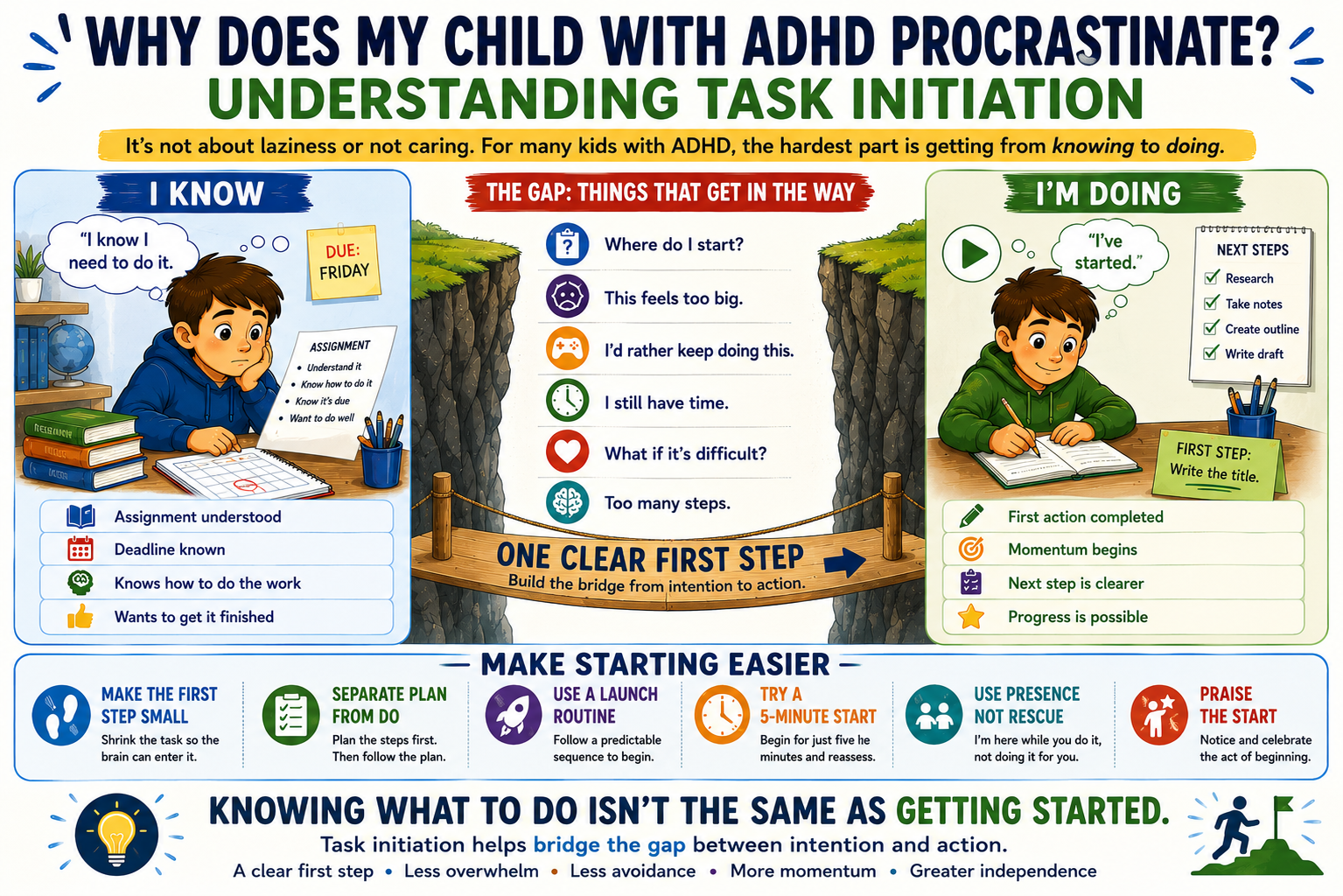
This connects closely with task initiation and procrastination.
A project due next week can remain abstract.
A project due tomorrow is harder to ignore.
A project due in 20 minutes creates immediate action.
The goal isn’t to rely on panic to create time awareness.
It’s to make time more visible before it becomes an emergency.
Time Management Is Also About Starting
Suppose homework takes 45 minutes.
Your child knows that.
They also know dinner is at 6:00.
But if they don’t begin until 5:40, knowing how long homework takes doesn’t help much.
Effective time management depends partly on task initiation.
The brain has to recognize:
If this takes 45 minutes, I need to begin by 5:15.
That seems obvious to adults because we’ve practiced backward planning for years.
Children may need that process made more explicit.
And It’s About Stopping
Time management also requires the opposite skill:
Stop.
If your child has 20 minutes before leaving but spends 18 minutes finishing a drawing, only two minutes remain for everything else.
So time awareness must connect to inhibition and transitions.
The brain has to recognize:
I may want to keep doing this, but I need to stop because something else requires my time now.
That’s a much more complicated skill than reading a clock.
Why Constant Time Reminders Become Exhausting
Parents often become the household clock.
“Thirty minutes!”
“Twenty minutes!”
“Ten minutes!”
“Five minutes!”
“Shoes!”
“We’re leaving!”
“Why aren’t you ready?”
The adult is externally supplying the child’s time-monitoring system.
That can work.
But it is exhausting, and it doesn’t automatically teach the child how to manage time independently.
The long-term goal is to gradually shift some of that responsibility outward into tools and routines, and eventually toward the child.
Make Time Visible
Time is invisible.
So make it easier to see.
Instead of only saying:
“You have 20 minutes.”
use something concrete:
⏰ a visual timer,
🕒 an analog clock,
📋 a written schedule,
📱 an alarm,
or
✅ a checklist with times.
For example:
MORNING
7:00 Get dressed
7:10 Breakfast
7:25 Brush teeth
7:30 Backpack + shoes
7:40 Ready by the door
7:45 Leave
Now the child isn’t being asked to internally organize the entire morning around one invisible deadline.
The schedule carries some of the cognitive load.
NIMH specifically recommends consistent routines, written reminders, and working on time management and organization for people with ADHD.

Teach Time Estimation Through Prediction
Instead of simply telling your child how long something takes, let them make a prediction.
Ask:
“How long do you think brushing your teeth and getting dressed will take?”
Maybe they say:
Three minutes.
Write it down.
Then time the actual routine.
Perhaps it takes 11 minutes.
Now compare:
PREDICTION: 3 minutes
ACTUAL: 11 minutes
This isn’t about proving the child wrong.
It’s about building a more accurate internal model.
Over time, prediction + observation can help children learn:
“I usually underestimate this.”
That’s valuable self-awareness.
Build in Transition Time
Adults often plan as though:
TASK ENDS → NEXT TASK STARTS
instantly.
Real life rarely works that way.
If soccer practice begins at 5:00 and driving takes 15 minutes, leaving at 4:45 may still be too late.
You may need time to:
find shoes,
fill the water bottle,
use the bathroom,
find the missing shin guard,
get into the car,
and actually pull out of the driveway.
That’s transition time.
Children may need explicit help learning that the time between activities counts too.
Work Backward From the Deadline
Suppose your child needs to leave for school at 7:45.
Instead of focusing only on:
LEAVE — 7:45
work backward.
7:45 — Leave
7:40 — At the door
7:35 — Shoes + backpack
7:25 — Brush teeth
7:10 — Finish breakfast
7:00 — Get dressed
Now the child can see that a deadline isn’t simply one point in time.
It creates a sequence leading up to it.
Backward planning is especially useful for:
📚 projects,
🏫 school mornings,
⚽ practices,
🎂 events,
🛏️ bedtime,
and
✈️ travel.
Use More Than One Kind of Time Cue
Not every child responds to the same cue.
One may benefit from:
AUDITORY
⏰ Alarm
Another from:
VISUAL
⌛ Timer
Another from:
ROUTINE
📋 Same sequence every day
Another from:
EVENT-BASED
“When this episode ends, shoes go on.”
Another may need:
MULTIPLE CUES
10 minutes → 5 minutes → timer ends.
The question isn’t:
“What time system should children use?”
It’s:
“What kind of cue helps this child successfully change behavior in response to time?”
Use “When” Instead of Repeating “Hurry”
Parents often say:
“Hurry up!”
But “hurry” isn’t especially informative.
A child may not know:
how much faster,
which step matters,
or when the task needs to be finished.
Instead:
“Shoes need to be on by 7:35.”
or:
“When the timer rings, we’re walking to the car.”
The expectation becomes concrete.
Don’t Make Everything an Emergency
When a family is constantly late, adults understandably become stressed.
Then every morning becomes:
Hurry!
Come on!
We’re late!
Move!
That urgency may get everyone out the door.
But if urgency becomes the child’s primary time-management system, they may learn to mobilize only when everything becomes an emergency.
Whenever possible, the goal is to create structure earlier.
A predictable sequence.
Visible time.
Clear starting points.
Transition cues.
External reminders.
Enough buffer for things to go wrong.
That’s very different from waiting until the deadline forces action.
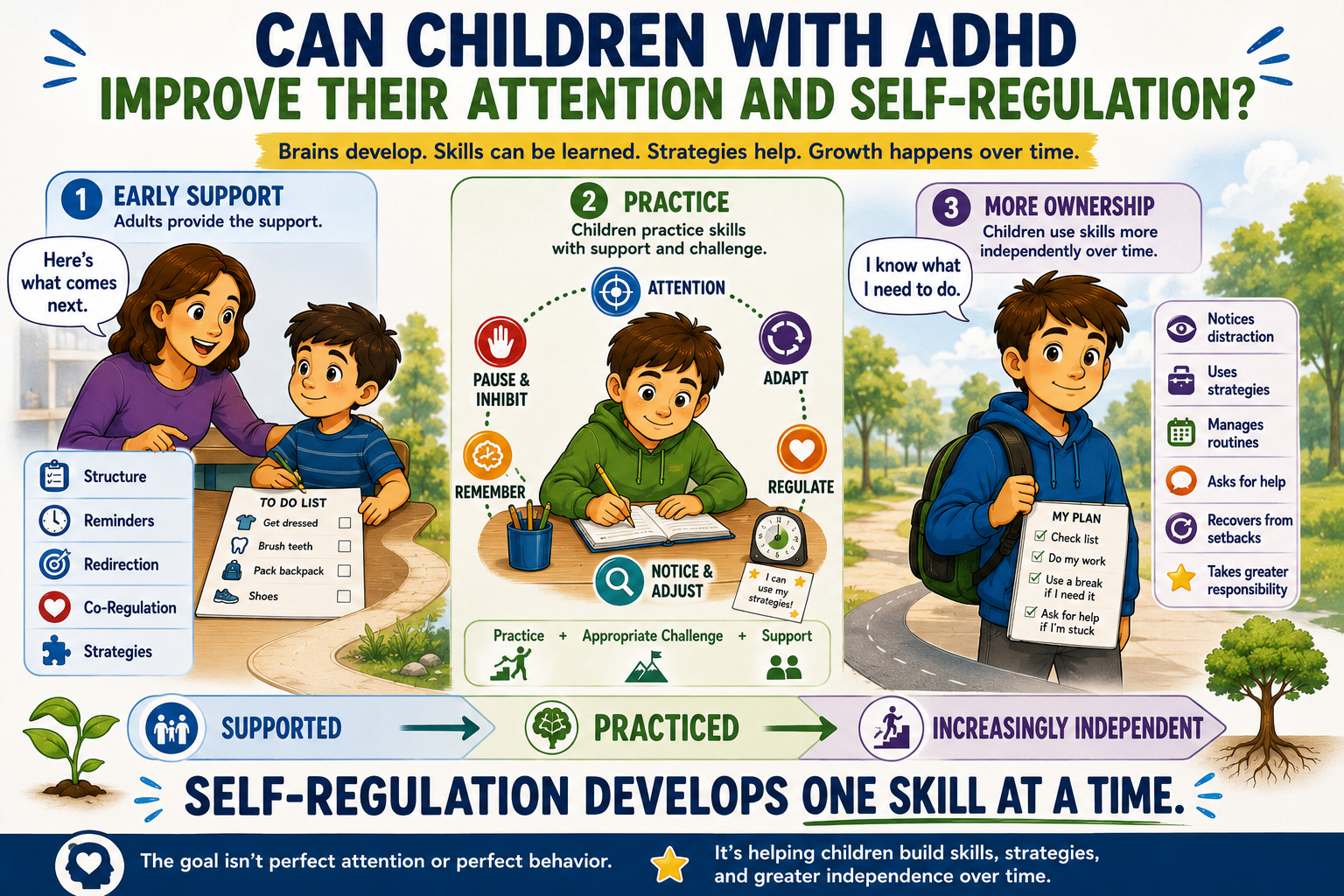
Support the Skill, Then Gradually Shift Responsibility
Early on, a parent may need to say:
“It’s 7:20. You need to brush your teeth.”
Later:
“Check the morning schedule.”
Eventually the child may look at the schedule without prompting.
Then perhaps they begin monitoring the clock themselves.
This progression should look familiar from the other executive-function skills we’ve discussed:
Adult manages → Adult supports → Child uses support → Greater independence
The goal isn’t to remove time supports just because a child reaches a certain age.
It’s to gradually shift more of the management toward the child as they develop the skills to handle it.
What Progress With Time Management Can Look Like
Progress doesn’t necessarily mean your child is never late again.
It may mean:
🌟 Checking the clock without being prompted.
🌟 Giving a more realistic estimate of how long homework will take.
🌟 Beginning to get ready before the parent says anything.
🌟 Recognizing that they need to stop playing.
🌟 Building extra time into a routine.
🌟 Using a timer independently.
🌟 Saying, “I need to leave in 20 minutes, so I should get my shoes now.”
🌟 Realizing after the fact, “I didn’t leave enough time for that.”
That last one matters too.
Self-awareness is part of learning.
Look Beyond “They Don’t Care About Being Late”
Repeated lateness can feel disrespectful.
Parents may think:
“Why doesn’t my child care that everyone is waiting?”
Sometimes a child truly may not appreciate the impact their lateness has on others.
That’s worth teaching.
But repeatedly arriving late can also reflect difficulties with planning, initiation, organization, transitions, estimating time, or monitoring progress.
Those explanations don’t eliminate responsibility.
They tell us what skills may need more support.
The better question may be:
“Where did the time-management process break down?”
Did they start too late?
Underestimate the task?
Lose track of time?
Become distracted?
Fail to stop?
Forget what came next?
Each answer points toward a different solution.
“Time Blindness” Isn’t a Diagnosis
It’s worth repeating that time blindness is not a formal ADHD diagnosis or diagnostic criterion.
Children can struggle with time for many reasons. They are also still developing time-estimation and planning abilities as they grow.
Difficulty with time alone does not mean a child has ADHD.
ADHD diagnosis requires a persistent pattern of inattention and/or hyperactivity-impulsivity that interferes with functioning or development, appears across settings, and meets established diagnostic criteria.
So use “time blindness” as a descriptive phrase—not as a diagnosis.
Understanding Your Child’s Individual Brain Skills
Two children who are always late may have completely different barriers.
One may dramatically underestimate how long tasks take.
Another may struggle to stop preferred activities.
Another may know what needs to happen but start too late.
Another may become distracted halfway through getting ready.
Another may forget the next step.
Another may struggle to organize the routine.
At NeuroFiT Connections, that’s why we begin with a comprehensive Brain & Body Assessment rather than assuming an ADHD diagnosis tells us everything we need to know.
Depending on your child’s age and abilities, we evaluate multiple areas of brain and body function to develop a broader picture of their individual strengths and challenges. Those findings help guide personalized recommendations and individualized brain and body coaching when a family enrolls in a program.
We don’t build a program around ADHD. We build it around your child.
Time Is Invisible. The Support Doesn’t Have to Be.
When your child is still barefoot five minutes before you need to leave, it can be incredibly difficult to understand how they didn’t see the problem coming.
But time-management difficulties often happen before the final scramble.
The child may have underestimated the task.
Started too late.
Lost track of time.
Stayed with one activity too long.
Forgot what came next.
Or failed to recognize when the plan needed to change.
That gives us a more useful question than:
“Why are you always late?”
We can ask:
“How can we make time easier to see, predict, and act on?”
Sometimes that means a timer.
Sometimes it’s a schedule.
Sometimes it’s working backward.
Sometimes it’s adding transition time.
Sometimes it’s comparing predicted time with actual time.
And sometimes it’s simply giving the child enough supported practice to begin understanding:
“If I need to be there then, I need to start now.”
Time may be invisible.
But we can make the path through it much easier to see.
Frequently Asked Questions
What is ADHD time blindness?
“Time blindness” is an informal term commonly used to describe difficulties noticing the passage of time, estimating how long something will take, planning around future events, or changing behavior based on the time remaining.
It is not a formal ADHD diagnosis or diagnostic criterion.
Is poor time management a symptom of ADHD?
ADHD can involve difficulties with organization, completing tasks, sustaining attention, and managing everyday responsibilities. Time-management difficulties can occur as part of that broader executive-function picture.
NIMH specifically recommends working on time management and organization as a practical ADHD strategy.
Why does my child always underestimate how long things will take?
Time estimation requires the child to predict their own pace and consider all the steps involved in a task.
A child may think only about the main task—“get dressed”—without including finding clothes, choosing what to wear, becoming distracted, finding socks, and transitioning to the next activity.
Comparing predicted time with actual time can help children gradually build more accurate estimates.
Why does my child only start moving when we’re already late?
Urgency may create a much clearer immediate demand than a distant deadline.
Before the situation becomes urgent, the child may struggle with initiation, estimation, distraction, transitions, or deciding when to stop another activity.
The goal is to provide enough structure earlier that an emergency isn’t required to create action.
How can I help my child manage time more independently?
Useful supports can include consistent routines, visual schedules, timers, written reminders, backward planning, transition cues, and breaking larger tasks into manageable steps.
NIMH specifically recommends routines, time-management and organization work, written reminders, and breaking large tasks into smaller steps.
As skills improve, parents can gradually shift more responsibility for using those supports to the child.
Does being late mean my child has ADHD?
No.
Lateness or poor time management alone cannot diagnose ADHD. ADHD requires a persistent pattern of symptoms that interferes with functioning, appears across multiple settings, begins in childhood, and meets established diagnostic criteria.
If attention, organization, impulsivity, time management, or other difficulties are persistently interfering with daily life, an appropriate healthcare professional can evaluate what may be contributing.
Continue Learning About ADHD
What Is ADHD? Understanding Attention, Executive Function & Self-Regulation
Learn how attention, executive function, and self-regulation work together throughout everyday life.
Why Can My Child Focus on Video Games but Not Homework?
Explore why attention can vary with interest, stimulation, feedback, reward, and task demands.
Why Does My Child with ADHD Forget Everything? Understanding Working Memory
Learn how working memory affects instructions, routines, organization, and schoolwork.
Why Are Transitions So Difficult for Children With ADHD?
Understand the brain skills involved in stopping one activity and successfully beginning another.
ADHD and Emotional Regulation: Why Are the Reactions So Big?
Explore what children need to pause, adapt, manage emotions, and recover.
ADHD and Executive Function: Why Everyday Tasks Can Feel So Difficult
See the hidden executive-function demands behind apparently simple everyday tasks.
Can Children With ADHD Improve Their Attention and Self-Regulation?
Explore skill development, strategies, support, and growing independence.
Why Does My Child With ADHD Procrastinate? Understanding Task Initiation
Learn why knowing what needs to be done and actually beginning it can be very different challenges.
ADHD Program for Children
Learn how NeuroFiT Connections begins with a comprehensive Brain & Body Assessment and develops programming around the individual child.