

The science project was assigned two weeks ago. You’ve reminded your child about it, their teacher has reminded them about it, and it’s written on the calendar. They know when it’s due, they know what they need to do, and now it’s 8:30 the night before the deadline.
The poster board is still blank.
You ask, “Why didn’t you start this earlier?” And your child gives you the answer that may be even more frustrating:
“I don’t know.”
Homework may play out the same way every afternoon. You say, “Time to start your homework.” Your child agrees, but ten minutes later nothing has happened. Another reminder comes and goes, and eventually you’re wondering:
They know it needs to be done. They know how to do it. Why won’t they just START?
Sometimes we call this procrastination. Sometimes we call it laziness. Sometimes we assume the child simply doesn’t care. But for some children with ADHD, the problem may begin before sustained attention, organization, or completing the task ever become relevant.
The first challenge may simply be getting the brain from knowing to doing.
That’s where task initiation comes in.
What Is Task Initiation?
Task initiation is the ability to begin an activity without unnecessary delay. That sounds simple, but a surprising amount of brain work may need to happen between “I need to do my homework” and the moment the pencil actually touches the paper.
The child may need to recognize what needs to be done, hold the goal in mind, figure out where to begin, gather materials, resist something more interesting, recognize that now is the appropriate time, shift away from the current activity, tolerate the discomfort of beginning, and finally…
▶️ START.
That’s a lot of work before the first math problem has even been attempted.
Procrastination Isn’t Always About Motivation
Sometimes children procrastinate because they simply don’t want to do something. Adults do that too. But when a child repeatedly struggles to get started, we shouldn’t automatically assume the problem is laziness, poor motivation, defiance, or simply not caring.
ADHD diagnostic criteria include difficulties with following through on instructions, organizing tasks and activities, completing tasks that require sustained mental effort, being easily distracted, and managing everyday responsibilities. Those difficulties can create barriers between intention and action.
A child may genuinely know the assignment matters, want to get it finished, understand that they’ll be stressed later, and still struggle to begin.
That means these are two different questions:
“Does my child want to do this?”
and
“Can my child efficiently organize themselves to start this?”
Knowing Isn’t Starting
Imagine your child is sitting at the kitchen table staring at a blank document. You ask whether they know the essay is due, whether they understand the topic, whether they know how to write an essay, and whether they realize time is running out.
They answer yes to all of it.
From the outside, it can seem impossible. They possess all the necessary knowledge, yet nothing is happening. But knowledge alone doesn’t initiate behavior.
The brain still has to convert:
I SHOULD
into:
I AM.
That little gap can become a major obstacle.

The Starting Line Can Hide a Lot of Brain Work
We often treat “start” as a single action. In reality, several different barriers can make the starting line difficult.
▶️ 1. The Starting Point Isn’t Clear
Consider the instruction:
“Work on your science project.”
What does that mean first? Research? Find pictures? Write the introduction? Buy poster board? Choose a topic? Open the assignment instructions?
If the task doesn’t have an obvious first action, the brain has to create one. For a child who struggles with planning, that can become the first barrier.
Compare:
“Work on your science project.”
with:
“Open the assignment and highlight the three things you have to include.”
Now there is a clear starting point.
📋 2. The Task Feels Too Big
“Clean your room.” “Write your report.” “Study for your test.” “Do your homework.”
These sound like tasks, but they’re actually categories containing many smaller tasks. A report may require choosing a topic, researching, taking notes, organizing information, drafting several sections, editing, and submitting the finished work.
If the child’s brain sees all of that at once, starting can feel overwhelming.
Sometimes procrastination isn’t:
“I don’t want to.”
It’s:
“I don’t know how to get into this.”
🔄 3. Something Else Has to Stop First
Starting one activity usually means stopping another. Before homework can begin, the child may have to stop gaming, watching television, building, reading, playing outside, or simply doing something more enjoyable.
So task initiation often includes a transition. The brain has to disengage from what I’m doing now and redirect toward what I need to do next.
As we’ve discussed in the transitions article, that shift can itself require attention shifting, inhibition, working memory, cognitive flexibility, and emotional regulation.
Sometimes the difficulty isn’t only starting homework.
It’s leaving what came before it.
💛 4. Starting Can Feel Uncomfortable
Think about a task you’ve been avoiding: taxes, cleaning the garage, a difficult email, a complicated form, or making an uncomfortable phone call. Before you begin, you may experience a vague feeling of “Ugh.”
Children experience that too. A task may feel boring, difficult, confusing, frustrating, too long, uncertain, or simply unpleasant.
Beginning means moving toward that discomfort. For a child who already expects the task to be difficult, avoidance can become especially appealing.
🎯 5. The Competing Activity Is More Engaging
Imagine the choice between continuing a preferred activity and beginning something difficult that won’t feel rewarding for another 45 minutes. That’s not exactly an equal competition.
As we’ve discussed elsewhere in this series, attention and engagement can vary depending on interest, stimulation, feedback, reward, and task demands. So the child isn’t initiating in a vacuum.
They may need to disengage from something immediately rewarding and begin something that requires sustained effort with a delayed payoff.
That can make the starting line considerably harder.
⏰ 6. “Later” Doesn’t Feel Urgent Yet
The project is due Friday. On Monday, that feels far away. Tuesday still seems fine. Wednesday feels manageable. By Thursday evening, the pressure is suddenly real.
Then something strange happens: the child who couldn’t begin all week can work with remarkable intensity.
Parents naturally wonder, “Why couldn’t you do this three days ago?” One possibility is that the distant deadline did not create enough immediate structure or urgency to organize behavior around the task.
As the deadline approaches, the consequences become more immediate and the decision disappears.
Start now or it won’t get done.
Urgency can temporarily create the starting line that the child was struggling to create earlier.
The Procrastination Cycle
Procrastination can become self-reinforcing. A difficult task appears, the child feels uncomfortable or overwhelmed, and avoidance brings immediate relief.
For a moment, the child feels better because they don’t have to deal with the task right now. But the task doesn’t disappear. Time gets shorter, pressure increases, and eventually the deadline creates an emergency.
The sequence may look something like this:
📚 TASK
↓
😟 “This looks hard.”
↓
⏳ “I’ll do it later.”
↓
😌 Immediate relief
↓
⏰ Less time remains
↓
😰 More stress
↓
🚨 Deadline pressure
↓
⚡ Frantic work
↓
😫 Exhaustion and frustration
↓
“I hate projects.”
Then the next large assignment arrives, and the child’s previous experience tells them that this is going to feel terrible again.
That’s why simply saying “Stop procrastinating!” doesn’t necessarily teach the child how to break the cycle.

Why Pressure Sometimes Seems to “Work”
Parents often notice that their child struggles to begin for hours, but once the deadline becomes immediate, they’re suddenly working. That can make it look like proof that the child could have done it all along.
But there’s another way to interpret what happened.
The deadline supplied something the child had difficulty generating earlier:
a clear NOW.
There are no longer endless possibilities about when to begin. The deadline has made that decision for them.
This may explain why urgency can temporarily organize behavior, but relying on crisis-level urgency comes with obvious costs: stress, conflict, rushed work, late nights, missed details, and repeated family frustration.
The goal isn’t to become better at creating emergencies.
It’s to make starting easier before an emergency is required.
Make the First Step Ridiculously Clear
Compare:
“Start your homework.”
with:
“Put your math worksheet on the table.”
The second instruction is almost absurdly small, and that’s exactly why it can work. Once the worksheet is on the table, the next action may be “Write your name,” followed by “Do problem number one.”
We’re reducing the amount of planning required to cross the starting line.
Starting creates the opportunity to continue.
Shrink the Task Until the Brain Can Enter It
If “Clean your room” isn’t producing action, make the entry point smaller: “Put the dirty clothes in the hamper.”
If “Write your essay” isn’t producing action, try: “Open a blank document and type the title.”
If “Study for your test” isn’t producing action, try: “Get your notes and highlight five important terms.”
If “Pack for the trip” isn’t producing action, try: “Put three shirts on the bed.”
The objective isn’t to pretend the larger task doesn’t exist.
We’re simply creating a manageable doorway into it.
Separate Planning From Doing
Sometimes children are being asked to plan and execute simultaneously. Consider “Go clean your room.” The child must decide what needs cleaning, what belongs where, what should happen first, what should happen next, and how to know when they’re finished—while also doing the cleaning.
Instead, separate those demands.
FIRST: PLAN
☐ Clothes in hamper
☐ Trash in bin
☐ Books on shelf
☐ Toys in baskets
☐ Make bed
THEN: DO
Now the child doesn’t have to continually generate the plan while performing the task. They can follow a visible sequence.
Use a “Launch Routine”
Pilots don’t decide from scratch how to take off every time they fly. They follow a sequence.
Children can benefit from predictable starting sequences too.
HOMEWORK LAUNCH
🎒 Backpack on table
↓
📋 Check assignments
↓
📚 Choose first subject
↓
✏️ Get materials
↓
⏰ Set timer
↓
▶️ Start first problem
The routine reduces the number of decisions required to begin. Over time, the sequence itself can become a cue:
This is how I start homework.
Try a Five-Minute Start
Sometimes the child isn’t resisting the first five minutes. They’re resisting the imagined next hour.
Instead of saying, “You have to finish your entire report,” try:
“Let’s work on getting started for five minutes.”
After five minutes, reassess. Sometimes the child will continue because the hardest part was crossing the starting line. Sometimes they genuinely need a break.
Either way, the child has practiced beginning.
And beginning is the skill we’re targeting.
Use Presence Without Taking Over
Sometimes simply having another person nearby can help a child stay oriented toward a task. You don’t necessarily need to give every answer, correct every mistake, or manage every step.
You may simply sit nearby while doing your own work.
The goal is:
“I’m here while you do it.”
not:
“I’ll do it for you.”
That distinction preserves responsibility while still providing structure.
Don’t Turn Starting into a Two-Hour Argument
There’s a frustrating paradox: the longer we argue about starting the task, the bigger the task becomes.
Now homework isn’t simply homework. It’s homework plus conflict, frustration, shame, consequences, lectures about responsibility, and everyone being angry.
Tomorrow, when homework appears again, the child’s brain remembers the whole experience.
Whenever possible, keep the starting cue short, clear, and actionable.
Instead of:
“How many times do I have to tell you? You know you have homework every day…”
try:
“Homework time. Check your launch list.”
Then give the child an opportunity to act.
Praise the Start, Not Just the Finish
Adults naturally celebrate completion: “Great! You’re done!”
But if initiation is difficult, notice that skill too.
“You got started without another reminder.”
“You weren’t sure where to begin, so you checked the instructions.”
“You really didn’t want to start, but you opened the assignment anyway.”
We’re helping the child recognize:
Starting is something I can do.
That matters.
Support Isn’t the Same as Rescue
Support should ideally help the child do more of the work—not remove the work.
There’s a difference between writing the first paragraph for them and helping them identify the first step. There’s a difference between cleaning the room because they won’t start and creating a simple checklist they can follow.
The useful question becomes:
“What’s the smallest amount of support that helps my child successfully get started?”
As skills and routines strengthen, that support can gradually change.
What Progress With Task Initiation Can Look Like
Progress doesn’t necessarily mean your child suddenly loves starting homework. It may mean they begin after one reminder instead of five, identify the first step more quickly, gather their materials independently, or use a launch routine without being prompted.
It may also mean they recognize, “I’m avoiding this because it feels overwhelming,” or ask, “Can you help me figure out where to start?”
Those are meaningful changes because the child is becoming more aware of what gets in the way and more capable of responding to it.
Independence doesn’t require wanting to do every task.
Adults certainly don’t.
It means becoming increasingly capable of getting ourselves into action even when motivation isn’t doing all the work for us.
Look Beyond “Lazy”
Imagine repeatedly hearing:
“You’re lazy.”
“You don’t care.”
“You’d do it if it mattered to you.”
Now imagine genuinely wanting to succeed while repeatedly struggling to translate intention into action.
Those labels don’t teach a skill. They may also create another barrier if the child begins to think, “Maybe I really am just bad at this.”
That doesn’t mean every delay should be excused as executive function. Children avoid things, test boundaries, make choices, and sometimes simply don’t want to do something.
But when difficulty starting tasks happens repeatedly across important parts of life, it’s worth looking deeper.
Ask:
“What is getting in the way of the start?”
That question gives us something useful to work with.
Task Initiation Isn’t a Diagnosis
Difficulty starting tasks does not automatically mean a child has ADHD.
Many things can contribute to procrastination or avoidance. A task may be too difficult, poorly understood, boring, anxiety-provoking, overwhelming, fatiguing, or connected to a learning difficulty.
Sleep, stress, mood, environmental demands, and other factors can affect performance too.
That’s why one behavior—such as procrastinating on homework—shouldn’t be used to diagnose ADHD.
Understanding Your Child’s Individual Brain Skills
Two children can both procrastinate for completely different reasons.
One may not know where to begin. Another may struggle to disengage from a preferred activity. Another may have difficulty holding the goal in working memory, while another may underestimate how much time remains or become overwhelmed by the size of the task.
At NeuroFiT Connections, this individual variation is why we don’t assume that an ADHD diagnosis tells us everything we need to know about a child.
We begin with a comprehensive Brain & Body Assessment to develop a broader understanding of the child’s individual strengths and challenges. Depending on the child’s age and abilities, we evaluate multiple areas of brain and body function and use those findings to help guide personalized recommendations.
For children who enroll in a program, individualized brain and body coaching activities are then selected around the child’s profile.
We don’t build a program around ADHD. We build it around your child.
Sometimes the Hardest Part Is Simply Beginning
From the outside, procrastination can look like:
“I won’t.”
But sometimes what’s happening underneath is closer to:
“I don’t know where to start.”
“This feels enormous.”
“I’m not ready to stop what I’m doing.”
“I have plenty of time.”
“I’m afraid this will be difficult.”
or simply:
“I know I need to do it, but I can’t seem to get myself moving.”
Understanding that doesn’t eliminate expectations. The homework still needs to be done, the room still needs to be cleaned, and the project still has a deadline.
But instead of spending all of our energy asking:
“Why haven’t you started?”
we can begin asking:
“What would make the first step easier to take?”
Maybe it’s making the first action obvious. Maybe it’s breaking the task down, using a checklist, establishing a predictable launch routine, setting a timer, having another person nearby, or practicing how to begin before the deadline creates an emergency.
Because sometimes the distance between:
KNOWING
and
DOING
is only one small step.
But that first step can be the hardest one.
Frequently Asked Questions
Is procrastination a symptom of ADHD?
Procrastination itself is not one of the diagnostic criteria for ADHD. However, ADHD can involve difficulties with organization, sustained mental effort, following through, distraction, and everyday responsibilities, all of which may contribute to procrastination or difficulty getting started.
What is task initiation?
Task initiation refers to getting started on an activity without unnecessary delay. Starting may require a child to identify the first step, organize materials, disengage from another activity, resist distractions, manage discomfort, remember the goal, and begin acting on it.
Why does my child wait until the last minute?
There isn’t one explanation. For some children, a distant deadline may not create enough immediate structure or urgency to organize action. Others may feel overwhelmed by the task, have difficulty identifying a starting point, avoid anticipated frustration, or become distracted by more immediately engaging activities.
Repeated last-minute work should be viewed in context rather than automatically attributed to ADHD.
Why can my child start video games immediately but not homework?
The two activities place very different demands on attention and motivation. A preferred activity may provide immediate engagement, clear goals, frequent feedback, and rewards, while homework may require planning, delayed reward, sustained mental effort, and multiple steps.
Being able to begin one readily therefore doesn’t necessarily tell us how easily the child can initiate the other.
How can I help my child get started without doing the work for them?
Try reducing the executive demands around the start. That might include identifying one concrete first action, breaking a large task into smaller steps, using a visible checklist, establishing a predictable starting routine, reducing distractions, or being present while the child begins.
The goal is to support the start without taking over the task itself.
Does my child’s procrastination mean they have ADHD?
No. Procrastination alone cannot diagnose ADHD.
If difficulties with attention, organization, impulsivity, task completion, or starting tasks are persistent and interfering with everyday life across settings, discuss them with an appropriate healthcare professional.
Continue Learning About ADHD
What Is ADHD? Understanding Attention, Executive Function & Self-Regulation
Learn how attention, executive function, and self-regulation contribute to everyday functioning.
Why Can My Child Focus on Video Games but Not Homework?
Explore why attention and engagement can change depending on interest, stimulation, feedback, reward, and task demands.
Why Does My Child With ADHD Forget Everything? Understanding Working Memory
Learn how the brain’s temporary mental workspace affects instructions, routines, organization, and schoolwork.
Why Are Transitions So Difficult for Children With ADHD?
Explore what the brain must accomplish to stop one activity and successfully begin another.
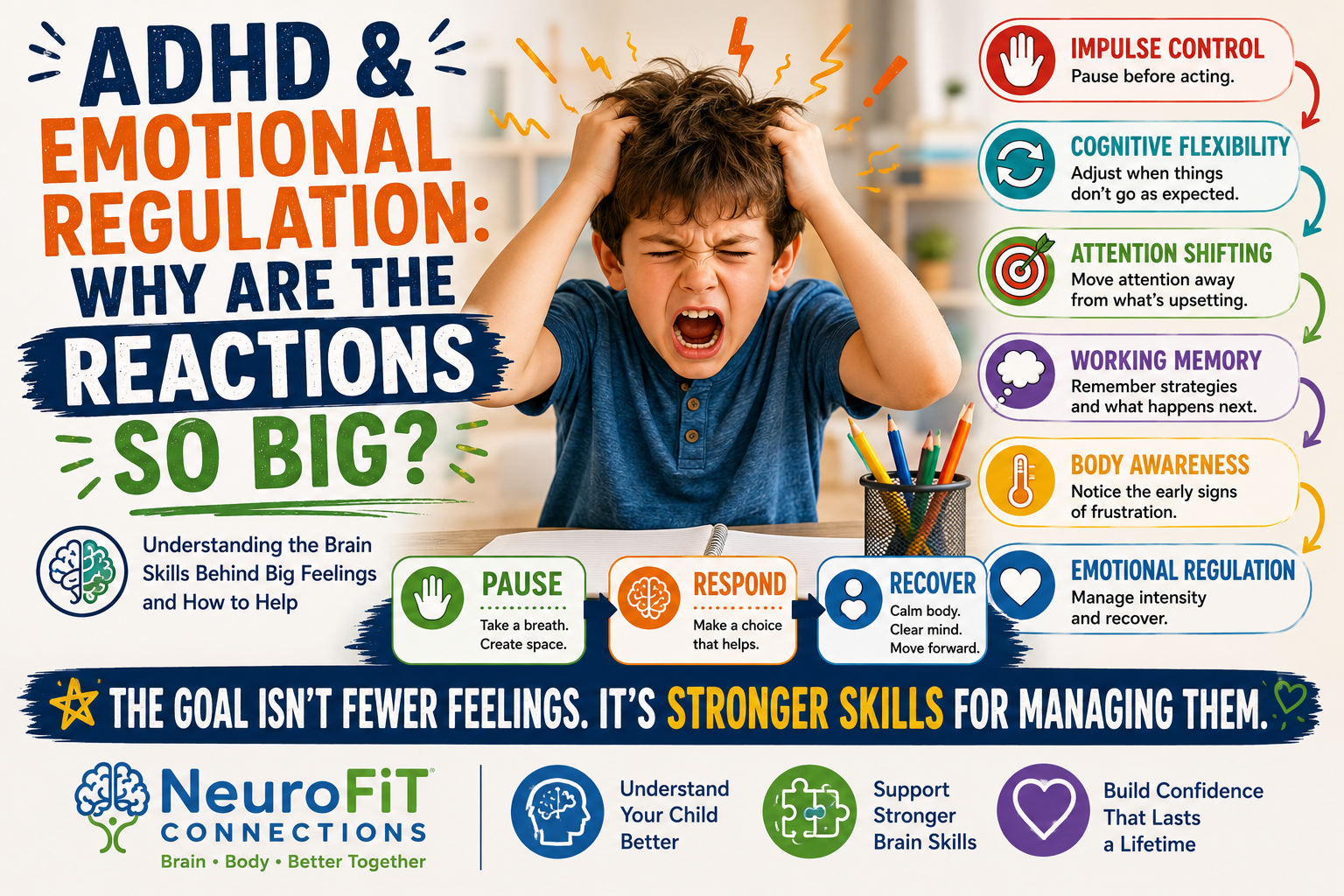
ADHD and Emotional Regulation: Why Are the Reactions So Big?
Learn about the brain skills involved in pausing, adapting, managing emotions, and recovering.
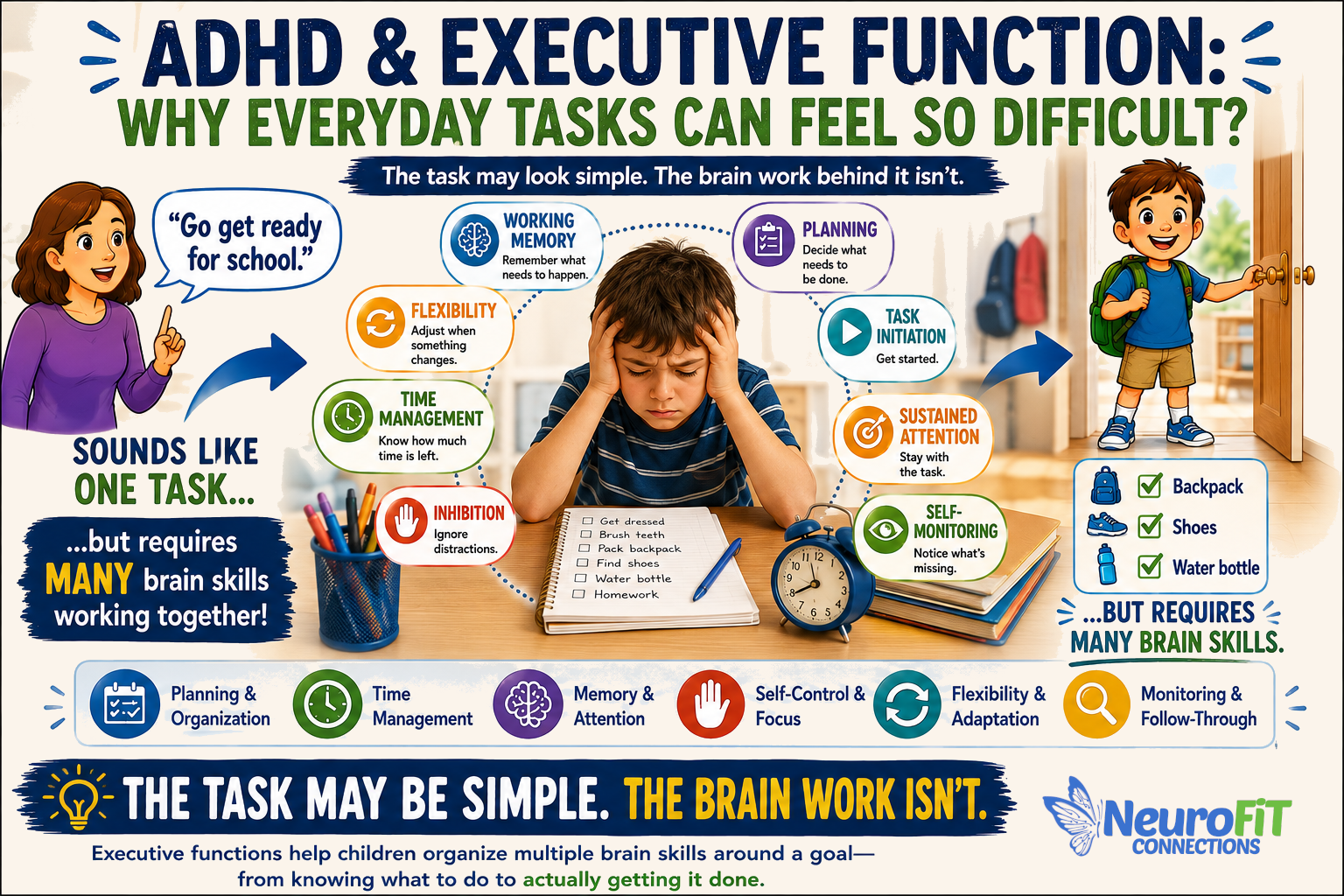
ADHD and Executive Function: Why Everyday Tasks Can Feel So Difficult
See how multiple executive skills work together to turn an intention into completed action.
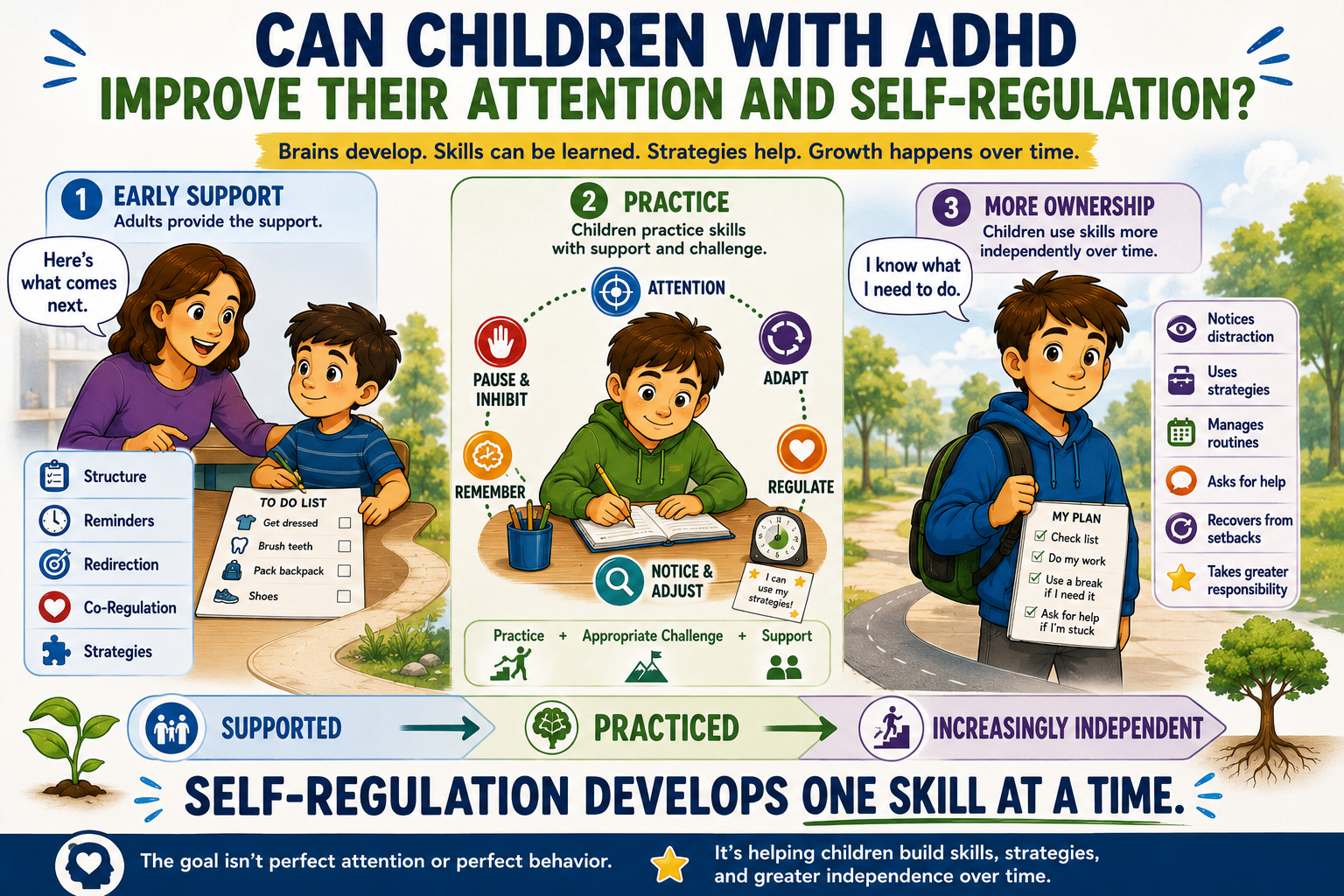
Can Children with ADHD Improve Their Attention and Self-Regulation?
Explore how development, strategies, support, practice, and increasing independence can contribute to growth.
ADHD Program for Children
Learn how NeuroFiT Connections begins with a comprehensive Brain & Body Assessment and develops personalized programming around the individual child.