

When a child is diagnosed with ADHD, one of the first questions parents often ask is:
“What caused this?”
Was it genetics? Something during pregnancy? Too much screen time? Diet? Stress? Something about the way their brain developed? Did we miss something when they were younger?
And underneath those questions, there may be an even more personal one:
“Was there something we could have done differently?”
Current research doesn’t point to one single cause of ADHD. Instead, ADHD is considered a neurodevelopmental disorder, and researchers are studying a complex combination of genetic influences, brain development and function, and prenatal and early-life factors.
That distinction is important because ADHD isn’t simply caused by a child being unmotivated, undisciplined, or unwilling to pay attention. The behaviors we see on the outside can reflect differences in the developing brain systems involved in attention, inhibition, reward, organization, working memory, and self-regulation.
There isn’t one ADHD brain, one ADHD child, or one simple explanation for why ADHD develops.
ADHD Is a Neurodevelopmental Disorder
The National Institute of Mental Health describes ADHD as a neurodevelopmental disorder characterized by persistent patterns of inattention, hyperactivity, and/or impulsivity that occur across situations and interfere with daily life. Symptoms begin during childhood, although the way those symptoms look can change considerably as a child develops.
The word neurodevelopmental gives us an important clue. ADHD is associated with how the brain develops and functions rather than simply how a child chooses to behave.
Researchers continue to investigate ADHD at many levels, including genes, molecules and hormones, brain structure and activity, and prenatal and early-life exposures. Rather than finding one broken system responsible for ADHD, research increasingly points toward a complex developmental picture involving multiple influences.

Is ADHD Genetic?
Genetics appears to play an important role in ADHD.
ADHD tends to run in families, and decades of family, twin, adoption, and molecular-genetic research support a substantial genetic contribution. But that does not mean scientists have discovered a single “ADHD gene.”
Instead, many genetic variations appear to contribute small amounts of risk, while some rarer genetic variations may also be involved. These genetic influences can overlap with those associated with other neurodevelopmental conditions.
Think of it less like:
ADHD gene → ADHD
and more like:
Many genetic influences + development + other biological and environmental factors → different levels of susceptibility and different developmental outcomes.
That’s one reason ADHD can look so different from one child to another.
If a Parent Has ADHD, Will Their Child Have It?
Not necessarily.
Having a biological relative with ADHD increases a child’s likelihood of having ADHD, but genetic risk isn’t destiny. Children inherit combinations of genetic variations rather than a predetermined behavioral outcome.
This also helps explain something families frequently notice: ADHD-related traits may appear across generations but look very different.
A child may struggle with hyperactivity and impulse control. A parent may remember being chronically disorganized and losing assignments. A grandparent may say:
“We didn’t call it ADHD when I was growing up, but I was exactly the same way.”
Shared genetics can contribute to similarities, but each person’s development and experience remain individual.
What Is Different About Brain Development in ADHD?
Researchers have found differences associated with ADHD in brain development, activity, and connectivity. Importantly, these are group-level research findings; there isn’t currently a brain scan that can diagnose an individual child with ADHD.
One large NIH study involving thousands of young people found ADHD symptoms were associated with atypical interactions between areas of the frontal cortex and deeper brain structures involved in learning, movement, reward, and emotion. The frontal regions involved included areas associated with attention and controlling unwanted behavior.
Earlier NIMH research also found differences in the timing of cortical maturation. In one major study, cortical development followed a broadly similar sequence in children with and without ADHD, but peak cortical thickness occurred later on average in the ADHD group—particularly in areas important for attention and cognitive control.
That doesn’t mean every child’s ADHD is caused by the same brain difference.
It tells us something broader:
ADHD involves development and function of brain systems—not simply a child’s willingness to behave differently.

What Brain Skills Can ADHD Affect?
ADHD is often described as an attention disorder, but attention is only part of the picture.
Depending on the individual child, ADHD can be associated with difficulties involving:
🎯 Sustained Attention
Remaining engaged with something long enough to complete it.
🛑 Inhibition
Pausing before responding or resisting distractions and impulses.
💭 Working Memory
Holding information in mind while using it.
📋 Planning & Organization
Creating and following a path toward a goal.
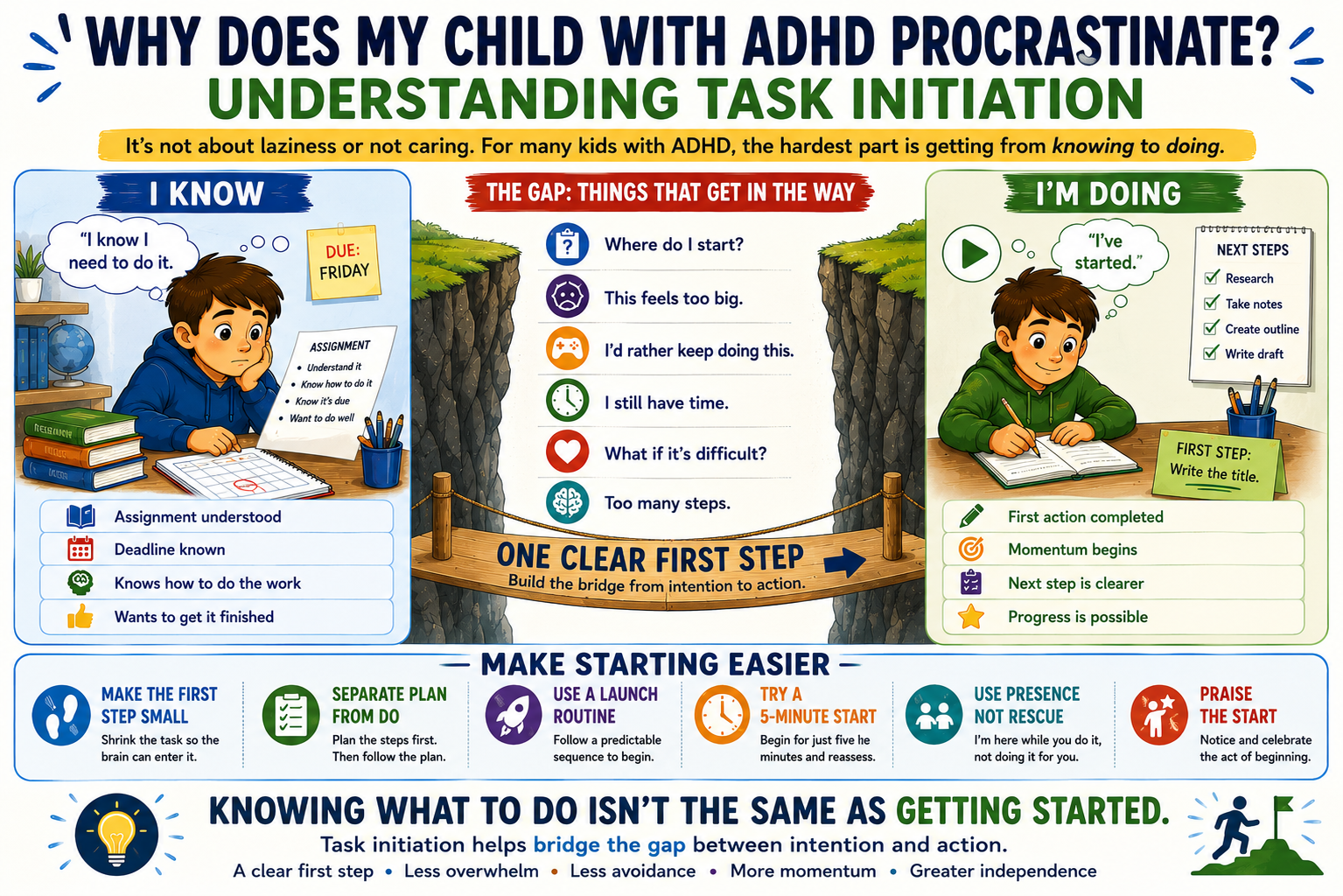
▶️ Task Initiation
Moving from knowing what needs to happen to actually beginning.
⏰ Time Management
Estimating, monitoring, and organizing behavior across time.
🔄 Cognitive Flexibility
Adjusting when expectations, activities, or circumstances change.
💛 Self-Regulation
Managing behavior and emotional responses across different situations.
This is one reason two children with the same diagnosis can appear almost nothing alike.
One child may be constantly moving and impulsive. Another may sit quietly but lose track of instructions, assignments, and belongings. Another may perform well academically but require enormous support to plan, organize, start, and complete everyday tasks.
The diagnosis may be the same. The underlying pattern of strengths and challenges may not be.
Is ADHD Caused by a Dopamine Imbalance?
This is an area where internet explanations often become too simple.
Dopamine is a neurotransmitter involved in brain functions including motivation, reward, movement, and learning, and dopamine-related systems have long been studied in ADHD. Other neurotransmitter systems and many neural circuits are also being investigated.
But describing ADHD simply as “a dopamine deficiency” or “a chemical imbalance” goes beyond what the evidence can establish.
Modern ADHD research examines interactions among multiple brain regions, networks, neurotransmitter systems, genes, and developmental processes. The large NIH brain-imaging study mentioned earlier, for example, found differences in connectivity involving frontal areas and deeper structures associated with reward, emotion, learning, and movement.
So dopamine matters to ADHD research.
It just isn’t the whole story.

Does Environment Cause ADHD?
Environment is another place where we need to distinguish risk factors from simple causes.
Research supports an important genetic contribution to ADHD, but researchers also study non-genetic factors that may influence neurodevelopment or ADHD risk. Reviews of ADHD research have examined factors including prematurity and low birth weight, certain prenatal exposures, lead exposure, and severe early adversity.
Finding an association doesn’t necessarily prove that one particular exposure caused a child’s ADHD. Genetic and environmental influences can interact in complicated ways, and many proposed environmental factors are associated with multiple developmental outcomes rather than ADHD specifically.
That’s why statements such as:
“This causes ADHD.”
deserve scrutiny.
The scientifically safer question is often:
“Does this factor appear to affect the likelihood or development of ADHD, and how strong is the evidence?”
Is ADHD Caused by Parenting?
No evidence supports poor parenting as the cause of ADHD.
Parenting certainly influences a child’s environment, habits, expectations, relationships, and development. Structure and support can also affect how successfully a child manages ADHD-related challenges.
But that’s very different from saying parenting causes ADHD.
ADHD is a neurodevelopmental condition with substantial genetic and biological contributions.
This distinction matters because ADHD-related behaviors can easily create a cycle of misunderstanding.
A child forgets something.
The parent assumes they weren’t listening.
The child becomes frustrated.
The parent increases reminders.
The child feels criticized.
The parent concludes the child isn’t trying.
Understanding the brain skills involved doesn’t eliminate expectations or responsibility. It gives families a better framework for deciding what kind of support the child may actually need.
Does Too Much Screen Time Cause ADHD?
This is another question that needs careful wording.
Screen use can affect sleep, routines, activity levels, family interaction, and how children spend their time. Some research has also found associations between patterns of digital-media use and attention-related symptoms.
But an association does not establish that screens are a single cause of ADHD.
A particularly important problem is reverse causation: children who already have attention, impulsivity, or reward-seeking differences may be especially attracted to highly stimulating digital activities. That can make it difficult to determine how much screen exposure contributes to later difficulties versus how much existing traits influence screen use.
So rather than saying:
“Video games caused my child’s ADHD,”
it is more useful to examine how digital activities are affecting this particular child’s sleep, routines, physical activity, attention demands, emotional regulation, and everyday participation.
Does Sugar Cause ADHD?
Despite the persistence of this belief, sugar has not been established as a cause of ADHD.
That doesn’t mean nutrition is irrelevant to a child’s health or functioning. Hunger, meal patterns, nutrient intake, sleep, hydration, and individual responses to foods can all affect how a child feels and performs during the day.
But those questions are different from:
“Did eating sugar cause my child’s ADHD?”
Current evidence does not support reducing ADHD to one food, nutrient, or dietary behavior.
Can Stress Cause ADHD?
Stress can absolutely affect attention, memory, sleep, emotional regulation, and behavior. A child experiencing significant stress may therefore display behaviors that resemble some ADHD symptoms.
But ADHD is a neurodevelopmental disorder, and diagnosis requires more than noticing that a child is distracted, impulsive, restless, or emotionally overwhelmed during a stressful period. Clinicians consider the child’s developmental history, duration of symptoms, degree of impairment, and whether difficulties occur across settings.
Stress may also make existing ADHD symptoms harder to manage.
That makes it important to ask not only:
“Does this child have difficulty paying attention?”
but also:
“When did this begin, where does it occur, what else is happening, and what factors make it better or worse?”
Why Does ADHD Affect Learning and Behavior?
Consider what a child needs to do during an ordinary school day.
Listen to instructions.
Hold those instructions in working memory.
Ignore distractions.
Begin the assignment.
Stay focused.
Monitor mistakes.
Manage frustration.
Keep track of materials.
Estimate time.
Transition to another activity.
Remember homework.
Bring it home.
Complete it.
Bring it back.
A child can be intelligent and completely capable of understanding the academic material while struggling with some of the brain skills required to consistently demonstrate what they know.
The same thing happens with behavior.
A child may know a rule and still struggle to inhibit a response in the moment. They may understand afterward exactly what they should have done differently.
Knowing the expectation and consistently regulating behavior around that expectation are not identical brain demands.
That’s one reason looking beyond the visible symptom can be so useful.
ADHD Isn’t Caused by a Lack of Intelligence
Children with ADHD can have abilities across the entire intellectual spectrum.
ADHD doesn’t tell us how intelligent a child is.
A bright child may understand complex ideas while repeatedly forgetting assignments. They may solve difficult problems but struggle to organize a backpack. They may read years above grade level while needing repeated reminders to brush their teeth.
This mismatch can be particularly confusing for adults:
“You can do THAT. Why can’t you do THIS?”
Because the two activities may rely on very different combinations of attention, working memory, planning, inhibition, motivation, and self-regulation.
Ability in one area doesn’t guarantee equal efficiency across every brain skill.
If ADHD Is Genetic, Can Anything Improve?
This is an important distinction:
Genetic does not mean unchangeable.
Genes influence development, but the brain develops through ongoing interactions among biology, experience, learning, environment, and maturation. NIMH research explicitly examines interactions among genes, environment, and developmental processes in neurodevelopmental conditions such as ADHD.
A child doesn’t need their genetics to change in order to develop stronger strategies, routines, awareness, skills, and independence.
That’s why our earlier question—Can Children With ADHD Improve Their Attention and Self-Regulation?—is different from asking whether we can erase the factors that contributed to ADHD.
The goal is not to create a different child.
The goal is to help the child develop the strongest skills and supports possible for the brain they have.
Why Understanding the Cause Matters
Parents don’t need to become neuroscientists.
But understanding ADHD as a neurodevelopmental condition can change the questions we ask.
Instead of:
“Why won’t you pay attention?”
we might ask:
“What makes it difficult to sustain attention here?”
Instead of:
“Why are you so disorganized?”
we can ask:
“Which part of this organizational system is breaking down?”
Instead of:
“You knew better.”
we can ask:
“What got in the way of using what you knew in that moment?”
We’re not removing accountability.
We’re becoming more precise about what the child needs to learn.
ADHD Has Causes—But Not One Cause
If you came to this article hoping for a single answer to “What causes ADHD in children?”, science doesn’t currently give us one.
What the evidence supports is more nuanced.
ADHD is a neurodevelopmental disorder. Genetics play an important role. Brain development and brain-network function are involved. Researchers continue to investigate prenatal, early-life, biological, and environmental influences. And these factors don’t operate independently—they interact throughout development.
That complexity also helps explain why ADHD can look so different from one child to another.
One child struggles most with attention.
Another with impulsivity.
Another with organization.
Another with working memory.
Another with emotional regulation.
Another has challenges across several areas.
The label tells us something important. It doesn’t tell us everything about the child.
What does all of this mean?
We know that ADHD can be influenced by many internal and external factors and understanding those factors can tell us a great deal about a child’s development. From a developmental perspective, many of these influences can be viewed through the lens of safety. When a developing nervous system perceives that it is not safe or adequately supported, it may remain more reliant on the primitive reflex systems designed to protect and sustain us early in life.
Primitive reflexes are automatic movement patterns that begin developing before birth and are present in infancy. They play important roles during the birth process and in early survival, feeding, movement, and neurological development. As the brain and nervous system mature, most primitive reflexes are gradually inhibited or integrated, allowing more sophisticated postural reflexes, voluntary movement, coordination, and higher-level brain functions to take greater control.
Human infants are particularly dependent compared with many other mammals. We are born with an immature nervous system and require an extended period of care, protection, movement, interaction, and connection with our parents and caregivers while the brain continues to develop. Primitive reflexes help support us during this critical developmental period.
When primitive reflexes remain active beyond the developmental period in which they are typically integrated, they may be a sign of neurological immaturity and can interfere with the development of more advanced motor, sensory, attentional, and regulatory functions. Rather than viewing retained primitive reflexes as the cause of ADHD, we can view them as valuable clues—signs that certain foundational neurological systems may not have matured as efficiently as expected.
For us at NeuroFiT Connections, Primitive Reflexes are a place to start. We can’t change the environment or genetics, but we can influence the reflexes. By integrating the retained reflexes, we give the brain a chance to properly mature.

Understanding Your Child’s Individual Brain Skills
At NeuroFiT Connections, that individual variation is why we don’t want to stop at the diagnosis.
We begin with a comprehensive Brain & Body Assessment designed to help us develop a broader picture of the child’s individual strengths and challenges. Depending on the child’s age and abilities, we look across multiple areas of brain and body function and use those findings to guide personalized recommendations.
For children who enroll in our program, we use that individual profile to help select personalized brain and body coaching activities.
We don’t build a program around ADHD. We build it around your child.
Frequently Asked Questions
What causes ADHD in children?
There is no single established cause of ADHD. Research indicates that ADHD is a neurodevelopmental condition involving substantial genetic influences along with differences in brain development and function. Researchers also continue to investigate prenatal, early-life, biological, and environmental factors that may influence risk.
Is ADHD genetic or caused by the environment?
Both genetic and non-genetic factors are relevant, but genetics appear to make a substantial contribution to ADHD risk. Rather than thinking in terms of “genetics or environment,” researchers increasingly examine how multiple biological, developmental, and environmental influences interact.
How does the brain function differently in ADHD?
Research has identified group-level differences in brain development, activity, and connectivity. A large NIH study found ADHD symptoms associated with atypical interactions between frontal brain regions and deeper structures involved in attention, behavior control, reward, emotion, learning, and movement. These findings cannot currently be used as a brain-scan test to diagnose an individual child.
Why does ADHD affect focus and attention?
Attention depends on multiple brain systems working together to select relevant information, resist distraction, maintain a goal, and redirect attention when necessary. ADHD can affect the consistency with which those processes operate, particularly when tasks differ in stimulation, interest, reward, complexity, or duration.
Can a dopamine imbalance cause ADHD?
Dopamine systems are involved in ADHD research, but describing ADHD simply as a “dopamine imbalance” is an oversimplification. ADHD research involves multiple neurotransmitters, brain regions, networks, genetic influences, and developmental processes.
Is ADHD a neurological condition?
ADHD is classified as a neurodevelopmental disorder. It begins during development and is associated with differences in brain function and development that can affect attention, hyperactivity, impulsivity, executive functioning, and everyday life.
Can ADHD develop later in adulthood?
ADHD is defined as a neurodevelopmental disorder with symptoms beginning in childhood. An adult may be diagnosed for the first time later in life, sometimes because childhood symptoms were overlooked or became more impairing as responsibilities increased. When ADHD-like symptoms first appear in adulthood, clinicians also consider other possible explanations.
How does ADHD affect behavior and learning?
ADHD can affect brain skills needed for school and everyday behavior, including attention, inhibition, working memory, organization, task initiation, planning, and self-regulation. The specific pattern varies considerably among children, which is why two children with ADHD can have very different challenges.
Learn More About ADHD
What Is ADHD? Understanding Attention, Executive Function & Self-Regulation
Learn how attention, executive function, and self-regulation work together and why ADHD can affect much more than simply paying attention.
Why Can My Child Focus on Video Games but Not Homework?
Discover why interest, reward, stimulation, feedback, and task demands can dramatically change how attention looks.
Why Does My Child with ADHD Forget Everything? Understanding Working Memory
Explore the brain’s temporary mental workspace and why instructions or intentions can disappear before a child uses them.
ADHD and Executive Function: Why Everyday Tasks Can Feel So Difficult
See the hidden brain work involved in planning, starting, organizing, monitoring, and completing everyday activities.
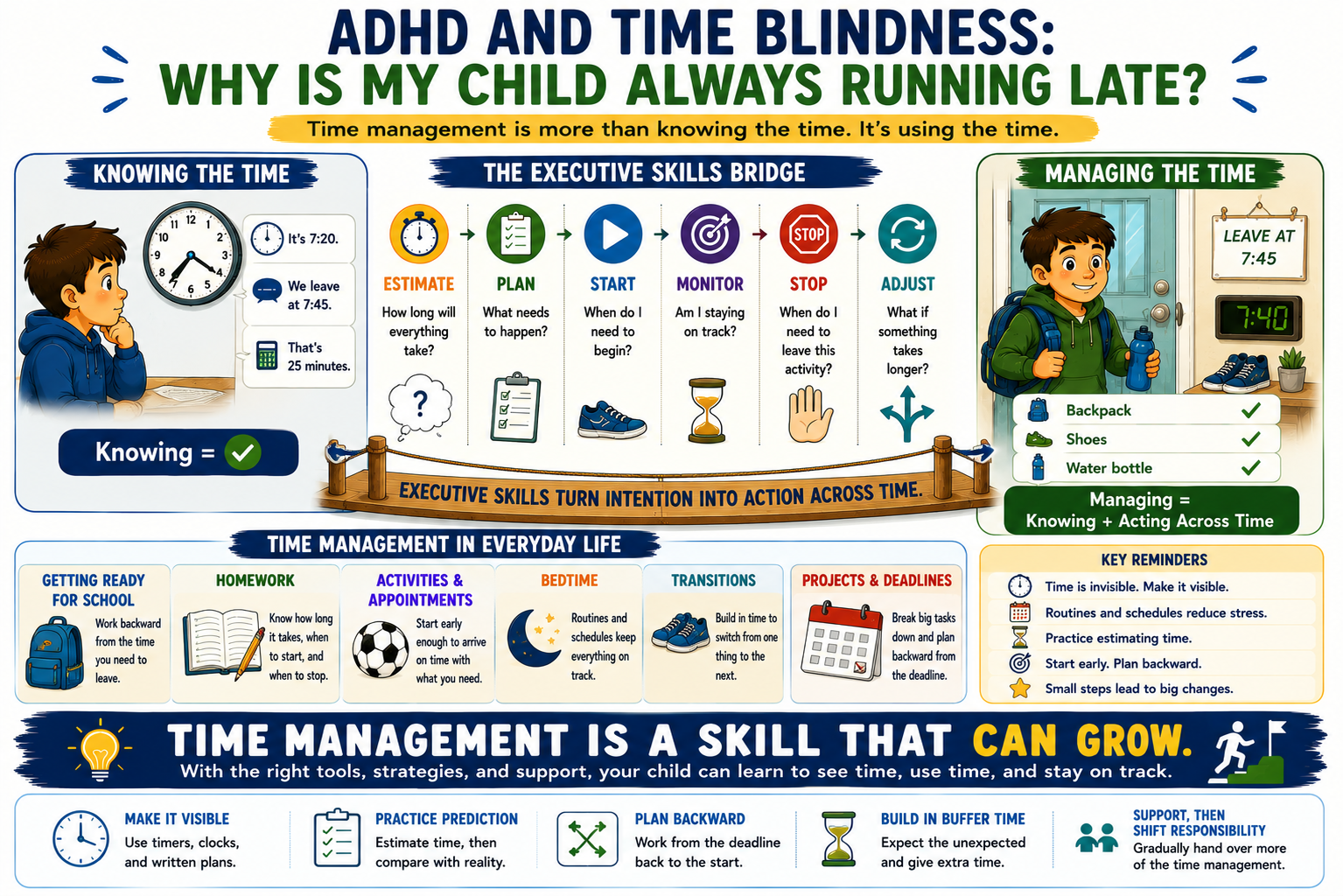
ADHD & Time Blindness: Why Is My Child Always Running Late?
Learn why children with ADHD may struggle to estimate, track, and manage time—and how simple supports can make time easier to see and manage.
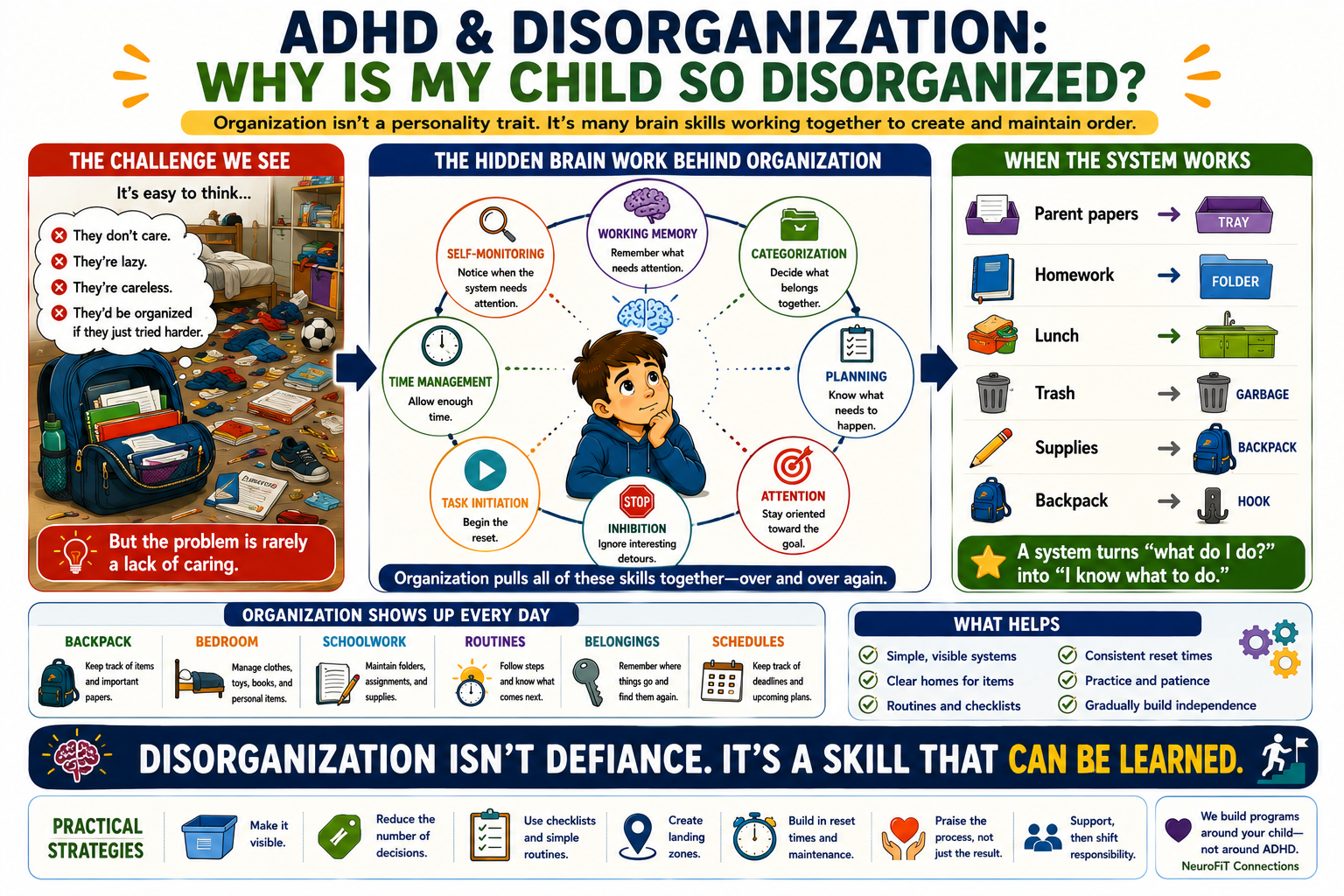
ADHD & Disorganization: Why Is My Child So Disorganized?
Explore the many executive-function skills required to create, use, and maintain organizational systems.
Child ADHD Program
Learn how NeuroFiT Connections uses a comprehensive Brain & Body Assessment to better understand each child’s individual strengths and challenges.