

The permission slip was definitely in the backpack.
Yesterday.
Today?
No idea.
One shoe is by the front door. The other has apparently entered another dimension. There’s a half-finished homework assignment on the kitchen counter, three pencils under the couch, a water bottle somewhere at school, and a library book that was due last Tuesday.
Then you walk into your child’s bedroom.
Clothes on the floor. School papers mixed with drawings. Toys everywhere. Clean laundry somehow indistinguishable from dirty laundry.
You say:
“Please clean up this mess.”
Your child looks around the room…
and seems genuinely unsure where to begin.
If this happens frequently, it’s easy to assume:
They don’t care.
They’re careless.
They’re lazy.
They’d be organized if they just tried harder.
But organization isn’t simply a personality trait. Staying organized requires the brain to notice information, decide what matters, create categories, remember where things belong, develop a plan, follow that plan, and maintain the system over time.
For some children with ADHD, that’s a lot of executive work.
Organization isn’t one skill. It’s many brain skills working together to create and maintain order.
What Does It Mean to Be Organized?
When we say someone is “organized,” we’re usually describing the outcome.
Their backpack is organized.
Their bedroom is organized.
Their assignments are organized.
Their schedule is organized.
But the finished product hides all the thinking required to create it.
Imagine organizing a messy desk. You need to look at everything that’s there, decide what should stay and what should go, determine which things belong together, create places for them, put them away, and remember that system the next time you use the desk.
Then you have to repeat the process tomorrow.
And the next day.
Creating order is only half the job. Maintaining it is the other half.
Why Can ADHD Make Organization Difficult?
ADHD can affect attention and executive-function abilities involved in organizing tasks and activities. Children may also struggle with distractibility, following through, sustained mental effort, or keeping track of materials.
That doesn’t mean every child with ADHD is disorganized. It also doesn’t mean every disorganized child has ADHD.
But for some children, several executive-function challenges can converge around organization.
The backpack isn’t necessarily chaotic because the child made one decision to be messy.
It may be chaotic because dozens of small organizational decisions weren’t made along the way.
The Hidden Brain Work Behind an Organized Backpack
Imagine your child arrives home from school.
Inside the backpack:
📄 math worksheet
📘 reading book
📝 permission slip
🥪 lunch container
✏️ loose pencils
🎨 artwork
📚 library book
🗑️ snack wrapper
📑 graded test
What should happen?
The child has to recognize that these items need different destinations, categorize them, decide what needs attention, remove what doesn’t belong, preserve what will be needed tomorrow, and remember anything requiring action.
The math worksheet goes to homework.
The permission slip goes to a parent.
The lunch container goes to the kitchen.
The library book stays in the backpack.
The snack wrapper goes in the trash.
The test may need to be signed.
That is not simply:
“Empty your backpack.”
It’s a sorting, prioritizing, remembering, decision-making, and follow-through task.

Organization Depends on Working Memory
Working memory helps us temporarily hold information in mind while we’re using it.
Your child may think:
“I need to give Mom this permission slip.”
Then they see the dog.
Put down the backpack.
Get a snack.
Start talking about something that happened at school.
Twenty minutes later, the permission slip is still inside the backpack.
The intention existed.
But it had to remain active long enough to become an action.
This is one reason external systems can be so useful. Instead of requiring the child to remember everything internally, we can create a reliable place for information to go.
For example:
📥 PARENT PAPERS
Every paper requiring a parent’s attention goes into one tray.
Now the child doesn’t have to remember:
“Tell Mom about the permission slip later.”
They have a physical action:
“Parent paper → tray.”
Organization Depends on Categorization
To organize something, you have to decide:
What belongs together?
Adults do this automatically in many situations.
Forks go with forks.
Socks go in the sock drawer.
Bills go in one place.
School supplies go somewhere else.
Children may not have systems that are equally clear.
Consider the instruction:
“Put your stuff away.”
Where does the LEGO instruction booklet go?
What about the drawing they’re still working on?
Where does the half-built craft belong?
What about the rock they found outside and absolutely must keep forever?
If everything doesn’t have a clear home, “put it away” becomes a decision-making task every single time.
And when the decision is difficult?
The floor becomes a very convenient category.
Organization Depends on Planning
A messy bedroom can feel like one enormous problem.
The child looks around and sees:
clothes,
toys,
books,
papers,
shoes,
cups,
blankets,
art supplies,
and miscellaneous treasures.
Where do you start?
A child with strong planning skills may naturally create a sequence:
First clothes. Then trash. Then toys. Then books.
Another child may pick up one toy, notice another toy, start playing with it, discover something under the bed, and ten minutes later be further from the goal than when they began.
The problem wasn’t necessarily unwillingness.
The task needed a plan.
Organization Depends on Attention
Cleaning and organizing require sustained attention to a goal.
Imagine the goal:
CLEAN THE DESK
The child picks up a worksheet.
They begin reading it.
Then they find a drawing.
They decide to finish the drawing.
Then they need a marker.
While looking for the marker, they find a toy.
Twenty minutes later, the desk is still messy.
The child has been active the entire time.
They just haven’t remained oriented toward the original goal.
This is an important distinction.
Being busy isn’t the same as being organized.
Organization Depends on Inhibition
Sometimes organization requires deciding:
Not now.
You find the LEGO piece while cleaning.
Don’t build with it.
You find a book.
Don’t start reading it.
You find an old photograph.
Don’t spend 15 minutes looking through pictures.
You remember something you wanted to tell Mom.
Maybe tell her after the current step is finished.
Every interesting object can become a detour.
Inhibition helps the child resist those detours long enough to complete the organizational goal.
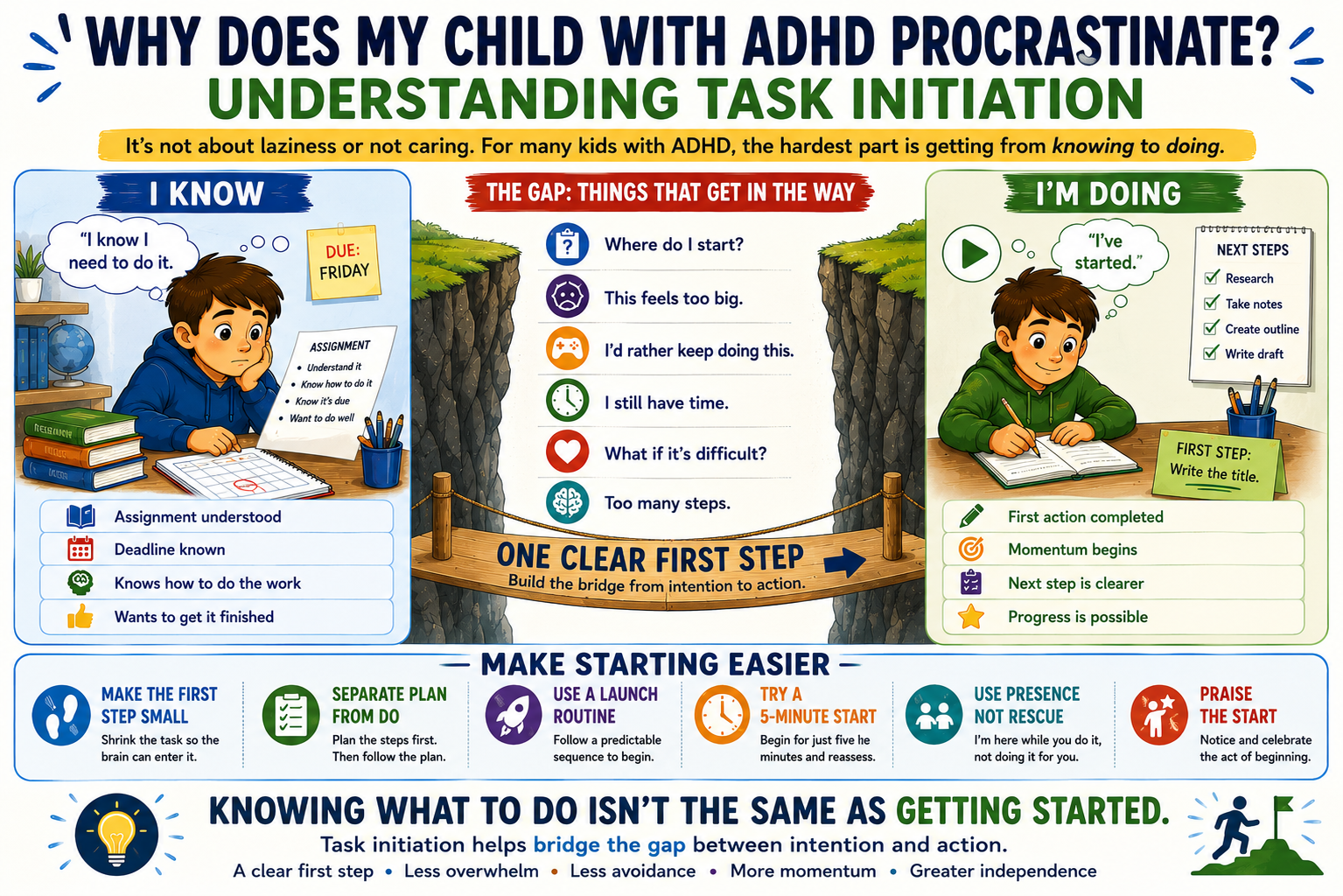
Organization Depends on Task Initiation
We’ve already explored why getting started can be difficult for some children with ADHD.
Organization often creates the perfect storm for initiation problems because the task may be vague, large, boring, and unclear.
“Organize your room.”
Where exactly does that start?
Compare that with:
“Put every piece of dirty clothing into this basket.”
Now the starting point is visible and concrete.
Once that step is finished:
“Great. Now let’s find everything that belongs in the trash.”
We’re turning one overwhelming task into a sequence of achievable actions.
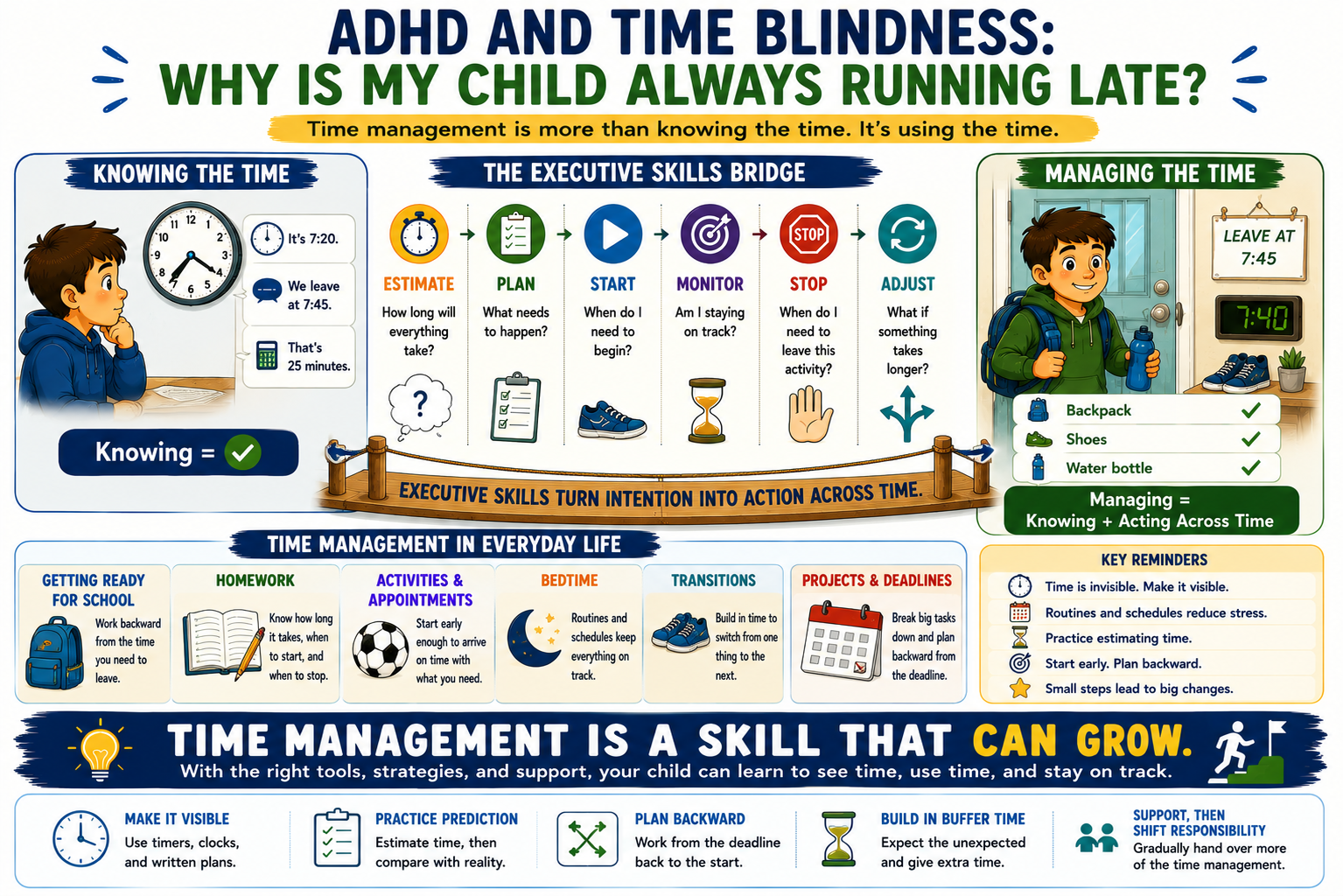
Organization Depends on Time Management
Organization also takes time.
A child may look at a bedroom that took three weeks to become chaotic and believe:
“I’ll clean it in five minutes.”
Five minutes later, they’re frustrated because they’re nowhere near finished.
Or they may spend 20 minutes carefully arranging one shelf while ignoring everything else.
Time management helps the child estimate the whole task, decide how much time to spend on each part, and monitor whether they’re making enough progress.
So organization and time management are closely connected.
Organization Depends on Self-Monitoring
This may be one of the least obvious pieces.
At some point, the child has to stop and ask:
“Is my system still working?”
Is the homework folder filling with old papers?
Are pencils accumulating at the bottom of the backpack?
Are dirty clothes actually reaching the hamper?
Did I put today’s worksheet where I’ll find it tomorrow?
Organization requires noticing when things begin drifting away from the system and correcting them.
Without that maintenance, even a beautifully organized backpack can return to chaos surprisingly quickly.
Why “Just Put It Away” May Not Be Enough
When adults say:
“Put it away.”
we assume the destination is obvious.
Sometimes it isn’t.
If your child repeatedly leaves something out, ask:
Does this item actually have a clear home?
And perhaps more importantly:
Is that home easy enough to use?
A complicated organizational system may look wonderful to an adult but fail completely for the child.
Imagine a toy system with 14 carefully labeled containers.
Technically, it’s organized.
But if the child has to decide whether a toy belongs in:
Action Figures
Characters
Pretend Play
or
Collectibles
every time they clean up, the system itself creates executive work.
Sometimes simpler is better:
🧸 TOYS
🎨 ART
📚 BOOKS
🧱 BUILDING
The best organizational system isn’t necessarily the prettiest.
It’s the one the child can actually use.
Make the System Visible
Organization becomes easier when the environment carries some of the information.
Instead of:
“Remember where everything goes.”
use:
🏷️ labels,
🧺 open bins,
📂 color-coded folders,
📥 designated trays,
📋 checklists,
🎒 assigned backpack pockets,
or
🖼️ pictures showing what belongs where.
For younger children, a photograph on a bin may work better than a written label.
For example:
👟 SHOES
🎒 SCHOOL
🎨 ART
🧱 BUILDING
Now the environment answers the question:
“Where does this go?”
The child doesn’t have to recreate the answer every time.

Reduce the Number of Decisions
Imagine this after school routine:
“Go through your backpack and take care of everything.”
That’s vague.
Now compare:
AFTER-SCHOOL RESET
- 🥪 Lunch container → kitchen
- 📥 Parent papers → tray
- 📚 Homework → desk
- 🗑️ Trash → garbage
- ✏️ Supplies → backpack
- 🎒 Backpack → hook
Same responsibility.
Far fewer decisions.
A predictable sequence can reduce the planning and working-memory demands involved in staying organized.
Create Landing Zones
Some items disappear because they don’t have a reliable destination.
Where do shoes go?
Where does the backpack go?
Where does homework go?
Where do papers for parents go?
Where does the water bottle go?
A landing zone creates a predictable location for frequently used items.
Near the door, for example:
🎒 backpack hook
👟 shoe basket
💧 water bottle spot
📥 school-paper tray
🧥 jacket hook
Now leaving the house doesn’t require a scavenger hunt.
The environment is helping maintain the routine.
Organize at the Point of Use
Sometimes systems fail because they’re located where adults want them rather than where the behavior actually happens.
If your child always drops their backpack beside the front door, placing the backpack hook upstairs in the bedroom may create unnecessary friction.
If dirty clothes always land beside the bed, perhaps the hamper belongs beside the bed.
If school papers always appear on the kitchen counter, perhaps the parent-paper tray belongs on the kitchen counter.
Instead of repeatedly fighting the child’s natural traffic pattern, ask:
“Where does this behavior actually happen?”
Then build the organizational support there.
Make Resetting Part of the Routine
Organization isn’t a one-time event.
Systems drift.
Papers accumulate.
Backpacks fill up.
Bedrooms get messy.
Instead of waiting until everything becomes overwhelming, build in small resets.
5-MINUTE BACKPACK RESET — FRIDAY
Remove old papers.
Throw away trash.
Restock pencils.
Check folders.
Return anything that doesn’t belong.
Or:
10-MINUTE BEDROOM RESET — BEFORE BED
Clothes.
Trash.
Toys.
Books.
Prepare for tomorrow.
Small maintenance routines can prevent a manageable amount of disorder from becoming an enormous organizational project.
Don’t Organize Everything for Your Child
When we’re running late, it’s faster to find the shoes ourselves.
It’s faster to pack the backpack.
It’s faster to clean the room.
It’s faster to organize the papers.
Sometimes that’s necessary.
But if adults consistently perform all of the organizational work, the child has fewer opportunities to practice the underlying skills.
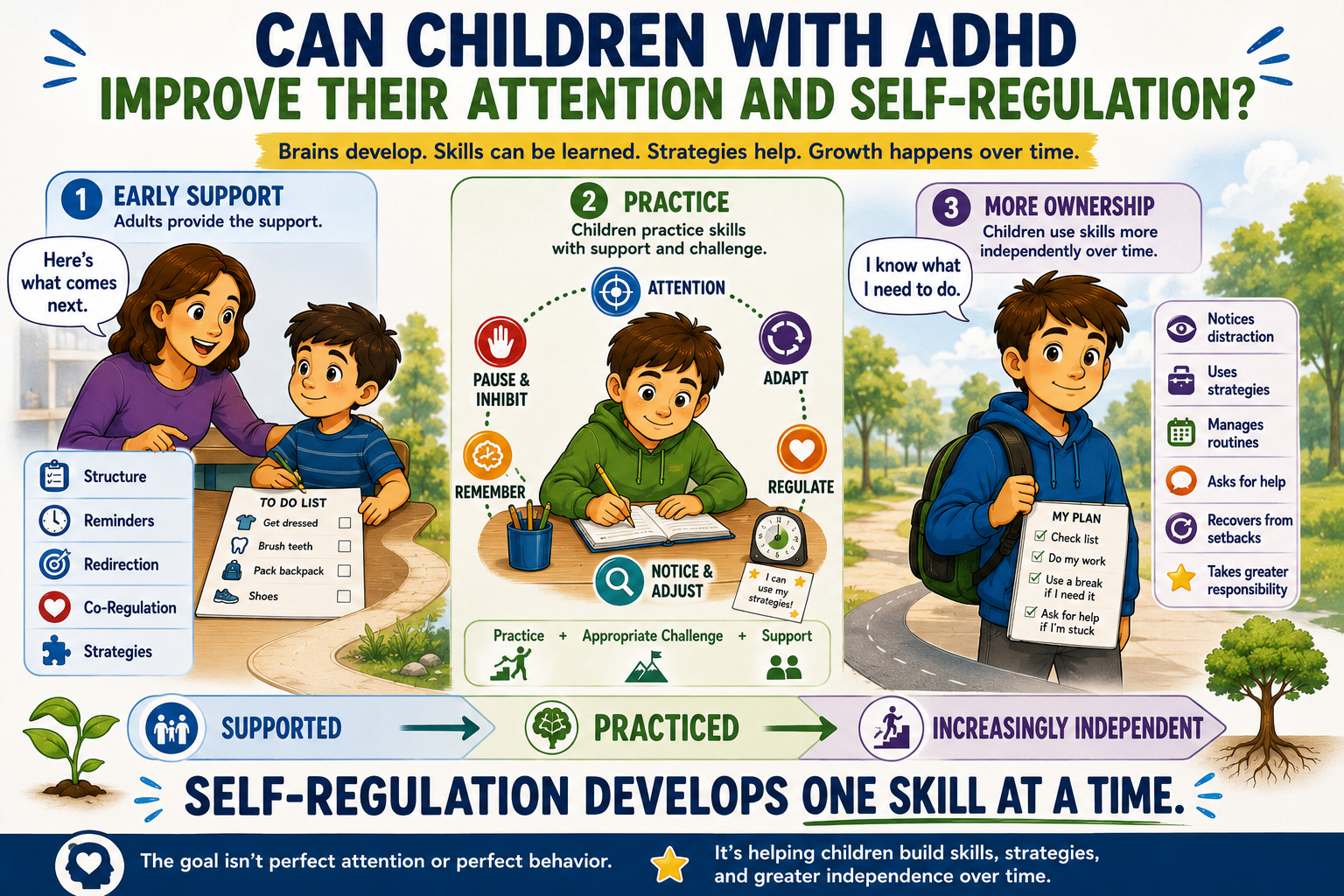
A better progression may be:
“Let’s organize this together.”
then:
“Use your checklist. I’ll be nearby.”
then:
“Do your backpack reset.”
Eventually:
The child owns the system.
The goal isn’t immediate independence.
It’s gradually moving more of the organizational responsibility toward the child.
Praise the System, Not Just the Clean Room
It’s natural to say:
“Your room looks great!”
But consider noticing how the child got there.
“You did all the clothes first, then moved to the toys. That plan really worked.”
“You put your permission slip in the parent tray without being reminded.”
“You checked your backpack before school and noticed the library book.”
Now we’re reinforcing the strategy, not simply the appearance of the finished product.
That’s important because the real goal isn’t:
A clean backpack today.
It’s:
A child who increasingly knows how to manage their backpack tomorrow.
What Does Progress With ADHD and Organization Look Like?
Progress doesn’t necessarily mean your child’s room always looks perfect.
It may mean they can find their homework more often, lose fewer belongings, follow a cleanup sequence, recognize when their backpack needs a reset, or begin putting important items in predictable places.
It may also look like the child saying:
“I need somewhere to put these papers.”
or:
“I keep losing my water bottle. I’m going to leave it beside my backpack.”
Those statements show something bigger than tidiness.
The child is beginning to recognize a problem and create a system to solve it.
That’s organizational thinking.
Look Beyond “Messy”
A messy room is not a diagnosis.
Neither is a disorganized backpack.
Children differ in how much order they prefer, and some perfectly healthy adults would probably prefer that nobody inspect their desk right now.
But when disorganization repeatedly interferes with school, routines, responsibilities, relationships, or independence, it’s worth asking what’s happening underneath it.
Instead of only asking:
“Why can’t you keep anything organized?”
ask:
“Which part of staying organized is difficult?”
Is it remembering?
Categorizing?
Planning?
Starting?
Staying focused?
Resisting distractions?
Estimating time?
Maintaining the system?
Different problems require different supports.
ADHD and Disorganization: Disorganization Isn’t a Diagnosis
Disorganization can occur in ADHD, but disorganization by itself does not mean a child has ADHD.
ADHD is diagnosed based on a persistent pattern of inattention and/or hyperactivity-impulsivity that interferes with functioning or development. Symptoms must meet established criteria and be considered across more than one setting.
Other factors can also affect organization, including age, stress, learning demands, sleep, anxiety, environmental expectations, and simply not having been taught an effective system.
So rather than diagnosing a child based on a messy bedroom or lost homework, look at the broader pattern of functioning and seek appropriate professional evaluation when concerns are persistent.
Understanding Your Child’s Individual Brain Skills
Two children can both appear extremely disorganized for very different reasons.
One may forget where things belong. Another may become distracted halfway through putting them away. One may struggle to create categories, while another understands the system perfectly but doesn’t initiate the cleanup.
Another may underestimate how much time organization requires. And another may have such a complicated system that maintaining it exceeds their current executive abilities.
At NeuroFiT Connections, this individual variation is why we begin with a comprehensive Brain & Body Assessment. Depending on your child’s age and abilities, we evaluate multiple areas of brain and body function to develop a broader understanding of their individual strengths and challenges.
Those findings help guide personalized recommendations and, for children who enroll in a program, individualized brain and body coaching activities.
We don’t build a program around ADHD. We build it around your child.
Organization Is a System, Not a Personality
It’s easy for a child who repeatedly loses things to begin hearing:
“You’re so disorganized.”
Eventually, that can become:
“I’m a disorganized person.”
But organization doesn’t have to be treated as a fixed character trait.
Children can learn to create homes for important items, use checklists, establish routines, break large organizational jobs into smaller steps, reset systems regularly, and recognize when something isn’t working.
They may always need more external structure than someone else.
That’s okay.
Adults use calendars, filing systems, labeled folders, reminders, inboxes, shelves, hooks, and countless other external systems every day.
We don’t consider those tools evidence that adults have failed to become organized.
The system is part of the skill.
So when the backpack explodes onto the kitchen floor again, instead of seeing only the mess, look for the process underneath it.
What needs a home?
What needs a routine?
What needs to become visible?
What needs fewer decisions?
What needs a reset?
And what part can your child begin learning to manage themselves?
Because the long-term goal isn’t simply:
“Keep your room clean.”
It’s:
“Learn how to create and maintain systems that help you manage your life.”
Frequently Asked Questions
Is disorganization a symptom of ADHD?
Difficulty organizing tasks and activities is included among the symptoms considered when evaluating ADHD. However, disorganization alone does not mean a child has ADHD, and organizational difficulties can occur for many reasons.
A diagnosis requires a broader pattern of symptoms and functional impairment across settings.
Why does my child with ADHD lose everything?
Losing belongings can involve several different processes. A child may not put an item in a consistent location, may become distracted while handling it, may forget where it was placed, or may not have an effective organizational system in the first place.
Creating simple, predictable homes for frequently used items can reduce how much information the child must remember internally.
Why can my child organize something once but not keep it organized?
Creating a system and maintaining a system require different kinds of effort. Even after everything has been organized, the child must repeatedly notice when something is out of place, remember where it belongs, put it away, and periodically reset the system.
That’s why short, predictable maintenance routines can be more effective than repeatedly waiting for everything to become chaotic.
Should I clean and organize my child’s room for them?
Sometimes children need substantial help, especially when the mess has become overwhelming. But rather than doing all the work indefinitely, consider organizing together, simplifying the system, creating visible categories, and gradually transferring more responsibility to the child.
The goal is not simply a clean room. It’s helping the child develop a process they can increasingly manage themselves.
What organizational tools can help children with ADHD?
Depending on the child, useful supports may include visual checklists, open bins, labels, designated landing zones, color-coded folders, backpack routines, timers, written schedules, and regular reset times.
The best system is generally not the most elaborate one. It’s the one the child can understand, access, and consistently use.
Does a messy bedroom mean my child has ADHD?
No. A messy bedroom cannot diagnose ADHD.
If disorganization occurs alongside persistent difficulties with attention, impulsivity, task completion, school performance, routines, or other areas of functioning, discuss those concerns with an appropriate healthcare professional.
Continue Learning About ADHD
What Is ADHD? Understanding Attention, Executive Function & Self-Regulation
Learn how attention, executive function, and self-regulation work together throughout everyday life.
Why Can My Child Focus on Video Games but Not Homework?
Explore why attention can vary with interest, stimulation, feedback, reward, and task demands.
Why Does My Child with ADHD Forget Everything? Understanding Working Memory
Learn how working memory affects instructions, routines, organization, and schoolwork.
Why Are Transitions So Difficult for Children With ADHD?
Understand the brain skills involved in stopping one activity and successfully beginning another.
ADHD and Emotional Regulation: Why Are the Reactions So Big?
Explore what children need to pause, adapt, manage emotions, and recover.
ADHD and Executive Function: Why Everyday Tasks Can Feel So Difficult
See the hidden executive-function demands behind apparently simple everyday tasks.
Can Children With ADHD Improve Their Attention and Self-Regulation?
Explore skill development, strategies, support, and growing independence.
Why Does My Child With ADHD Procrastinate? Understanding Task Initiation
Learn why knowing what needs to be done and actually beginning it can be very different challenges.
ADHD and Time Blindness: Why Is My Child Always Running Late?
Learn why children with ADHD may struggle to estimate, track, and manage time—and how simple supports can make time easier to see and manage.
ADHD Program for Children
Learn how NeuroFiT Connections begins with a comprehensive Brain & Body Assessment and develops programming around the individual child.