

One of the first questions parents ask after learning about Developmental Coordination Disorder (Dyspraxia) is:
“Will my child ever get better?”
It’s an understandable question.
Watching your child struggle with handwriting, riding a bicycle, sports, dressing, or other everyday activities can be frustrating—for both you and your child.
The encouraging news is that the brain continues to learn and adapt throughout childhood.
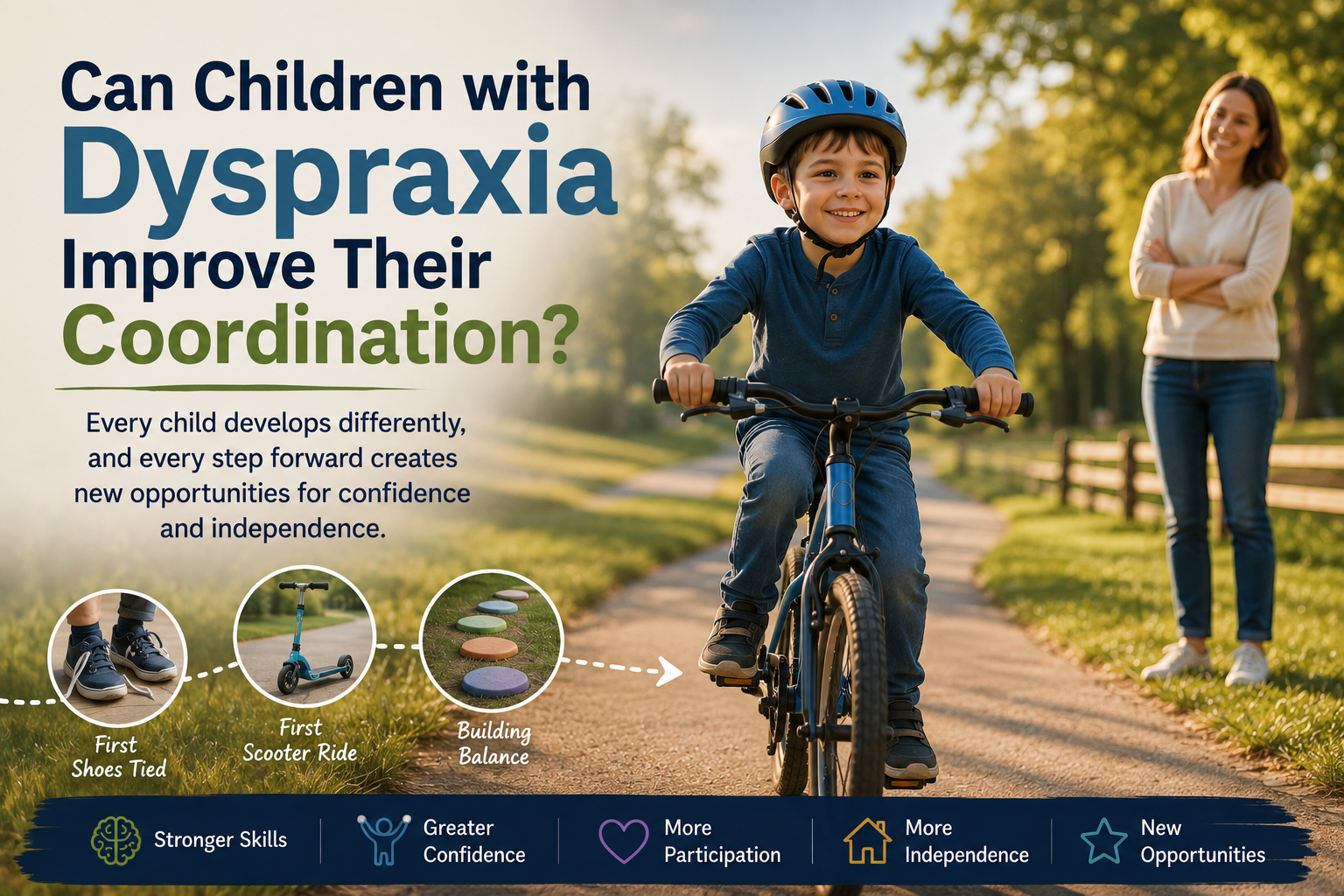
Every child develops differently, and no two children follow exactly the same path. While no one can predict precisely how much progress an individual child will make, understanding how the brain develops—and providing appropriate support—can help children continue building movement skills, confidence, and independence over time.
The Brain Is Designed to Learn
One of the brain’s greatest strengths is its ability to learn through experience.
Every time children practice a new skill, the brain is:
- Building connections
- Strengthening existing pathways
- Refining movement
- Improving timing
- Learning from feedback
This ability to adapt is known as neuroplasticity.
Neuroplasticity does not mean progress is immediate or guaranteed.
It means the brain remains capable of learning throughout life.
Improvement Looks Different for Every Child
Parents sometimes picture progress as a straight line.
Real life rarely works that way.
Some children make rapid gains in one area while continuing to need support in another.
For example, a child may become much more confident:
🚲 Riding a bicycle
while still finding handwriting challenging.
Another child may improve:
✏️ Handwriting
while continuing to struggle with sports.
Progress is rarely identical across every skill because each activity depends on a different combination of brain systems.
Building Foundational Brain Skills
Rather than focusing on a single activity, it is often helpful to consider the foundational skills that support many different types of movement.
These include:
🧠 Motor planning
🤸 Balance
🧭 Body awareness
👁️ Visual-motor integration
✋ Fine motor control
🏃 Gross motor coordination
🎯 Attention
📋 Executive functioning
As these foundational skills become stronger, children may find it easier to participate in a wide range of everyday activities.

Progress Is More Than Better Coordination
Families often notice changes that extend beyond movement itself.
Children may become more willing to:
🤝 Join group activities
🎒 Take on responsibilities
🚲 Try new experiences
🏃 Participate in sports
🍳 Help at home
🌟 Explore hobbies
Improved confidence often encourages greater participation—and participation creates even more opportunities for learning.
Why Individualized Support Matters
Every child with Dyspraxia has a unique neurological profile.
Some children need more support with:
- Balance
- Motor planning
- Body awareness
- Visual-motor integration
- Fine motor skills
- Attention
- Executive function
Because these differences vary from child to child, personalized assessment plays an important role in developing an effective plan.
How NeuroFiT Connections Can Help
At NeuroFiT Connections, every child begins with a comprehensive Brain & Body Assessment designed to better understand the neurological systems supporting movement, learning, and everyday participation.
Rather than focusing solely on the diagnosis, we identify each child’s individual strengths and challenges.
Using those results, we develop a personalized brain training program designed to strengthen the foundational brain skills that support coordinated movement and growing independence.

Small Improvements Can Lead to Big Changes
Progress isn’t always measured by dramatic milestones.
Sometimes the most meaningful changes are everyday moments.
👟 Tying shoes independently.
✏️ Writing without becoming frustrated.
⚽ Joining a playground game.
🚲 Riding around the neighborhood.
🎒 Organizing a backpack.
🍴 Using utensils more comfortably.
Each success becomes another opportunity to build confidence.
Looking Toward the Future
Children continue developing throughout childhood and adolescence.
As they gain experience, practice movement, and build confidence, many families notice gradual improvements in participation and independence.
Every journey is unique.
The goal isn’t perfection.
The goal is helping each child reach their own potential.
Final Thoughts
Developmental Coordination Disorder does not define a child’s future.
Children are continually learning.
Continually adapting.
Continually growing.
By understanding the brain systems that support coordinated movement—and providing individualized support—we can help children build stronger foundations for movement, confidence, participation, and lifelong independence.
Because every child deserves the opportunity to move, learn, participate, and thrive.
Frequently Asked Questions
Can children with Dyspraxia improve their coordination?
Many children continue to develop movement skills over time. Progress varies from child to child and depends on many factors, including individual strengths, opportunities to practice, and appropriate support.
What is neuroplasticity?
Neuroplasticity is the brain’s ability to adapt and learn through experience. It allows children to continue developing new skills throughout childhood and beyond.
Does improvement happen at the same rate for every child?
No. Every child develops differently. Progress may occur more quickly in some skills than others, and each child’s developmental journey is unique.
Why is a personalized assessment important?
Children with Dyspraxia have different strengths and challenges. A comprehensive assessment helps identify the specific brain systems that may benefit from individualized support.
How does NeuroFiT Connections help?
Every child begins with a comprehensive Brain & Body Assessment. Using those results, we create a personalized brain training program designed to strengthen the neurological systems supporting movement, confidence, and everyday participation.
Related Articles
- What Is Dyspraxia? Understanding Developmental Coordination Disorder
- Is My Child Just Clumsy or Could It Be Dyspraxia?
- Why Do Some Bright Children Struggle with Coordination?
- How the Brain Coordinates Movement
- Why Handwriting, Sports & Everyday Tasks Can Be So Difficult
- Helping Children Build Confidence Through Movement