

ADHD is often described as a problem with attention.
But for many children, the story is much bigger than simply having trouble focusing.
A child with ADHD may forget what they were asked to do halfway through doing it. They may start their homework but become distracted before finishing the first problem. They may know they shouldn’t interrupt but speak before they have a chance to stop themselves. They may struggle to estimate how long something will take, keep track of their belongings, transition away from a favorite activity, or recover when something doesn’t go according to plan.
And then there are moments when that same child can concentrate intensely on something they love.
For parents, that inconsistency can be confusing.
Understanding ADHD begins with recognizing that attention is only one part of a much larger system of brain skills that help children manage themselves and navigate everyday life.
What Is ADHD?
Attention-Deficit/Hyperactivity Disorder, or ADHD, is a neurodevelopmental disorder characterized by persistent patterns of inattention and/or hyperactivity and impulsivity that interfere with functioning or development.
ADHD is generally described in three presentations:
Predominantly Inattentive Presentation
Children may have difficulty sustaining attention, following through on tasks, organizing activities, remembering instructions, or keeping track of belongings. They may appear to daydream or seem as though they aren’t listening, even when they are trying to pay attention.
Predominantly Hyperactive-Impulsive Presentation
Children may have difficulty remaining still, waiting their turn, controlling impulses, or regulating their activity level. They may interrupt, talk frequently, act before thinking, or seem constantly “on the go.”
Combined Presentation
Children demonstrate significant characteristics of both inattention and hyperactivity-impulsivity.
ADHD can look very different from one child to another—and its presentation can change as children grow.
That is one reason looking beyond the label is so important.
ADHD Is More Than “Not Paying Attention”
Imagine telling a child:
“Go upstairs, put your shoes on, brush your teeth, grab your backpack, and meet me by the door.”
That sounds like one instruction.
To the brain, it isn’t.
The child has to:
- Direct attention toward you.
- Process what you said.
- Hold several instructions in working memory.
- Determine the correct sequence.
- Begin the first task.
- Resist distractions along the way.
- Remember what comes next.
- Monitor progress.
- Keep track of time.
- Transition from one task to another.
- Ultimately arrive at the door with everything they need.
That simple morning instruction depends on multiple brain systems working together.
For a child with ADHD, some of those processes may require significantly more conscious effort.
This is why repeatedly saying “Just focus!” or “You need to try harder!” often doesn’t address what is actually making the task difficult.
Three Important Pieces of the ADHD Puzzle
To better understand ADHD, it helps to look at three closely connected areas:

🎯 Attention
Attention is the brain’s ability to select important information while managing competing information from the environment and from within ourselves.
But attention isn’t simply on or off.
Children need to be able to:
- Direct attention.
- Sustain attention.
- Ignore distractions.
- Shift attention when appropriate.
- Divide attention when a task requires it.
- Return attention after becoming distracted.
This helps explain something that frequently puzzles parents:
“If my child has ADHD, how can they concentrate on a video game for hours?”
Having ADHD does not mean a child is incapable of paying attention.
Attention can vary considerably depending on factors such as interest, novelty, stimulation, motivation, reward, fatigue, and the demands of the task.
A child who becomes deeply engaged in something interesting can still have significant difficulty regulating attention when the activity is repetitive, less stimulating, requires prolonged mental effort, or offers little immediate reward.
📋 Executive Function
Executive functions are the brain’s management skills.
They help us decide what needs to happen—and then organize our thoughts and behavior to make it happen.
Executive functioning includes skills involved in:
- Planning
- Organization
- Working memory
- Task initiation
- Prioritization
- Time management
- Impulse control
- Cognitive flexibility
- Self-monitoring
- Goal-directed behavior
Consider homework.
Knowing how to do the math problems is only one part of completing the assignment.
A child also has to remember that homework exists, bring the correct materials home, begin the assignment, ignore distractions, determine how much time is available, persist when something becomes difficult, complete the work, put it back into the backpack, and remember to turn it in tomorrow.
A child can be completely capable of doing the academic work while struggling with the executive functions surrounding it.
That’s an important distinction.
💛 Self-Regulation
Self-regulation helps children manage their behavior, emotions, attention, and level of arousal in response to what is happening around them.
A child might understand that they shouldn’t interrupt.
But knowing the rule and being able to pause long enough to follow it are different skills.
The same is true when something goes wrong.
A child may know that losing a game isn’t a catastrophe while still experiencing an emotional response that feels enormous in the moment.
Self-regulation helps children:
- Pause before responding.
- Manage impulses.
- Tolerate frustration.
- Adjust their activity level.
- Recover from disappointment.
- Adapt to unexpected changes.
- Transition between activities.
- Return to a calmer state after becoming upset.
Difficulties in these areas can sometimes be interpreted as deliberate misbehavior when the child may actually be struggling to regulate their response.
Why ADHD Can Look So Inconsistent
One of the most frustrating aspects of ADHD for families can be inconsistency.
A child completes an assignment independently on Monday…
…and can’t seem to begin a similar assignment on Tuesday.
They remember everything they need for soccer…
…but forget their homework folder three days in a row.
They spend an hour building an elaborate LEGO creation…
…but struggle to remain engaged with a worksheet for ten minutes.
That inconsistency can make adults wonder:
“I know they can do this. Why aren’t they doing it?”
The better question may be:
“What was different about the demands on their brain in this situation?”
Interest, motivation, environment, distractions, fatigue, emotional state, task complexity, working-memory demands, and the amount of structure available can all influence performance.
Ability and performance are not always the same thing.
What ADHD Can Look Like in Everyday Life
ADHD doesn’t stay in the classroom.
The brain skills involved in attention, executive functioning, and self-regulation are used throughout a child’s day.
Families may notice challenges with:
📚 Learning
Following lessons, remembering directions, starting assignments, completing work, or consistently demonstrating what they know.
🎒 Organization
Keeping track of homework, school supplies, clothing, sports equipment, schedules, and responsibilities.
⏰ Time Management
Estimating how long activities will take, getting ready on time, meeting deadlines, or recognizing how much time has passed.
🏡 Daily Routines
Moving through morning routines, chores, homework, meals, and bedtime without frequent reminders.
🤝 Relationships
Waiting, listening, taking turns, controlling impulses, and navigating the give-and-take involved in friendships.
💛 Emotional Regulation
Managing frustration, disappointment, excitement, unexpected changes, and other strong emotions.
🌟 Confidence
Repeatedly forgetting, being corrected, falling behind, or feeling as though everyday tasks are easier for everyone else can affect how children begin to see themselves.
And that last one matters enormously.
ADHD Does Not Define Intelligence
A child can have ADHD and be exceptionally bright.
They may be creative thinkers, imaginative storytellers, talented artists, enthusiastic problem-solvers, curious scientists, gifted athletes, or passionate experts on subjects they love.
Difficulty with executive functioning does not mean a child lacks intelligence.
Sometimes the challenge is not knowing what to do.
It’s consistently organizing the brain and behavior necessary to do what they know.
Recognizing that distinction can change the way adults respond to a struggling child.
Instead of:
“You’re not trying.”
we can begin asking:
“Which part of this task is making it difficult to get started or follow through?”
Many Brain Systems Work Together
There is no single “attention center” responsible for everything we associate with ADHD.
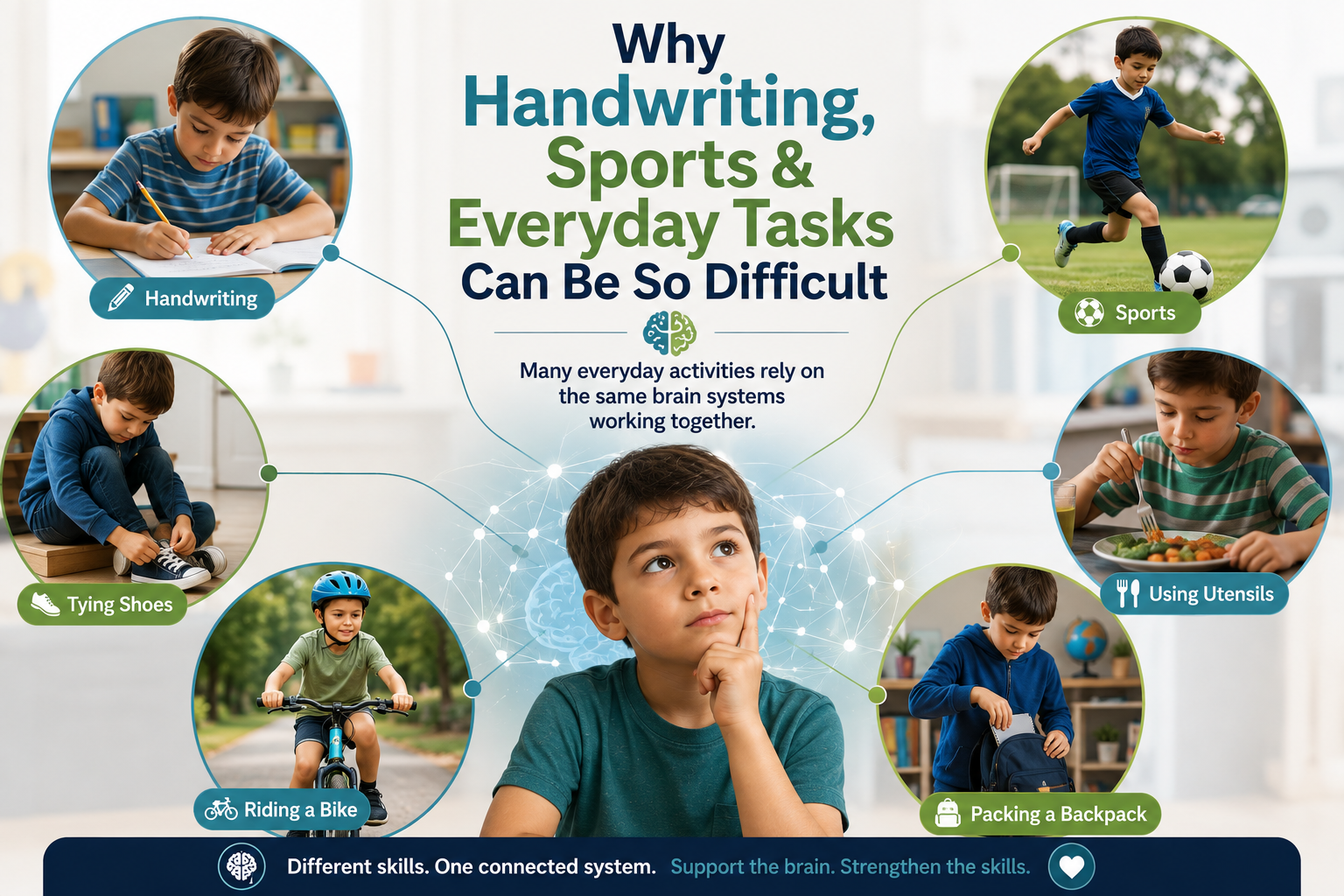
Attention, executive functioning, working memory, impulse control, emotional regulation, sensory processing, movement, and arousal depend on interacting brain networks and systems.
That interconnectedness helps explain why ADHD can affect so many apparently unrelated parts of everyday life.
Completing an assignment may involve attention and working memory.
Getting ready for school adds sequencing, organization, motor skills, and time awareness.
Playing successfully with friends adds impulse control, emotional regulation, flexible thinking, and social awareness.
Everyday functioning is a team effort within the brain.
Why Understanding the Individual Child Matters
Two children can both have an ADHD diagnosis and still have remarkably different needs.
One may struggle primarily with sustained attention.
Another may have significant difficulties with working memory and organization.
Another may manage academics well but struggle with impulsivity and emotional regulation.
And another may experience challenges across several areas.
That’s why a diagnosis can provide useful information without telling us everything about the individual child.
At NeuroFiT Connections, we begin with a comprehensive Brain & Body Assessment designed to help us better understand each child’s unique pattern of strengths and challenges.
Depending on the child’s age and abilities, we evaluate multiple areas of brain and body function. The results help us identify foundational skills that may benefit from additional support and guide the development of a personalized program.
We don’t build a program around ADHD. We build it around the child.

Can Children Strengthen These Skills?
The brain continues developing throughout childhood and adolescence.
It also has the capacity to change in response to experience, learning, and practice—a property known as neuroplasticity.
Children routinely develop skills through repeated experience.
They learn to balance.
Read.
Write.
Ride a bicycle.
Solve increasingly complicated problems.
Manage responsibilities.
Regulate emotions.
Plan ahead.
Many skills associated with attention and executive functioning also continue developing as children grow.
That doesn’t mean ADHD simply disappears with enough practice, nor does every child follow the same developmental path. But children can learn strategies, develop skills, receive appropriate supports, and become better equipped to navigate areas that are difficult for them.
Progress may look different for every child.
For one, it might mean completing homework with fewer reminders.
For another, remembering what comes next in a morning routine.
For another, pausing before interrupting.
And for another, recovering from frustration and trying again.
Small changes in everyday functioning can create meaningful opportunities for confidence and independence.
Looking Beyond the Diagnosis
An ADHD diagnosis can help families understand why certain things have been difficult.
But it should never become the definition of the child.
Your child is more than their attention span.
More than their backpack.
More than unfinished homework.
More than impulsive moments.
More than difficult mornings.
Understanding ADHD gives us a better framework for understanding the challenges—but understanding the individual child gives us a place to begin supporting them.
At NeuroFiT Connections, our goal is not to change who a child is. It’s to better understand the foundational brain skills that may be making everyday life more difficult and provide personalized opportunities to strengthen those skills.
Retain the strengths. Make the challenges less limiting.
ADHD can affect many parts of everyday life because attention, executive function, and self-regulation work together.
I’d put this immediately after “Three Important Pieces of the ADHD Puzzle,” before we begin the individual Attention subsection.
For the featured image, I’d go more human and realistic: a bright, engaged child at a desk with school materials, backpack, clock, and everyday responsibilities subtly surrounding them, with a soft illuminated brain-network motif. Headline: “What Is ADHD?” and subheading: “Understanding Attention, Executive Function & Self-Regulation.”
Frequently Asked Questions
Is ADHD just a problem with attention?
No. Attention is an important part of ADHD, but ADHD can also affect executive functioning, working memory, impulse control, organization, time management, cognitive flexibility, and self-regulation.
That is why ADHD can influence much more than a child’s ability to concentrate in school. The same foundational skills are used for completing routines, remembering responsibilities, managing emotions, navigating friendships, and becoming increasingly independent.
Can a child with ADHD focus really well on things they enjoy?
Yes. ADHD does not mean a child is unable to focus.
Attention can vary depending on interest, novelty, stimulation, motivation, reward, fatigue, and the demands of a task. A child may become deeply engaged in a favorite activity while finding it much harder to sustain attention during something repetitive, less stimulating, or mentally demanding.
This inconsistency is one reason ADHD can sometimes be misunderstood as a lack of effort or motivation.
What is executive function, and how is it related to ADHD?
Executive functions are the brain skills that help children manage their thoughts, actions, and responsibilities.
They include planning, organization, working memory, task initiation, time management, impulse control, cognitive flexibility, and self-monitoring.
A child with executive-function challenges may know exactly what they need to do but struggle to get started, remember the steps, stay organized, manage their time, or follow through.
Why does my child with ADHD forget directions so easily?
Working memory allows us to temporarily hold information in mind while using it.
When working memory is under heavy demand, a child may hear and understand a direction but lose part of the information before completing it. Multi-step instructions can be particularly challenging because the child must remember the steps while simultaneously carrying them out and managing distractions.
This can look like a child isn’t listening when the difficulty may actually involve holding and using the information they heard.
Is emotional regulation part of ADHD?
Difficulties with emotional self-regulation can occur in children with ADHD, although emotional dysregulation is not itself one of the core diagnostic criteria for ADHD.
Some children may experience frustration intensely, react quickly, have difficulty adapting when something unexpected happens, or need more time to recover after becoming upset.
Understanding the role of self-regulation can help adults look beyond the behavior and consider what skills the child may be struggling to use in that moment.
Can children with ADHD strengthen attention and executive-function skills?
Children continue developing attention, working memory, planning, organization, self-regulation, and other executive-function skills throughout childhood and adolescence.
The brain also changes in response to learning and experience through neuroplasticity. With appropriate support, practice, strategies, accommodations, and opportunities to develop skills, children can become better equipped to manage areas that are difficult for them.
Progress will look different for every child. The goal isn’t to change who a child is—it’s to help them develop skills and supports that allow their strengths to shine while making everyday challenges less limiting.
Related Articles
- Why Can My Child Focus on Video Games but Not Homework?
- Why Does My Child with ADHD Forget Everything?
- Why Are Transitions So Difficult for Children with ADHD?
- ADHD and Emotional Regulation: Why Are the Reactions So Big?
- ADHD and Executive Function: Why Everyday Tasks Can Feel So Difficult
- Can Children with ADHD Improve Their Attention and Self-Regulation?