
It’s 8:00 p.m.
You’ve already announced bedtime.
Then reminded your child again.
And again.
But somehow they still need a drink of water, can’t find their pajamas, remembered something they absolutely must tell you, suddenly need to finish building something, and have developed a passionate interest in a book they ignored all afternoon.
Eventually, they’re in bed.
But now they’re talking, moving, thinking, asking questions, or telling you:
“I’m not tired.”
For many families of children with ADHD, bedtime can become one of the most difficult transitions of the day. Research consistently finds that sleep difficulties are common among children with ADHD, including problems falling asleep, staying asleep, and getting sufficient or efficient sleep.
But there’s an important distinction:
ADHD doesn’t automatically explain every sleep problem.
Sleep difficulties can have many causes, and sleep disorders themselves can sometimes produce daytime behaviors that resemble or intensify ADHD symptoms. That’s why understanding what happens before, during, and after bedtime matters.
Why Can Bedtime Be So Difficult for Children With ADHD?
We tend to think of bedtime as one instruction:
“Go to bed.”
But consider everything a child may actually need to do.
They have to stop what they’re doing, disengage attention from something interesting, understand that bedtime is approaching, shift into a different routine, remember multiple steps, resist distractions, manage disappointment about the day ending, reduce stimulation, and eventually settle enough to fall asleep.
That can involve attention, inhibition, working memory, time management, cognitive flexibility, emotional regulation, and other executive functions.
Bedtime may look like one transition, but it can require many brain skills working together.
For a child already tired at the end of the day, those demands may become even harder to manage.
ADHD and Sleep Problems Often Occur Together
Sleep difficulties are more common in children with ADHD than many parents realize. A recent meta-analysis comparing thousands of children with ADHD with typically developing children found group-level differences across several sleep measures, including sleep duration, sleep efficiency, time required to fall asleep, and nighttime awakenings.
A broader systematic review involving more than 42,000 children likewise concluded that sleep disturbances are common in childhood ADHD and may worsen behavioral outcomes.
That doesn’t mean every child with ADHD will have sleep difficulties, nor does it mean every bedtime struggle is caused by ADHD.
Instead, it tells us that sleep deserves attention when we’re trying to understand the whole child.
“Go Get Ready for Bed” Is Not One Task

Imagine saying:
“Go get ready for bed.”
An adult immediately understands what that means.
A child may actually need to:
- Stop playing.
- Put something away.
- Go upstairs.
- Find pajamas.
- Change clothes.
- Put dirty clothes away.
- Use the bathroom.
- Brush teeth.
- Get water.
- Choose a book.
- Get into bed.
- Settle down.
And somewhere around Step 3, the child notices a toy.
Or starts talking.
Or remembers something.
Or forgets what they were supposed to be doing.
Suddenly:
“Get ready for bed”
has turned into 25 minutes of parental reminders.
The problem may not simply be resistance to sleep.
The bedtime routine itself can be an executive-function task.
Bedtime Requires Stopping Something Else
Before children can begin bedtime, they usually have to stop something.
And often it’s something much more interesting.
🎮 Video game
📺 Television
🧱 LEGO
📚 Favorite book
🎨 Drawing
💬 Conversation
🧸 Imaginative play
Stopping a preferred activity requires more than hearing:
“Time for bed.”
The child must disengage attention, inhibit the desire to continue, shift toward the next activity, and sometimes manage disappointment or frustration.
This connects directly to what we discussed in Why Are Transitions So Difficult for Children With ADHD?
The problem isn’t always:
“I refuse to go to bed.”
Sometimes it’s:
“My brain is having difficulty leaving what I’m doing now and moving toward what comes next.”
Time Management Can Make Bedtime Harder
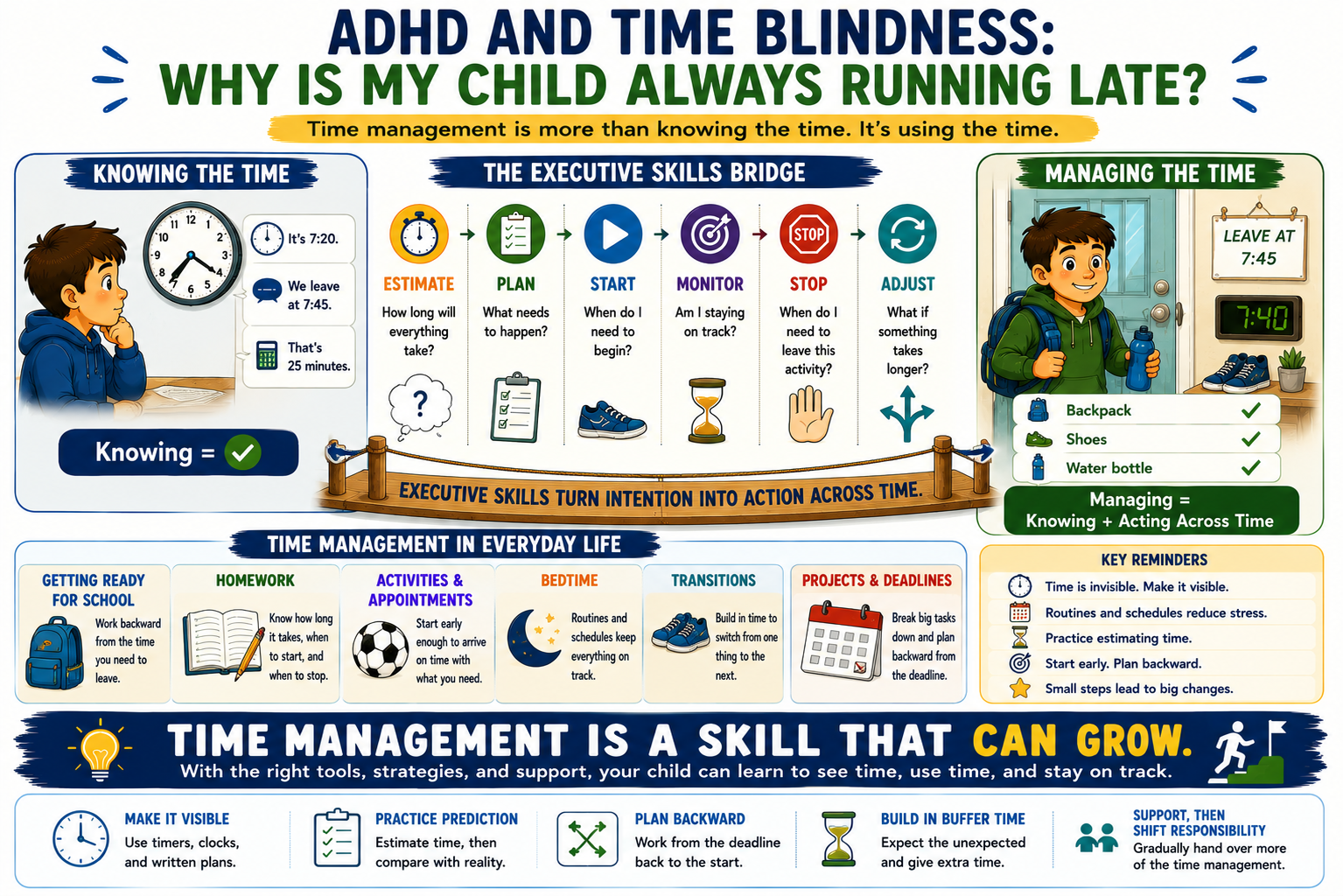
We explored this in ADHD & Time Blindness: Why Is My Child Always Running Late?
The same issue can appear at night.
You say:
“Bedtime is in 30 minutes.”
To an adult, that means:
I should start wrapping things up.
A child may hear:
“I have 30 more minutes!”
Twenty-five minutes later, nothing has changed.
Now the parent says:
“Five minutes! Start getting ready!”
And suddenly the child has to stop, transition, remember the routine, and complete several tasks under pressure.
The evening goes from:
🟢 Plenty of time
to
🔴 BED. NOW.
Making the bedtime sequence visible can reduce how much time-related information the child has to organize internally.
Working Memory Matters at Bedtime
Consider:
“Put your pajamas on, brush your teeth, use the bathroom, get your water, and pick a book.”
That sounds straightforward.
But it contains multiple pieces of information that have to remain active while the child moves through the routine.
A child may put on pajamas…
walk toward the bathroom…
notice something…
and forget everything after that.
The parent sees:
“I just told you what to do!”
The child may genuinely have lost the remaining steps from working memory.
A visible bedtime checklist moves that information outside the brain.
BEDTIME
☑ Pajamas
☑ Bathroom
☑ Brush teeth
☑ Water
☑ Book
☑ Bed
Now the child doesn’t have to hold the entire sequence in mind.
They can look.
Emotional Regulation Can Show Up at Bedtime Too
Bedtime can carry emotion.
A child may be disappointed that playtime is over, upset about something that happened during the day, worried about tomorrow, afraid of the dark, reluctant to separate from a parent, or simply exhausted.
And exhaustion itself can make regulation harder.
That means what looks like:
“bedtime behavior”
may sometimes involve emotional regulation as much as sleep.
A child who managed disappointment reasonably well at 4:00 p.m. may have much less capacity remaining at 8:30 p.m.
That doesn’t mean expectations disappear.
It means we should recognize that the same demand may be harder for the brain to manage when the child is tired.
A Tired Child Doesn’t Always Look Tired
Adults often imagine a tired child as sleepy, quiet, and ready for bed.
Children don’t always cooperate with that picture.
Fatigue can coexist with restlessness, emotionality, impulsive behavior, difficulty concentrating, and other daytime challenges. Sleep problems can also produce symptoms that resemble ADHD, which is one reason the CDC notes that sleep disorders are among the conditions clinicians should consider when evaluating ADHD-like symptoms.
So:
“They still have plenty of energy!”
doesn’t necessarily tell us whether the child is adequately rested.
Sleep and ADHD Can Create a Difficult Cycle

This relationship can become circular.
ADHD-related challenges can make bedtime routines and settling more difficult.
Poor sleep can then make attention, memory, emotional regulation, and behavior harder the following day. Sleep disturbances may worsen behavioral outcomes in children with ADHD, according to systematic-review evidence.
Then the child reaches the next evening after another demanding day.
And the cycle begins again.
ADHD can make sleep harder—and insufficient or disrupted sleep can make daytime functioning harder.
That makes sleep an important part of the overall picture rather than simply something that happens after the “important” part of the day is finished.
Not Every Sleep Problem Is ADHD
This is one of the most important sections of this article.
If a child with ADHD has persistent sleep difficulties, don’t automatically assume:
“That’s just their ADHD.”
Children can have sleep disorders and other conditions that require appropriate evaluation.
The American Academy of Pediatrics recommends screening children being evaluated for ADHD for coexisting physical conditions including sleep apnea.
Sleep disorders can also mimic or worsen ADHD-like symptoms. The AAP has specifically highlighted the importance of screening children with ADHD symptoms for underlying sleep problems.
Pay particular attention to persistent concerns such as loud or frequent snoring, pauses or difficulty breathing during sleep, significant daytime sleepiness, unusual nighttime movements, repeated awakenings, or ongoing difficulty falling or staying asleep.
Those are conversations to have with your child’s pediatrician or another qualified healthcare professional rather than simply treating them as behavioral problems.
Could ADHD Medication Affect Sleep?
For some children, medication can affect sleep.
The CDC notes that sleep problems can occur as a side effect of ADHD medications, and children can respond differently to different medications and doses. Research has also found associations between stimulant treatment and sleep difficulties in some children.
That does not mean parents should stop or change medication on their own.
If sleep difficulties appear after starting medication or changing the dose or timing, discuss what you’re seeing with the prescribing healthcare provider. Medication benefits, timing, dosage, side effects, and the child’s overall functioning need to be considered together.
Make Bedtime Predictable Before Bedtime Begins
One of the simplest ways to support bedtime is to make it predictable.
Instead of bedtime suddenly arriving:
“Okay! Turn it off. It’s bedtime!”
create a visible runway toward it.
For example:
EVENING PLAN
🕖 7:00 Free time
🕢 7:30 15-minute warning
🕗 7:45 Finish current activity
🪥 7:50 Bathroom + teeth
👕 8:00 Pajamas
📚 8:05 Read together
🌙 8:20 Lights out
The exact schedule will vary by child and family.
The important idea is:
Don’t make bedtime a surprise.
Predictability can reduce the number of transitions, reminders, and decisions that have to be managed in the moment.

Use “Now → Next → Then”
You don’t necessarily need an elaborate chart.
For some children, three steps are enough:
NOW
🎮 Finish game
↓
NEXT
🪥 Teeth + pajamas
↓
THEN
📚 Story + bed
The child can see where they are and where they’re going.
This is particularly useful when bedtime routines tend to become long strings of verbal instructions.
Reduce Stimulation Before Bed
A consistent wind-down period can help create a clearer transition between daytime activity and sleep.
That may include dimming lights, reducing highly stimulating activities, following a predictable hygiene routine, reading, or choosing another calm activity that works for the child.
Screen use deserves particular attention because it can extend stimulating activities right up to bedtime and can interfere with established routines. The AAP encourages clinicians to assess sleep hygiene, including screen use in the bedroom, when evaluating children’s sleep.
The goal isn’t to create a perfect Instagram-worthy bedtime routine.
It’s to help the environment increasingly communicate:
The active part of the day is ending.
Keep the Routine Simple Enough to Use
It’s easy to design a beautiful bedtime routine containing 17 steps.
Then nobody follows it.
A useful routine should be:
Predictable.
Visible.
Repeatable.
Realistic.
If your child consistently struggles with a particular part, look closely at that step.
Maybe the routine has too many decisions.
Maybe pajamas aren’t where they need to be.
Maybe choosing a book turns into a 15-minute negotiation.
Maybe brushing teeth becomes a distraction point.
Maybe the transition away from screens is happening too abruptly.
Instead of concluding:
“Bedtime doesn’t work.”
ask:
“Where does bedtime break down?”
That gives you something specific to address.
External Support Isn’t Failure
Parents sometimes worry that a child “shouldn’t need” a checklist, timer, visual schedule, or repeated bedtime structure.
But adults externalize information constantly.
We use calendars.
Alarms.
Reminders.
To-do lists.
Timers.
Morning routines.
Navigation systems.
Supporting a child externally while skills are developing isn’t the opposite of independence.
Done thoughtfully, it can become the bridge toward it.
Instead of the parent saying:
“Go brush your teeth!”
every night, the eventual goal may be for the child to notice:
“I’m at the teeth step.”
The reminder has moved from the adult to the system.
How Much Sleep Does My Child Need?
Sleep needs vary somewhat among individuals, but age-based recommendations provide useful reference points.
The American Academy of Sleep Medicine recommendations endorsed by the AAP call for children ages 6–12 to regularly get 9–12 hours of sleep per 24 hours, while teenagers ages 13–18 should generally get 8–10 hours.
That means bedtime isn’t only about whether a child eventually falls asleep.
The question is whether their schedule consistently allows enough opportunity for restorative sleep given when they need to wake up.
If a child has to wake at 6:30 a.m., a bedtime routine that doesn’t begin until 10:00 p.m. may simply not leave enough room for adequate sleep.
What About Melatonin?
Melatonin is commonly discussed among families dealing with childhood sleep difficulties, including ADHD.
But “it’s natural” doesn’t mean every child should automatically take it.
A 2026 AAP review notes evidence of benefit for melatonin in some children with ADHD or autism while also emphasizing the need for appropriate evaluation of pediatric insomnia and underlying contributors.
If you’re considering melatonin or another sleep aid for your child, discuss it with your child’s healthcare provider rather than treating it as the first solution to every bedtime problem.
A persistent sleep problem deserves an effort to understand why the child isn’t sleeping well.
What Does Progress at Bedtime Look Like?
Success doesn’t necessarily mean:
“My child goes to bed perfectly every night.”
Progress might mean the transition begins with fewer reminders.
The child checks the bedtime routine independently.
They stop a preferred activity after one warning instead of five.
They remember the next step.
They settle more consistently.
They recognize:
“I’m getting tired.”
They begin using strategies that help their body and mind wind down.
Or the family discovers that what appeared to be a behavioral bedtime problem actually deserves medical evaluation.
Progress is not simply getting a child into bed faster. It’s understanding what’s getting in the way and building a better path toward sleep.
Understanding the Whole Child
Sleep is another good example of why we don’t want to reduce a child to an ADHD diagnosis.
Two children may both resist bedtime, but for completely different reasons.
One may struggle primarily with transitions.
Another with working memory.
Another with time awareness.
Another with emotional regulation.
Another may simply have a bedtime routine that doesn’t provide enough predictability.
And another may have an underlying sleep problem requiring medical evaluation.
Understanding the individual child helps us ask better questions about the behaviors we’re seeing.
At NeuroFiT Connections, our comprehensive Brain & Body Assessment is designed to help us develop a broader understanding of a child’s individual strengths and challenges across multiple areas of brain and body function. Those findings help guide personalized recommendations and, for children who enroll, individualized brain and body coaching activities.
We don’t build a program around ADHD. We build it around your child.
Frequently Asked Questions About ADHD and Sleep
Do children with ADHD have more trouble sleeping?
Sleep difficulties are commonly reported in children with ADHD, and research has identified group-level differences in several sleep measures. However, sleep varies considerably among individual children, and not every child with ADHD has a sleep problem.
Why does my child with ADHD fight bedtime?
There may be several contributors. Bedtime requires stopping a current activity, shifting attention, following a routine, remembering multiple steps, regulating emotions, and settling down. Some children may struggle with those demands even before actual sleep begins.
Persistent bedtime resistance can also have other causes, so it shouldn’t automatically be attributed to ADHD.
Can lack of sleep make ADHD symptoms worse?
Insufficient or disrupted sleep can affect attention, memory, emotional regulation, and behavior, and research suggests sleep disturbances may worsen behavioral outcomes in children with ADHD. Sleep disorders can also sometimes produce symptoms that resemble ADHD.
Can sleep problems look like ADHD?
Yes. Sleep problems can contribute to difficulty concentrating, remembering, regulating behavior, and functioning during the day. The CDC specifically notes sleep disorders among conditions that can have symptoms similar to ADHD.
Should children with ADHD be evaluated for sleep problems?
Persistent or concerning sleep difficulties should be discussed with a healthcare professional. AAP ADHD guidelines recommend screening for coexisting conditions, including sleep apnea, and pediatric sleep experts emphasize routinely considering sleep disorders in children presenting with ADHD symptoms.
Can bedtime routines help children with ADHD?
Predictable routines, visible steps, consistent schedules, and appropriate sleep-hygiene practices can be useful. A systematic review found growing evidence supporting sleep-hygiene interventions for children with ADHD and sleep difficulties, although the researchers noted limitations in the available studies.
How much sleep should a child with ADHD get?
General age-based sleep recommendations still apply. Children ages 6–12 are generally recommended to get 9–12 hours, while teenagers ages 13–18 are recommended to get 8–10 hours per 24 hours on a regular basis. Individual circumstances should be discussed with the child’s healthcare provider when sleep remains a concern.
Learn More About ADHD
What Is ADHD? Understanding Attention, Executive Function & Self-Regulation
Understand why ADHD involves much more than simply having difficulty paying attention.
Why Are Transitions So Difficult for Children With ADHD?
Learn about the brain skills required to stop one activity, shift gears, and successfully begin another.
Why Does My Child With ADHD Forget Everything? Understanding Working Memory
Discover why instructions can disappear before a child has a chance to act on them.
ADHD and Emotional Regulation: Why Are the Reactions So Big?
Explore the skills involved in recognizing, managing, and recovering from strong emotions.
ADHD & Time Blindness: Why Is My Child Always Running Late?
Learn why knowing the time and successfully managing behavior across time are different skills.
Can Children With ADHD Improve Their Attention and Self-Regulation?
Explore what meaningful progress can look like as children develop strategies, awareness, and greater independence.
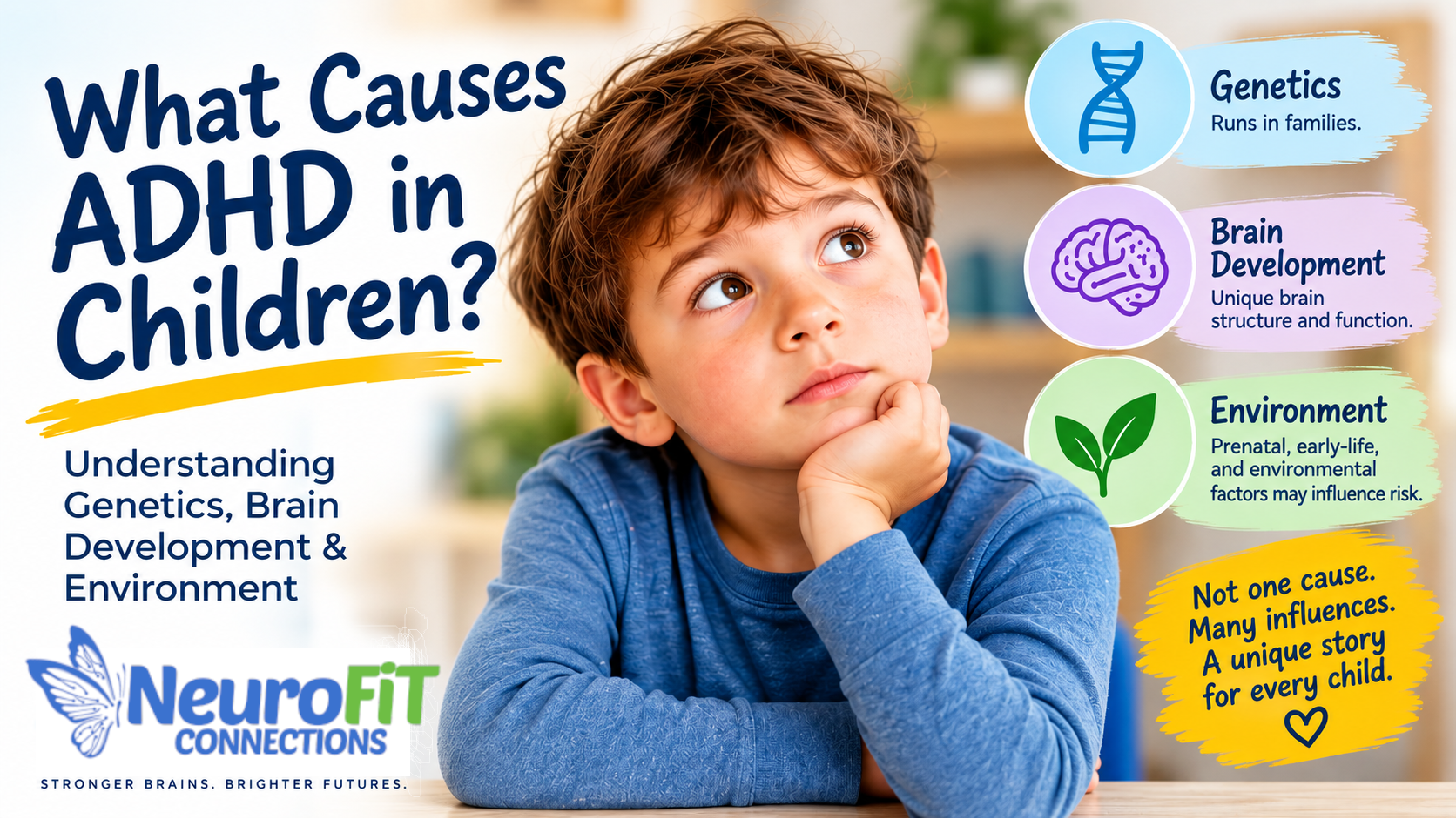
What Causes ADHD in Children? Understanding Genetics, Brain Development & Environment
Explore what research tells us about genetics, brain development, environment, and why ADHD doesn’t have one simple cause.
Child ADHD Program
Learn how NeuroFiT Connections approaches each child individually through a comprehensive Brain & Body Assessment and personalized program.