

You tell your child:
“Put your shoes on, grab your backpack, get your water bottle, and meet me by the door.”
A few minutes later, they’re standing in the kitchen.
No shoes.
No backpack.
No water bottle.
And they can’t remember why they went into the kitchen in the first place.
Or maybe your child studies the spelling words at home and seems to know them—then struggles to remember them when completing an assignment.
They finish their homework but forget to put it in their backpack.
They walk upstairs to get something and return without it.
They hear the first part of a multi-step instruction but seem to lose everything that comes after it.
For parents, it can feel like:
“I literally just told you!”
But sometimes the problem isn’t whether your child heard you.
It may be whether their brain was able to hold onto the information long enough to use it.
That’s where working memory comes in.
What Is Working Memory?
Working memory is the brain’s ability to temporarily hold information in mind while we’re doing something with it.
The National Institute of Mental Health describes working memory as actively maintaining and updating information that is relevant to a goal or task. Working memory has limited capacity and must also resist interference from competing information.
A simple way to think about it is:
Working memory is your brain’s mental workspace.
Imagine a small whiteboard inside your brain.
You temporarily write down the information you need:
Shoes → Backpack → Water Bottle → Door
Then, as you complete each step, you update the board.
Working memory allows you to keep that information available without needing someone to repeat it.
But the whiteboard isn’t unlimited.
And distractions can erase what’s written on it surprisingly quickly.

Working Memory Isn’t the Same as Long-Term Memory
This distinction is important.
A child may be able to tell you every Pokémon character they’ve learned, remember exactly what happened on vacation two years ago, or recite facts about dinosaurs…
…and still forget what you asked them to do 30 seconds ago.
That isn’t necessarily contradictory.
Long-term memory helps us store information over extended periods.
Working memory helps us temporarily hold and manipulate information while completing a task.
NIMH distinguishes working memory from long-term memory and other cognitive processes such as attention.
Your child may have an excellent memory for information that has been stored while still finding it difficult to keep several pieces of information active during an everyday task.
Why Working Memory Matters in ADHD
Working-memory difficulties are not the same thing as ADHD, and not every child with ADHD will have the same working-memory profile.
However, working memory and other executive-function skills can be important areas to consider when evaluating children with ADHD. NIMH notes that an ADHD evaluation may include psychological testing of cognitive abilities such as working memory and executive functioning to identify individual strengths and challenges.
Working memory interacts with attention in an especially important way.
To remember:
“Put your homework in your backpack after you finish brushing your teeth,”
your child must first pay attention to the instruction.
Then they must keep that information active while they:
walk to the bathroom,
find the toothbrush,
brush their teeth,
notice the dog,
hear their sibling,
think about something happening at school tomorrow…
…and somehow keep HOMEWORK → BACKPACK available through all of it.
That’s a lot for a small mental whiteboard.
What Working-Memory Challenges Can Look Like
Working-memory difficulties don’t usually announce themselves by saying:
“Hello! I’m working memory!”
Instead, parents see the consequences.
👂 “They Never Listen”
You give three instructions.
Your child completes the first one and forgets the other two.
It can look like they weren’t listening.
But they may have heard—and even understood—everything you said.
The information simply didn’t remain available long enough for them to act on all of it.
📚 “They Know This!”
Your child correctly answers a math problem one moment and seems completely lost during the next.
Some academic tasks require children to hold information in mind while simultaneously manipulating it.
Mental arithmetic is a simple example.
To calculate 27 + 18 mentally, a child has to keep numbers and intermediate results available while performing the calculation.
The challenge may therefore involve more than understanding the mathematical concept.
🎒 “They Forget Everything”
Homework.
Lunchbox.
Water bottle.
Permission slip.
Soccer cleats.
Library book.
Working memory can contribute to everyday forgetfulness, particularly when information must remain active while a child is doing something else.
📝 “They Lose Their Place”
A child begins writing a sentence but forgets what they intended to say.
They read a paragraph and reach the end without remembering how it began.
They begin a multi-step math problem and lose track of which step comes next.
All of these activities place demands on working memory.
🏡 “I Have to Repeat Myself All Day”
Morning routines can become an endless cycle of:
“What are you supposed to be doing?”
“Where are your shoes?”
“Did you brush your teeth?”
“What did I just ask you?”
Repeated reminders can be exhausting for parents—and frustrating for children who may genuinely be trying to remember.
Attention and Working Memory Work Together
Working memory and attention aren’t identical, but everyday tasks often require both.
Imagine trying to carry a tray across a crowded room.
The tray represents the information you’re holding in working memory.
Every distraction is someone bumping into you.
A television.
A sibling talking.
A dog barking.
A notification.
A toy on the floor.
A new thought.
A frustration.
The child not only has to hold the tray but protect what’s on it while navigating everything else.
NIMH’s definition specifically notes that working memory has limited capacity and must resist interference.
That helps explain why a child might successfully follow an instruction in a quiet room but lose it almost immediately in a busy classroom.
The task hasn’t necessarily changed. The amount of competition for their mental workspace has.
he Hidden Working-Memory Demands of School
Working memory is involved throughout the school day.
Consider something as ordinary as:
“Take out your science book, turn to page 42, read the first section, and answer questions one through five in complete sentences.”
Before the child has answered a single science question, their brain has already been asked to:
- Listen to the teacher.
- Hold multiple instructions in mind.
- Ignore surrounding distractions.
- Locate the correct book.
- Remember the page number.
- Navigate to the correct section.
- Remember what they’re supposed to read.
- Remember what happens after reading.
- Begin the assignment.
And now the actual academic work starts.
A bright child can understand the science perfectly well and still struggle with the working-memory demands surrounding the assignment.
That’s one reason academic performance doesn’t always reflect what a child actually knows.
Why “Try Harder to Remember” Doesn’t Always Work
We often treat remembering as though it’s purely a matter of effort.
“Pay attention.”
“Remember what I told you.”
“You need to be more responsible.”
But telling someone to remember something doesn’t increase the capacity of their working memory.
And giving a child more verbal information because they forgot the first information can sometimes make the problem worse.
Imagine that mental whiteboard again.
If it’s already full, writing six additional instructions on it isn’t going to create more space.
Sometimes the solution isn’t asking the child to hold more information internally.
It’s moving some of that information outside the brain.
External Supports Aren’t Cheating
This is an important mindset shift.
A checklist isn’t doing the task for your child.
A visual schedule isn’t doing the task for your child.
Writing down an assignment isn’t doing the task for your child.
These tools reduce the amount of information that must remain active in working memory so the child can devote more mental resources to actually completing the task.
NIMH recommends practical strategies for ADHD that include maintaining consistent routines, writing down assignments and reminders, breaking larger tasks into manageable steps, and providing practical assistance when needed.
Think of external supports as scaffolding.
We provide enough structure for the child to succeed while continuing to develop greater independence.

Helping a Child Who Struggles With Working Memory
There are several ways parents can make everyday demands more manageable.
Give Fewer Instructions at Once
Instead of:
“Go upstairs, change your clothes, put your uniform in the hamper, bring down your water bottle, and start your homework.”
Try:
“Go upstairs and change your clothes. Come back when you’re ready.”
Then give the next step.
Use Visual Reminders
A morning checklist can replace repeated verbal prompting:
☐ Get dressed
☐ Brush teeth
☐ Eat breakfast
☐ Pack backpack
☐ Get shoes
☐ Grab water bottle
The information stays visible even if the child’s attention shifts.
Ask the Child to Repeat the Instruction
After giving an instruction, ask:
“What’s the plan?”
This can help you determine whether the information was understood and retained before the child walks away.
Make the Environment Do Some of the Remembering
Backpack by the door.
Homework folder in the backpack.
Sports equipment in one designated location.
A visual schedule in the kitchen.
The more consistently information is built into the environment, the less the child has to recreate it from memory every day.
Break Complex Tasks Into Steps
Large assignments place heavy demands on working memory and executive function.
Breaking them into smaller pieces gives the child a clear target:
First: read the directions.
Next: complete questions 1–3.
Then: check your answers.
Reduce Unnecessary Distractions
When the task already places significant demands on working memory, competing information can make maintaining the important information even harder.
Sometimes simplifying the environment makes the task itself more manageable.
Support Is Not the Opposite of Independence
Parents sometimes worry:
“If I keep giving reminders or checklists, won’t my child become dependent on them?”
The goal isn’t to remind a child forever.
The goal is to provide the right amount of support at the right stage of development.
We do this constantly in other areas.
We hold the bicycle while a child learns to balance.
We read together before expecting independent reading.
We demonstrate how to tie a shoe before expecting a child to do it alone.
Support creates opportunities for successful practice.
As skills and routines become stronger, support can gradually change.
Independence is often something we build toward—not something we demand before the necessary skills are ready.
Looking Beyond “Forgetful”
When we label a child as forgetful, careless, irresponsible, or unmotivated, we describe what happened.
We don’t necessarily explain why it happened.
A more useful question is:
What did this task require my child to hold in mind?
Then ask:
How many steps were there?
How long did the information need to remain active?
What distractions occurred?
Was the child simultaneously doing something else?
Did they have an external reminder?
Did they know which information was most important?
Those questions help us understand the demands being placed on the child rather than assuming the behavior tells us everything about their effort.
Understanding Your Child’s Individual Brain Skills
Working memory doesn’t operate alone.
Everyday activities require multiple systems to work together, including attention, processing, planning, organization, inhibition, cognitive flexibility, sensory processing, movement, and self-regulation.
And two children with ADHD may have very different patterns of strengths and challenges.
At NeuroFiT Connections, that’s why we begin with a comprehensive Brain & Body Assessment rather than assuming an ADHD diagnosis tells us everything we need to know.
Depending on a child’s age and abilities, we evaluate multiple areas of brain and body function to develop a broader picture of how that individual child processes information, coordinates movement, supports learning, and interacts with the world around them.
Those findings help guide the development of a personalized program focused on the foundational skills that may benefit from additional support.
We don’t build a program around ADHD. We build it around your child.
Your Child May Not Be Forgetting on Purpose
When you’ve reminded your child about the backpack five times and it’s still sitting on the kitchen floor, frustration is understandable.
But understanding working memory gives us another possibility to consider.
Maybe the question isn’t:
“Why doesn’t my child care enough to remember?”
Maybe it’s:
“How can we make this information easier to hold onto and act upon?”
That small change in perspective can lead to very different solutions.
Your child can be intelligent.
Capable.
Motivated.
Trying.
And still need additional support managing the enormous amount of information everyday life asks their developing brain to hold, organize, update, and use.
Understanding the skill behind the struggle gives us a better place to begin.
Frequently Asked Questions
What is working memory?
Working memory is the ability to temporarily maintain and update information that is relevant to what we’re doing. It has limited capacity and must resist interference from competing information.
Children use working memory when following directions, solving problems mentally, reading, writing, completing routines, having conversations, and remembering what comes next while already doing something else.
Is working memory the same as short-term memory?
They’re related concepts, but they aren’t identical.
Short-term memory generally refers to temporarily storing information. Working memory involves actively maintaining and updating information so it can be used while accomplishing a task. NIMH treats working memory as distinct from short-term and long-term memory.
Is poor working memory a sign of ADHD?
Working-memory difficulties can occur in children with ADHD, but difficulty with working memory alone does not mean a child has ADHD.
ADHD diagnosis requires a comprehensive evaluation of persistent symptoms and their effects across settings. Other conditions and circumstances can produce difficulties that resemble ADHD, which is one reason appropriate professional evaluation matters.
4. Why can my child remember things they love but forget my instructions?
Remembering information stored in long-term memory and temporarily holding instructions in working memory place different demands on the brain.
A child may have an extraordinary memory for favorite subjects while having difficulty keeping several new instructions active long enough to complete them.
Interest and attention can also influence what information is successfully processed and maintained.
Should I make my child repeat instructions back to me?
Having a child briefly repeat or summarize an instruction can be useful because it lets you check whether they understood and retained what you said.
Keep the interaction simple rather than turning it into a test:
“Tell me the two things you’re going to do.”
If the child can’t repeat them, simplify the instruction or provide a visual reminder.
Do checklists make children dependent on reminders?
Not necessarily.
External supports can reduce the amount of information a child must hold internally while completing a task. The goal is to provide enough structure for successful practice and gradually adjust that support as skills and routines develop.
NIMH recommends strategies including consistent routines, written reminders, breaking larger tasks into smaller steps, and practical assistance for people with ADHD.
Related Articles
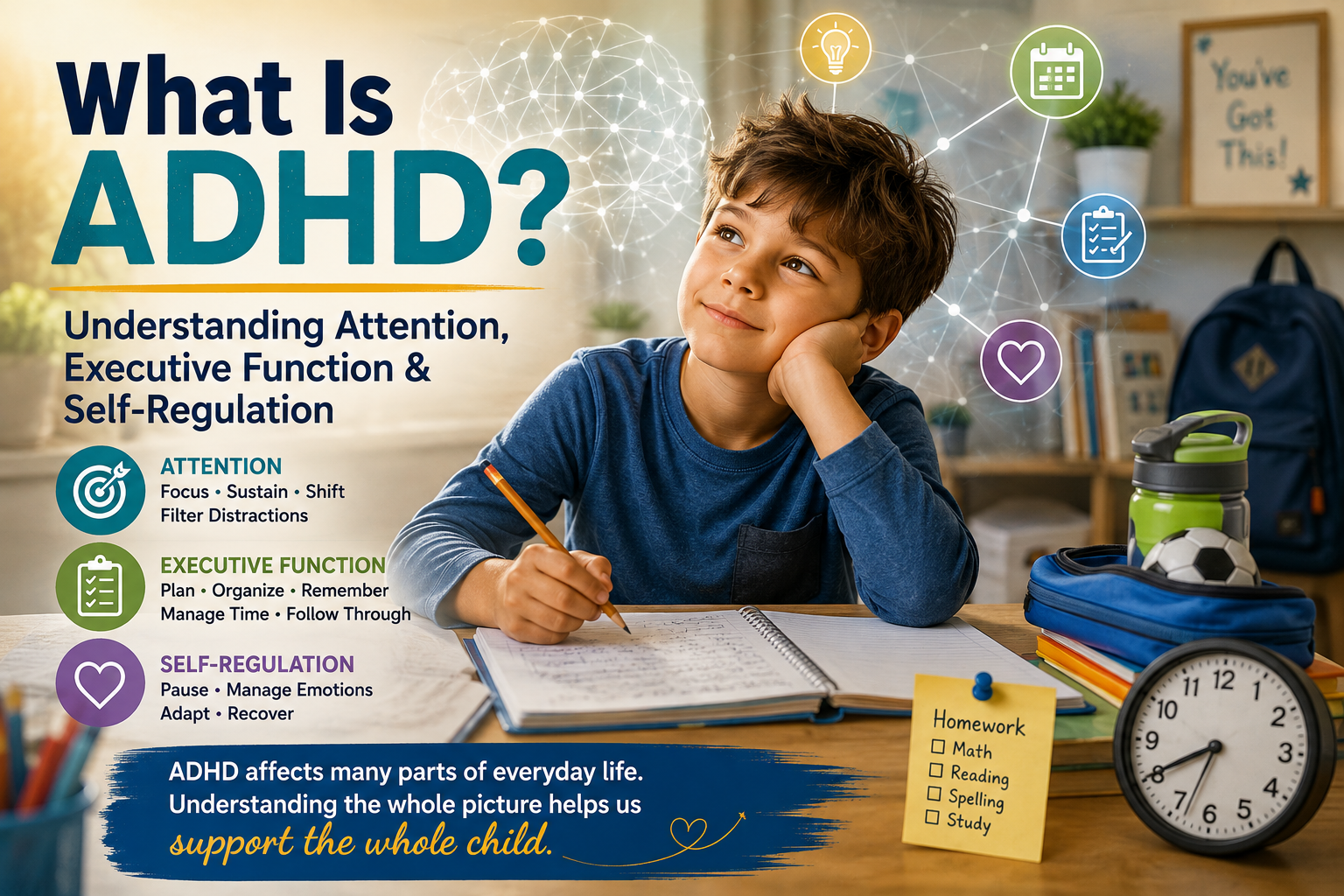
- What Is ADHD? Understanding Attention, Executive Function & Self-Regulation
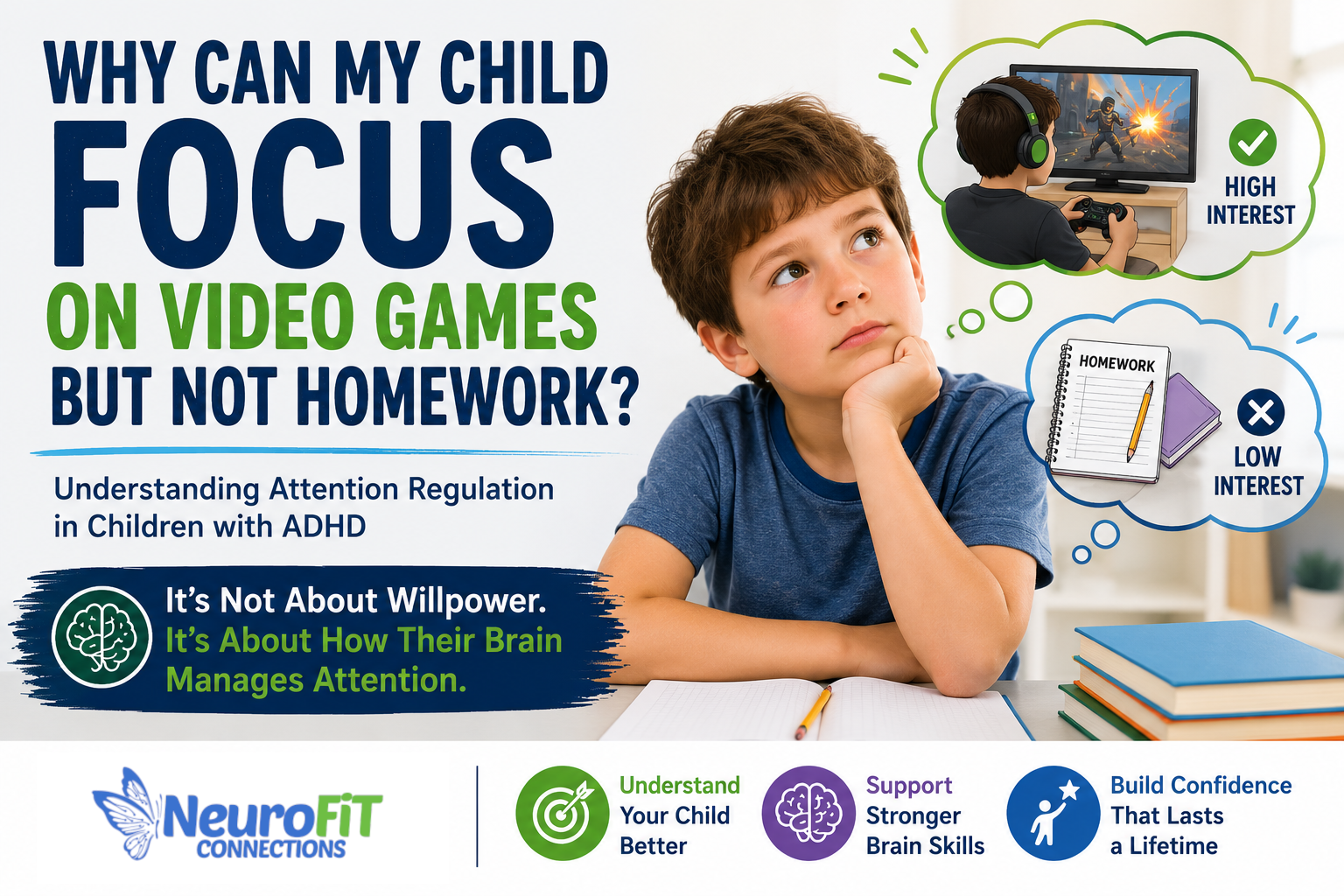
- Why can my child focus on video games, but not homework?
- Why Are Transitions So Difficult for Children with ADHD?
- ADHD and Emotional Regulation: Why Are the Reactions So Big?
- ADHD and Executive Function: Why Everyday Tasks Can Feel So Difficult
- Can Children with ADHD Improve Their Attention and Self-Regulation?