

When most people think about dyscalculia, they think about math class.
Addition.
Subtraction.
Multiplication.
Fractions.
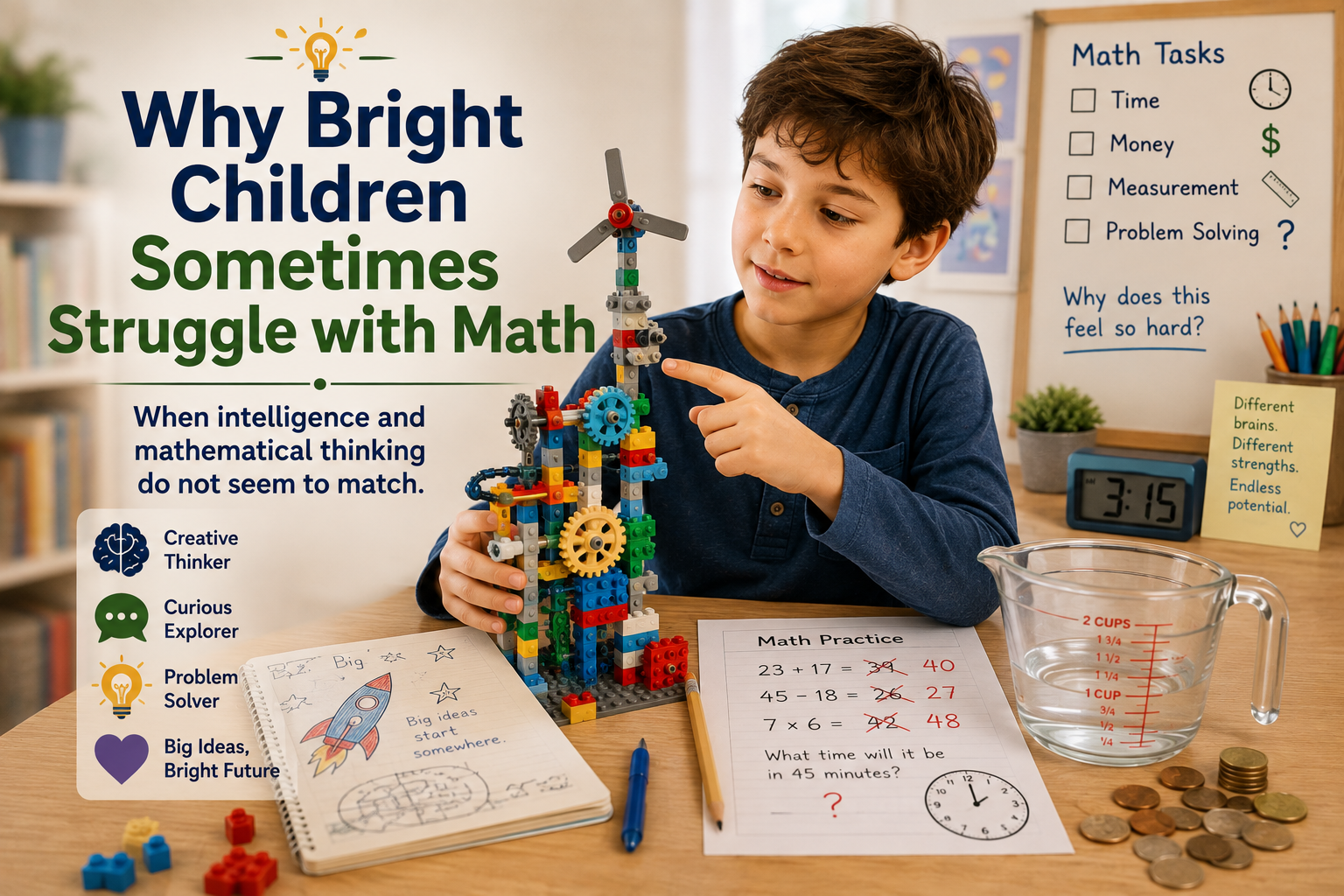
But many parents notice something else long before a math worksheet becomes difficult.
Their child struggles to:
- Be ready on time.
- Understand how long something will take.
- Count money.
- Follow recipes.
- Estimate distances.
- Plan ahead.
- Organize daily routines.
At first, these challenges may seem unrelated.
In reality, they often rely on many of the same brain skills that support mathematical thinking.
That’s why dyscalculia can affect far more than school.
Time Is More Than Reading a Clock
Many parents say:
“My child can read the numbers on a digital clock, but still has no idea whether they have enough time to get ready.”
That’s because understanding time involves much more than recognizing numbers.
Children also need to understand:
- Duration
- Elapsed time
- Sequencing
- Estimation
- Planning backwards
- Cause and effect
For example:
If school starts at 8:00…
Breakfast takes 20 minutes…
Getting dressed takes 15 minutes…
Driving takes 10 minutes…
When should they wake up?
That’s a mathematical reasoning problem—not simply a clock-reading problem.
Money Is More Than Counting Coins
Money requires several brain skills at once.
Children must understand:
- Quantity
- Value
- Comparison
- Estimation
- Addition
- Subtraction
- Decision making
Imagine buying a snack.
A child must determine:
- How much does it cost?
- How much money do I have?
- Will I have enough?
- How much change should I receive?
Even a simple purchase combines multiple mathematical concepts.
Planning Depends on Mathematical Thinking
Planning is filled with hidden mathematics.
Children constantly estimate:
- How long homework will take.
- When to start getting ready.
- How much time remains.
- Which activity comes first.
- Whether they have enough time for another activity.
Planning also requires:
- Working memory
- Executive function
- Sequencing
- Attention
These systems all work together.

Everyday Tasks We Rarely Think About
Children use mathematical thinking when they:
🕒 Tell time
💰 Buy lunch
🛒 Compare prices
🍳 Follow recipes
📅 Organize homework
🎲 Keep score
📏 Measure ingredients
🧭 Follow directions
None of these feel like “doing math.”
Yet every one depends on understanding numerical relationships.

Why Every Child Looks Different
One child may struggle mostly with:
Time.
Another:
Money.
Another:
Planning.
Another:
Measurement.
Another:
Estimating.
Why?
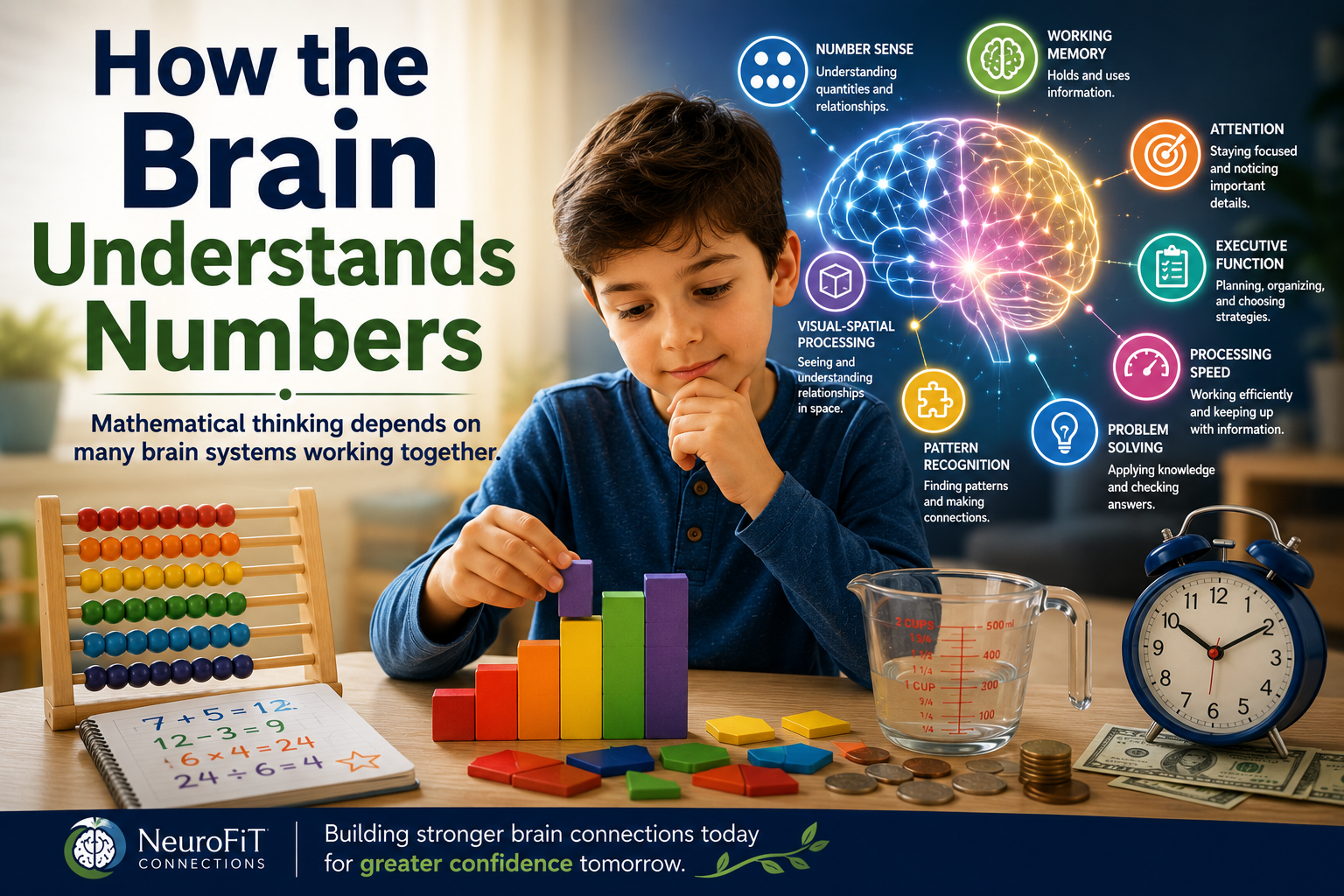
Because mathematical thinking depends on many different brain systems working together.
One child may have stronger number sense.
Another stronger working memory.
Another stronger attention.
Every profile is unique.
Looking Beyond the Symptom
If your child struggles with everyday numerical tasks, the important question isn’t:
“Why can’t they tell time?”
It’s:
“What brain skills make telling time difficult?”
That shift changes everything.
Instead of treating isolated symptoms, we begin understanding the underlying brain functions that support them.
How NeuroFiT Connections Can Help
At NeuroFiT Connections, every child begins with a comprehensive Brain & Body Assessment.
Rather than assuming every child needs the same support, we evaluate the foundational brain skills involved in learning and mathematical thinking.
Using those results, we create a personalized brain training program designed specifically for your child’s unique profile of strengths and challenges.
Because understanding why everyday tasks are difficult is often the first step toward helping children become more confident and independent.
Final Thoughts
Time.
Money.
Planning.
Measurement.
Shopping.
Cooking.
Navigation.
These aren’t simply “adult skills.”
They’re everyday opportunities for children to build confidence and independence.
When mathematical thinking becomes easier, many of these daily activities can begin feeling less overwhelming.
That’s why dyscalculia is about much more than math.
It’s about helping children confidently understand and navigate the world around them.
FAQ
Can dyscalculia affect telling time?
Yes.
Understanding time involves duration, sequencing, estimation, and planning—not simply reading numbers on a clock.
Why is money difficult for children with dyscalculia?
Money combines number sense, quantity, comparison, estimation, addition, subtraction, and decision making.
Does dyscalculia affect planning?
Often, yes.
Planning relies on mathematical reasoning, executive functioning, working memory, and understanding elapsed time.
Is this related to executive functioning?
Sometimes.
Executive function and mathematical thinking frequently work together during planning and organization.