

One of the most confusing experiences for parents is watching a bright, capable child struggle with mathematics.
Your child may ask thoughtful questions, understand complex stories, build imaginative creations, remember fascinating facts, or explain scientific ideas with surprising detail.
Then math homework begins.
Suddenly, the same child may become frustrated, forget a process they understood yesterday, lose track of steps, or struggle with a problem that appears simple to everyone else.
Parents often say:
“I know my child is smart. Why is math so difficult?”
The answer is important:
Intelligence and mathematical ability are not the same thing.
Mathematical thinking depends on a particular combination of brain skills working together. A child can be highly intelligent while still experiencing significant difficulty with number sense, working memory, visual-spatial processing, sequencing, attention, or mathematical reasoning.
Your Child’s Intelligence Is Not the Problem
Children who struggle with math are often bright in many noticeable ways.
They may:
- Use advanced vocabulary.
- Ask insightful questions.
- Understand stories and conversations easily.
- Create elaborate drawings or structures.
- Solve practical problems creatively.
- Remember details about subjects they love.
- Demonstrate strong verbal or artistic abilities.
These strengths are real.
A difficulty with numbers does not erase them.
Unfortunately, because school performance is frequently measured through assignments, tests, and timed calculations, children may begin believing their struggles with math define how intelligent they are.
They do not.
Mathematical Thinking Requires More Than Intelligence
Math is not a single ability.
To solve even a relatively simple problem, a child may need to:
- Understand what the numbers represent.
- Recognize the relationship between quantities.
- Remember the question.
- Decide which operation or strategy to use.
- Hold intermediate answers in working memory.
- Follow the steps in the correct order.
- Maintain attention.
- Check whether the final answer makes sense.
A child may understand the lesson while struggling with one or more parts of this process.
For example, a child may know how subtraction works but lose track of the intermediate numbers while completing a multi-step problem.
Another may memorize multiplication facts but have difficulty understanding the quantities those facts represent.
Another may reason well verbally but struggle to interpret a graph, number line, or geometric relationship.

Knowing the Answer and Producing the Answer Are Different
Parents sometimes notice that their child can explain a mathematical idea during a conversation but cannot complete the same type of problem independently on paper.
That disconnect can happen because understanding a concept and carrying out a procedure place different demands on the brain.
A child may understand that two groups of five make ten but still struggle to:
- Recall the related number fact quickly.
- Write the calculation correctly.
- Choose the correct operation in a word problem.
- Remember each step in a longer procedure.
- Recognize when the same concept appears in a different format.
The knowledge may be present.
The difficulty may lie in accessing, organizing, or applying it efficiently.
Why Repetition Does Not Always Solve the Problem
When a child struggles with math, the natural response is often more practice.
Sometimes additional instruction and repetition are helpful.
However, repeatedly practicing a skill does not always address the underlying reason the child is struggling.
A child with weak number sense may memorize that 7 + 5 = 12 without developing an intuitive understanding of why the answer is 12.
A child with working-memory challenges may understand a procedure during instruction but lose track of it while completing the problem alone.
A child with visual-spatial difficulties may know a concept verbally but struggle when it is presented through graphs, place value, geometry, or spatial arrangements.
This is why more worksheets do not always lead to greater understanding.
Math Difficulties Can Affect Confidence
Children are highly aware when something seems easier for their classmates.
They may notice that others complete problems quickly, remember facts automatically, or understand instructions after hearing them once.
After repeated frustration, children may begin saying:
- “I’m bad at math.”
- “I can’t do this.”
- “I’m stupid.”
- “I don’t want to try.”
- “It doesn’t matter because I’ll get it wrong.”
These statements often reflect discouragement rather than ability.
Avoidance can become a form of protection. If children do not try, they do not have to experience another visible struggle.
Over time, this can affect classroom participation, homework, willingness to ask questions, and confidence in areas that extend well beyond mathematics.
Dyscalculia Is Not a Measure of Potential
Dyscalculia affects how a person understands and works with numbers and mathematical relationships.
It does not determine creativity, curiosity, problem-solving ability, compassion, verbal intelligence, imagination, or future potential.
A child may struggle to estimate how long an activity will take while demonstrating remarkable insight into people.
They may find multiplication facts difficult while creating highly sophisticated artwork.
They may struggle with money calculations while showing advanced mechanical or scientific curiosity.
Children are more than the areas in which they struggle.

Looking Beyond the Math Worksheet
At NeuroFiT Connections, we believe it is important to look beyond the visible symptom.
A low math grade tells us that a child is struggling.
It does not necessarily tell us why.
That is why every NeuroFiT program begins with a comprehensive Brain & Body Assessment designed to help us better understand the foundational brain functions that support learning and mathematical thinking.
We look at areas that may include:
- Number sense
- Working memory
- Visual and visual-spatial processing
- Executive functioning
- Attention
- Processing speed
- Pattern recognition
- Coordination and other foundational systems
Using those results, we develop a personalized brain training program designed around the child’s individual profile of strengths and challenges.

Helping Children Recognize Their Strengths
Supporting a child who struggles with math involves more than improving performance.
It also means protecting and rebuilding the child’s belief in themselves.
Children benefit from hearing:
- “Your difficulty with math does not define your intelligence.”
- “It is okay to need a different explanation.”
- “Taking longer does not mean you are less capable.”
- “We can work to understand what makes this difficult.”
- “Your strengths matter just as much as your challenges.”
When children begin separating their identity from their struggles, they often become more willing to ask questions, attempt unfamiliar problems, and persist when something feels difficult.
How Stronger Foundations Can Support Learning
Imagine how different math might feel if a child did not have to use so much mental energy simply keeping track of the steps.
They could focus more fully on understanding relationships, recognizing patterns, solving problems, and applying concepts to everyday situations.
Our goal is not simply faster calculations or better test scores.
It is to strengthen the foundational brain skills that support learning, problem-solving, confidence, and greater independence.
Because bright children deserve the opportunity to demonstrate everything they are capable of—not just the abilities that are easiest to measure.
Final Thoughts
A child can be intelligent and still struggle significantly with math.
Those two realities can exist at the same time.
Mathematical thinking depends on many specialized brain skills, and every child develops a unique combination of strengths and challenges.
When a child’s performance does not seem to match their intelligence, it is worth looking beyond effort, motivation, and grades.
The better question may be:
“What is making mathematical thinking so difficult for this child?”
Understanding that question can open the door to more personalized support, less frustration, and renewed confidence.
Because every child deserves the confidence to understand, navigate, and succeed in the world around them.
Frequently Asked Questions
1. Can a highly intelligent child have dyscalculia?
Yes. Dyscalculia is not caused by low intelligence. A child may be highly capable in language, creativity, science, problem-solving, or other areas while experiencing persistent difficulty with numbers and mathematical relationships.
2. Why can my child understand math during instruction but forget it later?
This may involve working memory, retrieval, attention, sequencing, or difficulty connecting a memorized procedure to a deeper understanding of the concept. Every child’s pattern is different.
3. Does struggling with math mean my child is not trying?
No. Many children who struggle with mathematical thinking are working extremely hard. The task may simply require much more mental effort than it does for their classmates.
4. Will more practice always help?
Practice can be valuable, but repetition alone may not resolve difficulties involving number sense, working memory, visual-spatial processing, executive function, or other foundational skills.
5. How does NeuroFiT Connections approach math difficulties?
We begin with a comprehensive Brain & Body Assessment to better understand the child’s individual brain-function profile. We then develop a personalized brain training program based on those findings rather than relying on a one-size-fits-all approach.
Related Articles
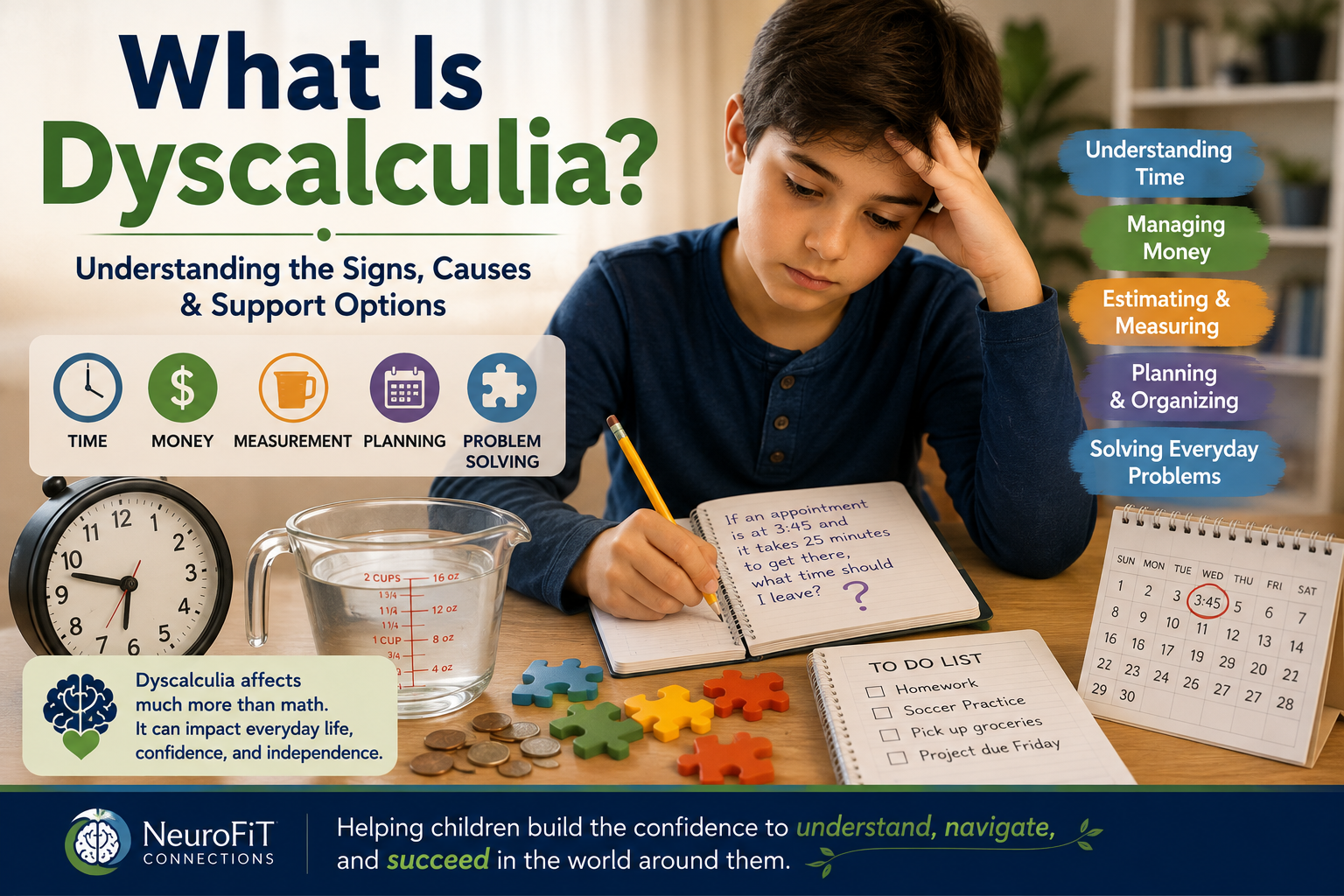
- What Is Dyscalculia? Understanding the Signs, Causes & Support Options
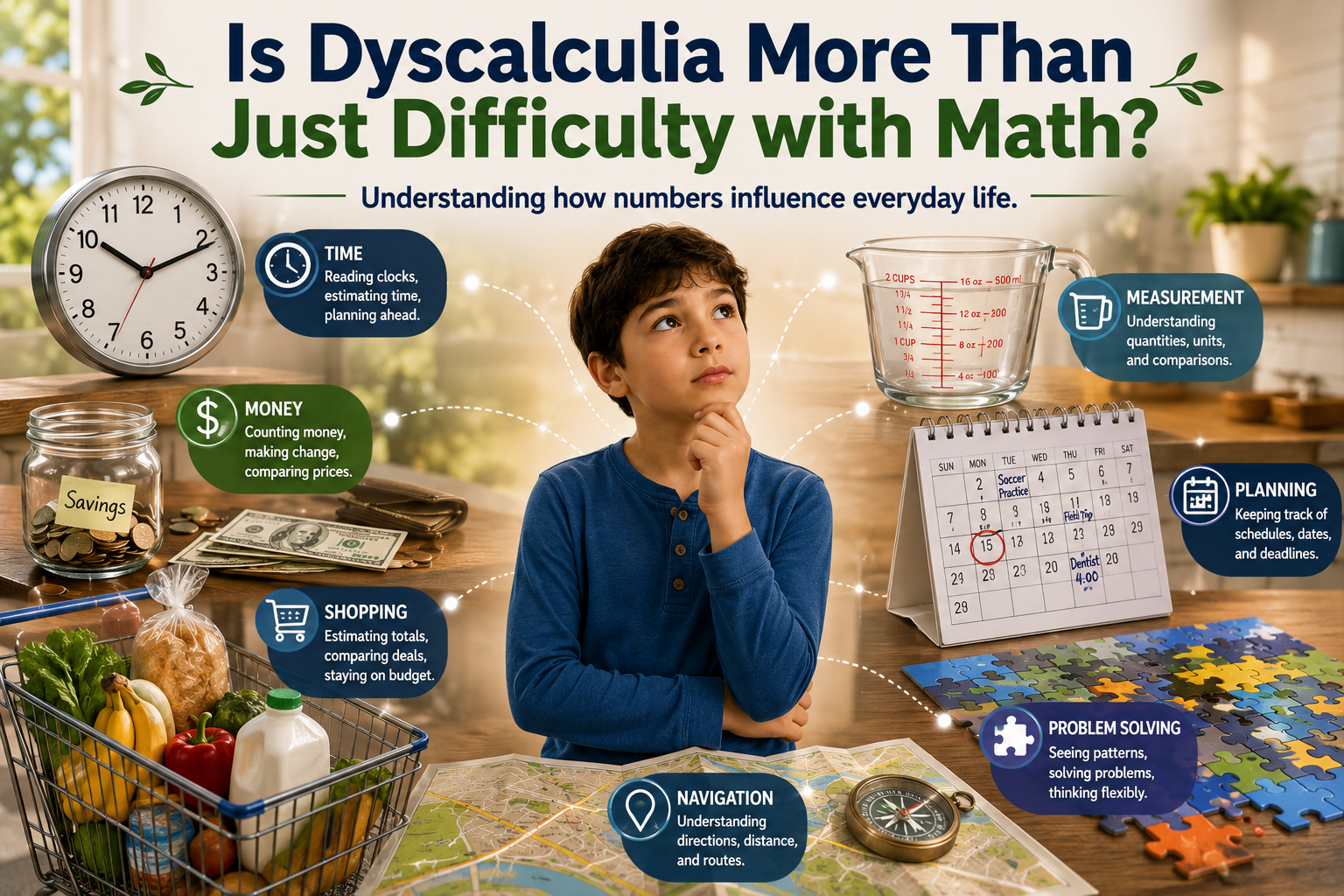
- Is Dyscalculia More Than Just Difficulty with Math?
- How the Brain Understands Numbers
- Why Telling Time, Counting Money & Planning Can Be So Difficult
- Helping Children Build Confidence with Numbers
- Does Using a Calculator Hurt or Help Children with Dyscalculia?