

“I know nothing is wrong. So why does my body still feel like something is?”
For many adults who experience anxiety, that disconnect can be one of the most frustrating parts.
Logically, you may know you’re safe. You may understand that the presentation isn’t dangerous, the crowded restaurant isn’t a threat, the change in plans isn’t a catastrophe, or the conversation you’re replaying probably didn’t mean what your brain keeps telling you it meant.
And yet your body may be responding very differently.
Your muscles tighten. Your heart beats faster. Your thoughts accelerate. You become unusually aware of sounds, movement, people, or sensations around you. You may feel restless, uncomfortable, or compelled to leave—even while another part of your brain is saying, “There’s nothing wrong.”
So which response is correct?
In a sense, both are real. And understanding why begins with recognizing that anxiety isn’t simply something you think.
It’s something your brain and body do together.
Anxiety Is Part of a System You Actually Need
We often talk about anxiety as though the goal should be to eliminate it. But the underlying ability to become more alert isn’t a defect.
It’s essential.
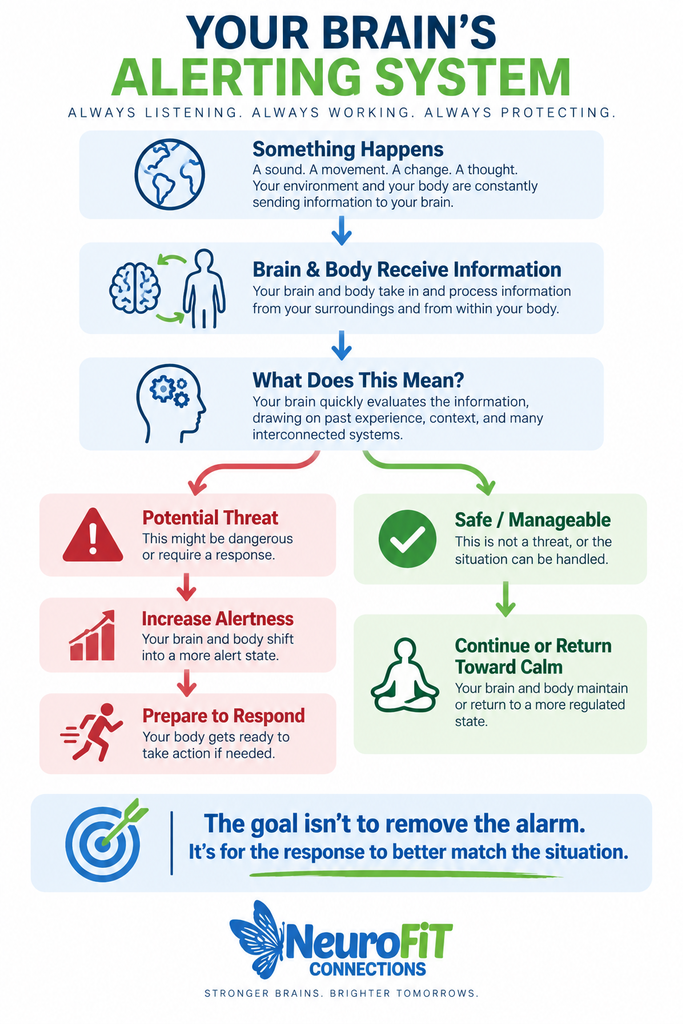
Your brain constantly receives information from both your environment and your body. It uses that information to determine what deserves your attention, what can safely be ignored, and whether something requires a response.
When circumstances suggest that something important or potentially threatening is happening, your brain can increase alertness and prepare your body to respond.
That may mean becoming more attentive before an important presentation. It may help you react quickly when a car suddenly pulls into your lane. It can make you more cautious when you’re walking alone through an unfamiliar area at night.
Those responses are useful.
NIMH describes anxiety as the body’s reaction to stress and notes that it can occur even when there is no current threat. Occasional anxiety is a normal part of life; it becomes a greater concern when it persists or begins interfering with everyday activities.
The problem isn’t having an alerting system. The problem is when the response doesn’t match the situation.
Your Thinking Brain Isn’t Working Alone

This helps explain something that can otherwise seem completely irrational:
You can know you’re safe and still not feel safe.
The brain’s response to potential threat isn’t controlled by one single “anxiety center,” nor does it depend entirely upon conscious thought.
Research points instead to interconnected processes involving attention, learning, memory, threat appraisal, sensory processing, decision-making, and physiological responses. Brain regions including the amygdala, hippocampus, insula, anterior cingulate cortex, and areas of the prefrontal cortex participate in different aspects of detecting, interpreting, contextualizing, and responding to potential threats.
That matters.
You can consciously look around a room and conclude:
I’m fine.
Meanwhile, other systems are processing enormous amounts of information outside your conscious awareness.
The sounds around you. Movement in your peripheral vision. Your balance and body position. Physical sensations inside your body. Memories and associations. Facial expressions. Changes in someone’s voice. What happened the last time you encountered something similar.
Your conscious interpretation is only one part of that much larger process.
Why Does the Brain Sometimes Respond When There Isn’t a Threat?
Imagine a smoke detector.
You absolutely want one in your house. If there’s a fire, you don’t want the detector carefully considering the situation for several minutes before deciding whether to sound the alarm.
You want it to react.
But what happens if it starts sounding every time you make toast?
The detector isn’t useless. And the solution isn’t necessarily to remove its batteries.
The response is simply occurring under circumstances that don’t require it.
The human brain is obviously vastly more complicated than a smoke detector, but the analogy helps explain an important point about anxiety.
Research has found that anxiety can involve biases in attention and threat appraisal. Anxious individuals may allocate greater attention to potentially threatening information, and neural circuits involved in threat processing can influence how strongly those cues are prioritized.
This can create an experience many adults recognize immediately:
“My reaction feels real even though I know it doesn’t make sense.”
The reaction is real.
The more useful question may be:
Why is your brain and body producing that response in this situation?
Anxiety Can Look Like More Than Worry
Because anxiety involves both brain and body, it doesn’t always look like someone visibly worrying.
It might look like perfectionism because mistakes feel disproportionately important.
It might look like procrastination because starting something creates an uncomfortable level of uncertainty.
It might look like indecision because your brain keeps generating another possibility that needs to be considered.
It can appear as irritability, difficulty sleeping, physical tension, restlessness, avoidance, trouble concentrating, or feeling exhausted at the end of an otherwise ordinary day. NIMH notes that anxiety can involve both mental and physical experiences, including excessive worry, uneasiness, tension, sleep problems, and bodily symptoms.
And sometimes it looks like nothing at all.
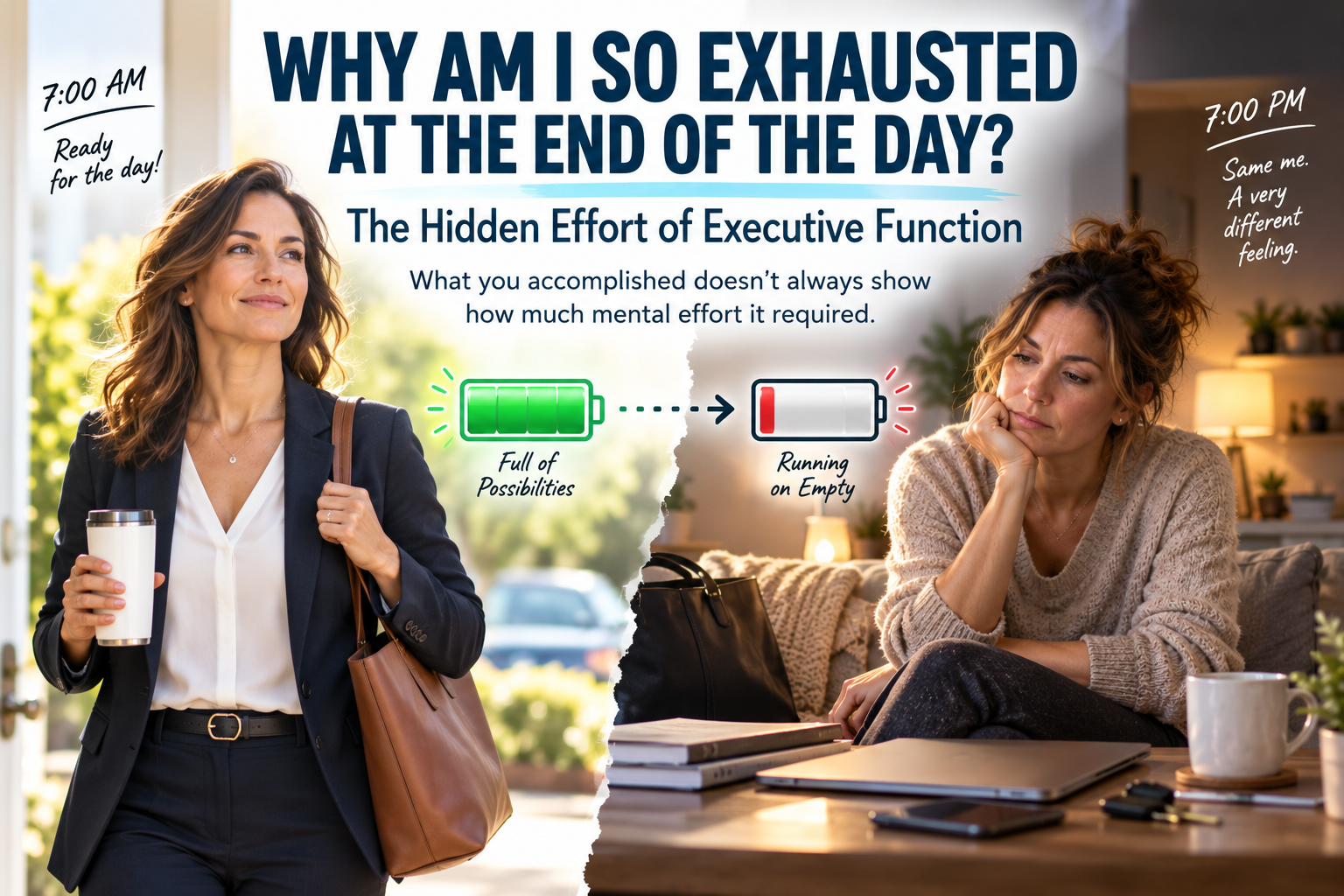
You may appear calm, successful, organized, and completely in control while internally expending enormous amounts of energy maintaining that appearance.
What people see on the outside doesn’t necessarily tell them how hard your brain and body are working on the inside.
What Do the Two Hemispheres Have to Do With It?
This is where the NeuroFiT Connections perspective becomes particularly important.
The two cerebral hemispheres don’t operate as two independent brains, and complex functions such as anxiety cannot simply be assigned entirely to the “left brain” or “right brain.” Both hemispheres participate in interconnected networks.
However, the hemispheres are also not functionally identical.
Research into emotional processing, attention, threat, arousal, and anxiety has identified lateralized patterns of brain function. More recent neuroimaging research continues to find lateralized differences within circuits associated with anxiety, although the precise patterns and their meaning remain an active area of investigation.
At NeuroFiT Connections, we take functional differences between the hemispheres seriously.
Our approach looks for patterns of functional imbalance rather than assuming that anxiety exists independently from the way the rest of the brain and body are functioning.
That’s an important distinction.
We’re not suggesting that there’s a simple “anxiety switch” on one side of your brain.
We’re asking a broader question:
Could differences in how your brain’s systems have developed and are functioning together be influencing how you interpret and respond to the world around you?
Where Do Primitive Reflexes Fit into the Picture?
Primitive reflexes are automatic movement patterns that emerge very early in development. They play important roles during infancy, and many are normally inhibited as the nervous system matures and voluntary motor control develops.
At NeuroFiT Connections, primitive reflexes are one of the areas we assess because we want to understand the broader pattern of brain and body development.
When reflex patterns we expect to have become integrated remain active, our approach considers whether they may be contributing to the individual’s overall functional pattern. When appropriate, primitive reflex integration activities become part of that person’s individualized Brain & Body Training program.
It’s important to distinguish the NeuroFiT framework from what the broader scientific literature has established.
Primitive reflexes can be observed in adults, including some neurologically healthy adults, and their meaning depends on the particular reflex, age, context, and method of assessment. Research has not established retained primitive reflexes as a universal cause of adult anxiety.
That doesn’t make them irrelevant to our assessment.
It means we don’t look at a single reflex—or any single finding—in isolation.
We look at the pattern.
This Is Why We Assess Before We Train
Two adults can both tell us:
“I have anxiety.”
That doesn’t mean we’ll find the same things when we assess them.
One person may demonstrate challenges involving timing and coordination. Another may show differences in visual or auditory processing. Someone else may have balance, proprioceptive, cognitive, motor, or primitive reflex findings that deserve attention.
And several of those patterns may occur together.
That’s why a NeuroFiT Brain & Body Assessment looks across multiple areas, including:
- Cognitive & executive skills
- Visual & oculomotor skills
- Auditory processing skills
- Fine motor skills
- Balance & postural control
- Coordination & motor planning
- Timing & rhythm
- Proprioception & body awareness
- Primitive reflexes
- Everyday challenges & individual goals
We aren’t trying to use those tests to prove that you’re anxious.
You already know what you’re experiencing.
We’re trying to develop a better picture of the brain and body of the individual experiencing it.
Can an Adult Brain Actually Change?
Yes—and this may be the most important part of the story.
The adult brain retains the ability to change in response to experience. This capacity for structural and functional adaptation is broadly described as neuroplasticity.
Research has demonstrated plasticity in adult brain regions involved in cognition, behavioral regulation, stress, fear, and anxiety. The brain continues adapting to experience well beyond childhood.
Neuroplasticity does not mean that every training method works, nor does the existence of neuroplasticity prove the effectiveness of a particular program.
What it establishes is something more fundamental:
Adulthood does not mean your brain has lost its capacity to learn and adapt.
That’s the biological principle that makes training possible.
The NeuroFiT Approach: Strengthen the Brain & Body Behind the Response

Once we understand an individual’s functional pattern, we can stop asking only:
How do we make this anxious feeling go away?
And begin asking:
What areas can we strengthen to help this brain and body function more efficiently?
At NeuroFiT Connections, Brain & Body Training is individualized according to assessment findings. Depending upon those findings, a program may incorporate cognitive, visual, auditory, sensory, balance, coordination, timing, motor, and primitive reflex activities.
Activities are progressively challenged as skills develop, providing repeated opportunities for the brain and body to practice.
The objective isn’t to take away the response that makes you alert when something genuinely requires your attention.
We want you to have that response.
We want your brain to become more alert when a car suddenly crosses into your lane.
We want you to become focused when something important requires your attention.
We want your brain and body prepared to respond when circumstances actually demand it.
What we don’t want is for an ordinary meeting, crowded restaurant, unexpected change in plans, or quiet evening at home to consistently produce a response better suited to an actual threat.
The goal isn’t a brain that never becomes anxious. It’s a brain and body better able to respond appropriately to the situation in front of you.
Knowing You’re Safe and Responding as Though You’re Safe
If you’ve ever told yourself:
“This is ridiculous. I know I’m fine.”
Your experience isn’t ridiculous.
Your conscious understanding and your brain and body’s response don’t always arrive at the same conclusion at the same time.
And simply understanding that distinction can change the question.
Instead of:
“Why can’t I just calm down?”
You can begin asking:
“Why is my brain and body responding this way—and what might we learn by looking more closely?”
That’s the question we start with at NeuroFiT Connections.
We don’t build programs around anxiety.
We build them around the brain and body of the person experiencing it.
Frequently Asked Questions About Anxiety and the Brain
Why do I feel anxious when I know nothing is wrong?
Your conscious understanding that you’re safe is only one part of how your brain determines how to respond. Threat processing involves interacting systems associated with attention, memory, learning, sensory information, physiological responses, and conscious appraisal. This helps explain why knowing you’re safe doesn’t always immediately make you feel safe.
Is anxiety all in my head?
Anxiety originates through brain processes, but it is very much a brain-and-body experience. It can affect muscle tension, sleep, attention, physical sensations, and other aspects of physiological function.
Is anxiety always bad?
No. Occasional anxiety is a normal part of life, and increased alertness can be useful when circumstances require additional attention or preparation. Anxiety becomes problematic when it persists, becomes disproportionate, or interferes with everyday functioning.
Can the adult brain change?
Yes. Adult brains retain substantial capacity for functional and structural plasticity in response to experience. Neuroplasticity is not limited to childhood.
Does NeuroFiT Connections diagnose or treat anxiety disorders?
NeuroFiT Connections does not diagnose anxiety disorders. Our Brain & Body Assessment examines an individual’s pattern of cognitive, sensory, visual, auditory, motor, balance, coordination, primitive reflex, and other foundational functions. Adults who need diagnosis or mental-health treatment should work with an appropriately qualified healthcare or mental-health professional.