What Is Functional Disconnection Syndrome?

Understanding One of the Foundational Concepts Behind the Melillo Method™

Many parents wonder why their child continues to struggle despite being intelligent, motivated, and receiving therapy, tutoring, or medication.

A child may have difficulty with:

  • Attention and focus
  • Reading and learning
  • Emotional regulation
  • Social communication
  • Motor coordination
  • Sensory processing
  • Executive functioning

Yet medical imaging often appears normal, and there may be no obvious structural problem with the brain.

The Melillo Method™ offers a different perspective.

One of its foundational concepts is Functional Disconnection Syndrome (FDS)—a theory developed by Dr. Robert Melillo to help explain why some individuals experience developmental, learning, behavioral, and neurological challenges despite having a structurally healthy brain.

Rather than asking only “What diagnosis does this child have?”, the Melillo Method asks:

“How well are different parts of the brain communicating with one another?”

How the hemispheres work together.
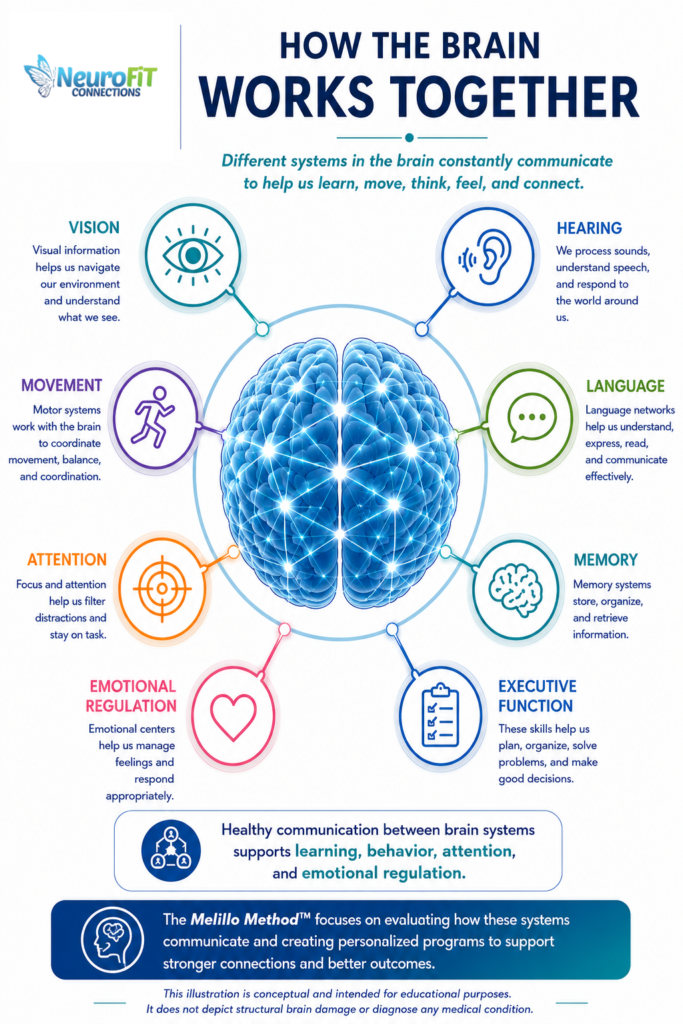
How the Brain Communicates

What Does "Functional Disconnection" Mean?

The word functional is important.

It means the brain itself is present and structurally intact.

The challenge is believed to involve how efficiently different regions of the brain communicate and work together, rather than damage to the brain itself.

Imagine an orchestra.

Every musician may be highly skilled.

But if they cannot hear one another or stay synchronized, the performance suffers.

The same idea applies to the brain.

Different regions may function well individually, but when communication between those regions becomes inefficient, learning, movement, attention, behavior, and emotional regulation may all be affected.

The Brain Is Built on Communication

The human brain contains billions of neurons connected through an enormous network of pathways.

These pathways allow information to move rapidly between different areas responsible for:

  • Movement
  • Vision
  • Hearing
  • Language
  • Memory
  • Emotion
  • Attention
  • Decision making
  • Social interaction

Healthy development depends not only on each region functioning well, but also on those regions communicating efficiently.

The Melillo Method refers to this communication as functional connectivity.

What Causes Functional Disconnection?

According to the Melillo Method, several developmental factors may contribute to differences in functional connectivity.

These may include:

  • Uneven hemispheric development
  • Retained primitive reflexes
  • Delays in motor development
  • Sensory processing differences
  • Vestibular dysfunction
  • Developmental timing differences

Every individual is unique, and Functional Disconnection Syndrome is not considered a single diagnosis.

Instead, it is a framework for understanding how different neurological systems interact.

How Can Functional Disconnection Affect Daily Life?

When communication between brain regions becomes less efficient, a wide variety of challenges may emerge.

These challenges often vary depending on which neurological systems are involved.

Examples may include:

Learning

  • Reading difficulties
  • Writing challenges
  • Processing speed
  • Organization
  • Working memory

Attention

  • Distractibility
  • Poor concentration
  • Executive functioning challenges
  • Impulse control

Emotional Regulation

  • Anxiety
  • Emotional reactivity
  • Difficulty adapting to change
  • Frustration tolerance

Motor Skills

  • Poor coordination
  • Clumsiness
  • Balance problems
  • Fine motor difficulties

Social Communication

  • Difficulty reading facial expressions
  • Trouble interpreting body language
  • Challenges understanding tone of voice
  • Limited social interaction

Sensory Processing

  • Sound sensitivity
  • Touch sensitivity
  • Motion sensitivity
  • Sensory seeking behaviors

Every individual presents differently because every brain develops differently.

How a functional disconnect can affect everyday life

Is Functional Disconnection Syndrome a Medical Diagnosis?

No.

Functional Disconnection Syndrome is not a formal medical diagnosis recognized within the DSM-5 or ICD.

Instead, it is a theoretical model developed by Dr. Robert Melillo that seeks to explain patterns of neurological development and functional brain organization.

The Melillo Method uses this framework to guide assessment and individualized intervention planning.

Functional Disconnection vs. Brain Damage

One of the most important distinctions is that Functional Disconnection Syndrome does not imply brain damage.

Brain damage refers to structural injury or disease affecting brain tissue.

Functional Disconnection Syndrome describes differences in how healthy brain regions communicate and coordinate with one another.

Because the brain remains capable of change throughout life, these communication patterns may also be capable of improving through neuroplasticity.

Functional Connectivity and Neuroplasticity

The brain is not fixed.

One of the most exciting discoveries in neuroscience is neuroplasticity—the brain’s ability to adapt, reorganize, and strengthen neural connections throughout life.

The Melillo Method is built upon this principle.

Rather than focusing only on symptoms, the method seeks to stimulate underactive neurological systems through carefully selected activities designed to strengthen communication between brain regions.

How Does the Melillo Method Evaluate Functional Disconnection?

At NeuroFiT Connections, we do not attempt to diagnose Functional Disconnection Syndrome.

Instead, we evaluate multiple neurological systems that may provide insight into how the brain is functioning.

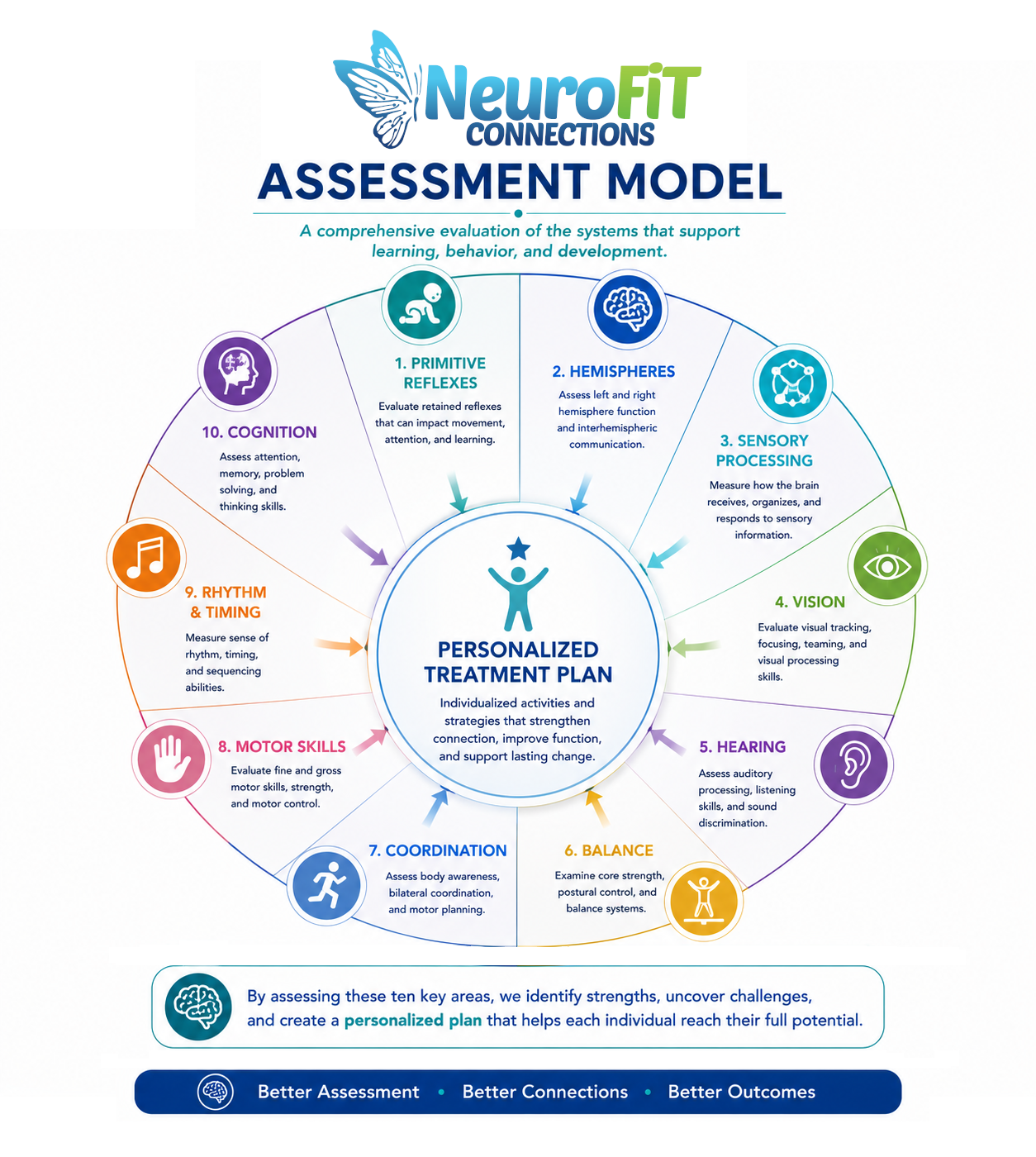
Our comprehensive assessment may include:

  • Primitive reflex testing
  • Balance evaluation
  • Coordination testing
  • Sensory processing assessment
  • Visual processing evaluation
  • Auditory processing assessment
  • Cognitive testing
  • Motor function assessment
  • Brain hemisphere evaluation

Looking at these systems together provides a more complete understanding of an individual’s neurological strengths and areas for growth.

How Does the Melillo Method Address Functional Disconnection?

Every NeuroFiT program is personalized.

Based on assessment findings, a program may include:

  • Primitive reflex integration activities
  • Balance training
  • Coordination exercises
  • Sensory stimulation
  • Cognitive exercises
  • Visual processing activities
  • Auditory processing activities
  • Home-based activities
  • Parent coaching

The goal is to encourage stronger communication among neurological systems while supporting healthy brain development through neuroplasticity.

Why This Matters

Many interventions focus primarily on managing symptoms.

The Melillo Method asks a broader question:

Why might these symptoms be occurring?

By understanding how different parts of the brain communicate—and where communication may be less efficient—it becomes possible to develop highly individualized programs designed to strengthen underlying neurological function.

This approach does not replace traditional therapies or medical care.

Instead, it provides another perspective for understanding how the brain develops and how personalized interventions may support learning, behavior, communication, and daily functioning.

NeuroFiT Connections Assessment Model

How NeuroFiT Connections Applies the Melillo Method

At NeuroFiT Connections, Functional Disconnection Syndrome serves as one of the guiding concepts behind our comprehensive assessments and personalized programs.

Rather than focusing on a diagnosis alone, we evaluate how different neurological systems work together.

By identifying strengths and areas that may benefit from additional support, we create individualized programs designed to help children and adults improve attention, learning, coordination, emotional regulation, communication, and overall brain function.

Every brain develops differently.

Our goal is to understand those differences and help each individual reach their fullest potential.

Could Functional Connectivity Be Affecting Your Child?

If your child struggles with ADHD, autism, dyslexia, sensory processing challenges, learning disabilities, coordination difficulties, or emotional regulation, a comprehensive neurological assessment may provide valuable insight into how their brain is functioning.

Understanding the “why” behind the symptoms is often the first step toward creating meaningful, individualized support.

Ready to Learn More?

Schedule a comprehensive assessment with NeuroFiT Connections and discover how the Melillo Method evaluates neurological function and supports personalized brain development.

Experience the Difference Our Programs Can Make!

ADHD Program for Kids

In as few as twelve weeks, the NeuroFiT Connections ADHD program resolves the underlying issues that are the cause of ADD and ADHD, strengthens the neurological connections in your child's brain and body, and improves their diet to get them caught up emotionally, mentally and physically.

Anxiety Program for Kids

The NeuroFiT Connections Anxiety program resolve the underlying conditions causing Anxiety and strengthens the neurological connections in your child's brain using specialized equipment and activities. In twelve to sixteen weeks, children suffering from Anxiety will become confident and self-assured without Anxiety.

Autism Spectrum Disorder Program for Kids

No matter what level of ASD your child has, the NeuroFiT Connections Autism program will get to and resolve the underlying conditions, strengthen the neurological connections in the brain, and resolve the issues that cause the symptoms you see to get your child caught up to where they are supposed to be.

Behavior Disorder Program for Kids

Behavior disorders, like so many of the disorders we work with, are hemispheric weaknesses. By resolving the underlying conditions and stimulating the weaker hemisphere, the disorder itself will virtually disappear in as few as twenty-four weeks.

Learning Disorder Program for Kids

Learning disorders can stem from auditory processing issues, ocular processing issues, or cognition issues. Those, in turn, stem from a hemispheric weakness. The NeuroFiT Connections program stimulates the weak hemisphere, resolves the underlying issues of the learning disorder, and resolves the auditory, ocular, and cognitive issues in just a few months.

Processing Disorder Program for Kids

Processing disorders are more than a neurological condition. They can also be a sensory issue, or cognition issue, etc. The Processing Disorder program is design to resolve the underlying conditions of those issues, strengthen the weaker hemisphere of the brain, and resolve any other issues a child has, all in just a few months.