

There is a remarkably persistent idea about the brain that goes something like this: children have flexible brains, adults have finished brains, and somewhere around the time you start worrying about your 401(k), what you’ve got is pretty much what you’re stuck with.
It’s an understandable assumption. Children seem to absorb new information constantly. They learn language, movement, social skills, academic skills, sports, music, and approximately seventeen new ways to operate whatever electronic device you handed them five minutes ago.
Adults can feel different. We develop routines, preferences, habits, and ways of doing things that have been practiced for years. Try moving the coffee mugs to a different cabinet and you may discover just how deeply the adult nervous system appreciates consistency.
But familiar does not mean fixed.
Your adult brain is still capable of learning and changing.
That capacity is called neuroplasticity, and understanding what it does—and just as importantly, what it does not mean—can change the way we think about learning, training, and development long after childhood.
What Is Neuroplasticity?
Neuroplasticity describes the nervous system’s ability to change its function and organization in response to experience, learning, practice, and other influences. Researchers have documented experience-dependent changes involving neural activity and connectivity as well as structural changes in the adult brain.
In simpler terms, what you repeatedly ask your brain and body to do can influence how efficiently they learn to do it.
Consider learning to play piano. At first, finding the right key may require conscious thought. Reading the music, controlling your fingers, keeping rhythm, listening to what you’re producing, and remembering what comes next can feel like several jobs happening simultaneously.
Practice doesn’t simply give you more knowledge about the piano. Over time, the task itself begins to change. Movements become more accurate, sequences become easier to produce, and skills that once demanded enormous conscious attention can become increasingly efficient.
Research into motor learning has demonstrated both functional and structural neuroplastic changes associated with acquiring and retaining practiced skills.
The pianist isn’t using the same brain in exactly the same way as on the first day of lessons.
Practice changes performance, and learning is accompanied by changes within the nervous system.
Isn’t Neuroplasticity Mostly a Childhood Thing?
This is where an important distinction is necessary.
The developing brain is extraordinarily plastic. Childhood contains sensitive developmental periods during which certain neural systems are particularly responsive to experience, and adult plasticity can be more constrained than plasticity during development.
But less plastic than a developing child’s brain does not mean no longer plastic.
Adult neuroplasticity is well established. Researchers have documented experience-dependent changes in adult sensory, motor, and cognitive systems, and contemporary research continues to investigate the mechanisms the mature nervous system uses to adapt.
That means there isn’t a birthday when the brain announces:
“Thank you for participating. Neural development is now closed.”
The rules change. The pace can change. Some kinds of learning may require more repetition and intentional practice.
But the capacity to learn remains.
You Already Use Neuroplasticity
You don’t need to enter a neuroscience laboratory to see the practical consequences of an adaptable adult nervous system. Think about something you can do now that you couldn’t do—or couldn’t do nearly as well—ten years ago.
Maybe you learned a new piece of software for work. Perhaps you learned pickleball, golf, piano, a new language, a complicated recipe, or how to operate technology that didn’t even exist when you were in school.
At first, you had to think through the steps. Eventually, at least some of them became easier and more automatic.
Driving provides a particularly good example. Think back to learning to drive and compare it with what happens now. A new driver may be consciously monitoring the accelerator, brake, mirrors, steering wheel, lane position, traffic signs, turn signal, and the car approaching from the left.
An experienced driver can coordinate many of those activities while simultaneously discussing dinner plans and wondering why the person in front of them apparently believes the left lane is a long-term residential opportunity.
The task didn’t become objectively simpler.
Your brain became better at performing it.

Neuroplasticity Isn’t Magic
The popularity of the word neuroplasticity has created a problem.
It sounds impressive.
Put “neuroplasticity” beside almost any exercise, app, game, device, or training program and suddenly it can sound as though neuroscience has proven that the activity will transform your brain.
That’s not how it works.
Evidence that the brain can change does not establish that every activity marketed as “brain training” produces meaningful improvements—or that improvements on a practiced task will automatically transfer to unrelated parts of everyday life.
This is one of the most important limitations in training research. Learning can be highly specific to what was actually practiced, and transferring improvement from a trained task to substantially different tasks or everyday functioning is not guaranteed.
Neuroplasticity tells us the brain has the capacity to adapt.
It doesn’t tell us that every method designed to produce adaptation works equally well.
Your Brain Gets Better at What You Ask It to Do
This brings us to one of the most important ideas in the entire discussion: specificity matters.
If you practice piano, you become better at playing piano. If you practice a particular tennis serve, you can become better at that serve. Motor-learning research shows that repeated practice is associated with skill acquisition and changes across interconnected neural systems.

That sounds obvious, but it becomes extremely important when discussing brain training.
Suppose someone becomes dramatically better at a computerized memory game after playing it every day. That’s interesting, but the next question matters enormously: Did the person become better at working memory more broadly, or did they become exceptionally good at that memory game?
Those aren’t necessarily the same thing.
A training activity should therefore be connected to the skill or functional area we’re actually trying to develop. We should also care whether changes begin to show up beyond the exercise itself.
Getting better at training isn’t the ultimate goal. Getting better at life is.
Repetition Matters—but So Does the Right Kind of Repetition
If the nervous system adapts in response to experience, repetition makes intuitive sense. A single piano lesson doesn’t make someone a pianist, just as one afternoon on a tennis court doesn’t create a reliable serve.
But repetition alone isn’t enough.
Repeating something incorrectly 5,000 times can simply make you extraordinarily experienced at doing it incorrectly. Effective learning can depend on factors such as task difficulty, feedback, progression, motivation, practice structure, and the nature of the skill being trained.
The challenge should be achievable but meaningful. As performance improves, the task may need to change so the person continues being appropriately challenged.
That’s one reason personalized training matters. Two people may begin with very different strengths, limitations, and learning needs, even if they arrived with the same diagnosis.
What About Those Patterns I’ve Had for Decades?
This question came up naturally in our discussion of adults who weren’t diagnosed with ADHD during childhood.
Adults can become remarkably good at compensation. If organization is difficult, you may build elaborate calendars. If you forget appointments, you may create multiple alarms. If getting started is difficult, you may learn to use urgency as fuel.
After twenty or thirty years, some of those systems can become deeply woven into the way you live.
That doesn’t mean they’re bad. Quite the opposite: some coping mechanisms are ingenious, and they may be a significant part of why someone has been successful.
But long-practiced patterns can also be deeply established. Adult neuroplasticity exists within a mature nervous system whose networks have already been shaped by years of experience, which is one reason learning in adulthood isn’t identical to development during childhood.
That may mean changing or building a skill takes more intentional effort and repetition.
Long-established does not mean unchangeable.
Is It Harder to Train the Adult Brain?
Sometimes, yes.
Children aren’t simply smaller adults. Their nervous systems are actively developing, and early experience helps shape neural circuits during periods of heightened plasticity. Adult brains have greater stability, which is actually useful—we probably wouldn’t want decades of accumulated learning constantly being rewritten by whatever happened Tuesday afternoon.
That stability comes with a tradeoff. Some changes can require more deliberate, sustained practice in adulthood.
Age doesn’t eliminate learning, either. A recent systematic review of motor learning across adulthood concluded that aging affects the neurophysiology of learning but does not eliminate the capacity for functional reorganization and skill acquisition.
So the better question isn’t necessarily:
“Am I too old for my brain to change?”
It may be:
“What am I asking my brain to learn, and how am I giving it the opportunity to learn it?”
Neuroplasticity Involves More Than “Making New Connections”
You’ve probably heard neuroplasticity described as “forming new neural connections.” That’s useful shorthand, but the biology is considerably richer.
Experience-dependent plasticity can involve changes in the strength and organization of existing connections, the formation and elimination of synapses, changes in patterns of neural activation, and alterations involving white matter and myelin. Researchers have found evidence that experience and learning can influence several levels of nervous-system organization.
Different forms of learning can also involve different brain systems. Motor learning, for example, involves interacting cortical and subcortical networks, and sensory and motor plasticity can influence one another rather than functioning as completely separate processes.
That matters because real life rarely asks one isolated part of the brain to work alone.
Catching a ball involves vision, timing, prediction, movement, body awareness, balance, and coordination. Reading involves visual and language systems, attention, eye movements, memory, and learned associations. Navigating a crowded grocery store while remembering what you need and answering your phone creates yet another combination of demands.
The brain and body work as systems.
What Does This Mean for Adults With ADHD, Anxiety, or Other Challenges?
Neuroplasticity should not be interpreted to mean that a diagnosis can simply be “trained away.”
ADHD is a neurodevelopmental disorder. Autism is a neurodevelopmental condition. Anxiety can involve multiple biological, psychological, environmental, and experiential factors. Different people with the same diagnosis can have very different strengths, challenges, histories, and support needs.
But a diagnosis also doesn’t mean that every skill associated with someone’s everyday functioning is fixed.
An adult with ADHD can learn organizational strategies. Someone who struggles with coordination can practice motor skills. Adults can learn new cognitive, perceptual, and physical skills throughout life. The adult nervous system’s capacity for learning provides the biological foundation that makes lifelong skill development possible.
The useful question therefore isn’t, “Can neuroplasticity cure my diagnosis?”
It’s:
“Which skills or functional areas are making everyday life harder, and which of those may be trainable?”
This Is Where Assessment Becomes Important
If neuroplasticity simply meant “do brain exercises,” assessment wouldn’t matter very much. We could hand everyone the same collection of activities and tell them to practice.
But people aren’t interchangeable.
One adult may struggle primarily with working memory and organization. Another may have difficulty with timing, coordination, or motor planning. Someone else may find visual tracking, balance, attention, sensory demands, or integrating several kinds of information at once unusually challenging.
Those differences matter because what you train should have some relationship to what you’re trying to strengthen.
At NeuroFiT Connections, our Brain & Body Assessment looks at multiple functional areas rather than assuming a diagnosis tells us everything we need to know. Depending on the individual, we may assess cognitive and executive skills, visual and oculomotor skills, auditory processing, fine motor skills, balance and postural control, coordination and motor planning, timing and rhythm, proprioception and body awareness, primitive reflexes, and everyday challenges and goals.
We’re trying to answer a practical question:
Where is this particular person’s brain and body having to work harder than they should?
From Assessment to Personalized Training
What we learn during the assessment helps us build a personalized Brain & Body Training program. The activities we select are based on the individual’s assessment findings rather than simply choosing a standard set of exercises because someone has ADHD, anxiety, autism, or another diagnosis.
Depending on what we identify, training may include activities involving cognitive skills, timing, coordination, visual-motor function, balance, motor planning, primitive reflex integration, and other functional areas. Activities can be progressed as abilities change so that the challenge remains appropriate to the individual.
The underlying principle is straightforward: if we want the nervous system to become better at something, we need to give it meaningful opportunities to practice the relevant skills.
But there’s an important scientific distinction here. Neuroplasticity provides a rationale for why repeated experience and practice can produce learning and neural adaptation. It does not, by itself, prove that every component of the NeuroFiT program—or any other particular program—will produce a specific outcome for every person.
We think that distinction makes the idea of neuroplasticity more useful, not less.
Why Everyday Change Matters More Than Exercise Scores
Imagine someone begins a training activity involving timing and coordination.
At first, it’s difficult. Their responses are inconsistent, and coordinating the movements requires considerable concentration. With practice, their performance improves.
That’s encouraging.
But we’re interested in another question too: Does anything outside the training room begin to feel different?
Perhaps an everyday movement becomes easier. Maybe a task requires less conscious effort. Perhaps the person handles multiple demands more efficiently or notices an improvement in a skill that matters to them.
That’s why goals matter. A number on a training screen can tell us something about performance on that task, but the meaningful outcome is whether improved abilities translate into everyday function.
The exercise is practice. Life is the test.

Your Brain Has Been Changing All Along
One of the fascinating things about neuroplasticity is that it isn’t something we suddenly activate by walking into a brain-training center.
Your nervous system has been adapting to experience your entire life.
Every skill you’ve learned, every habit you’ve practiced, every movement you’ve refined, and every environment you’ve adapted to has contributed in some way to the nervous system you have today.
That includes helpful patterns and less helpful ones.
If you’ve spent twenty years relying on deadline pressure to get started, you’ve had a lot of practice operating that way. If you’ve avoided an activity because it was difficult, you’ve had less opportunity to practice the underlying skills involved in it. If you’ve developed elaborate compensation strategies, those strategies themselves have become practiced behaviors.
Neuroplasticity isn’t automatically positive or negative.
The brain learns from what it repeatedly experiences.
So, Can the Adult Brain Really Change?
Yes.
The scientific evidence that adult brains retain meaningful plasticity is substantial. Learning and experience can produce functional and structural changes, and adults continue acquiring perceptual, cognitive, and motor skills across the lifespan.
But the more useful answer is a little more nuanced.
The adult brain is not identical to the developing child’s brain. Long-established patterns can take time and repetition to change. Training effects can be specific to what is practiced, and improvements don’t automatically transfer to every aspect of everyday life.
That’s precisely why the question shouldn’t stop at:
“Can my brain change?”
The next question is much more interesting:
“What do I want my brain and body to become better at doing?”
Once we know that, we can start thinking about what should be assessed, what should be practiced, how progress should be measured, and whether the changes are beginning to matter where they count.
Because adulthood doesn’t mean learning is over.
It means we can be much more intentional about what we practice next.
Frequently Asked Questions About Neuroplasticity in Adults
What is neuroplasticity?
Neuroplasticity is the nervous system’s capacity to change its function or organization in response to experience, learning, practice, injury, and other influences. It can involve changes in neural activity and connectivity as well as structural changes within the nervous system.
Can the Adult Brain Really Change After Childhood?
No. Plasticity is particularly pronounced during development, and some forms become more constrained as the nervous system matures, but the adult brain retains meaningful capacity for learning and adaptation.
Is it harder to change the brain as an adult?
Some forms of learning and neural change can be more difficult or require more deliberate practice in adulthood because the mature nervous system is more stable than the developing brain. However, adults and older adults continue to demonstrate learning and functional neural reorganization.
How long does neuroplasticity take?
There isn’t one timetable. Neural and behavioral changes depend on what is being learned, the person, the amount and structure of practice, task difficulty, prior experience, and many other factors. Research has documented training-associated changes over different timescales, so claims that neuroplasticity universally takes a particular number of days should be treated cautiously.
Does repetition help change the brain?
Repeated practice is an important part of many forms of learning, but repetition by itself isn’t a guarantee of useful change. Task selection, difficulty, feedback, progression, motivation, and practice structure can all influence learning.
Are brain games an effective way to use neuroplasticity?
Getting better at a brain game demonstrates learning of that task, but improvement doesn’t necessarily transfer broadly to unrelated skills or everyday functioning. Transfer is one of the important questions researchers consider when evaluating cognitive training.
Can older adults still learn new skills?
Yes. Aging can affect the mechanisms and pace of learning, but research continues to demonstrate skill acquisition and functional reorganization in older adults.
Can neuroplasticity cure ADHD, autism, or anxiety?
Neuroplasticity should not be described as a cure for ADHD, autism, or anxiety. It describes the nervous system’s capacity for change and learning. The more useful question is whether particular functional skills can be strengthened through appropriately targeted practice.
How does NeuroFiT Connections use the concept of neuroplasticity?
Neuroplasticity provides part of the scientific rationale for using repeated, progressive practice to develop skills. NeuroFiT begins with a Brain & Body Assessment to identify individual strengths and challenges, then uses those findings to guide personalized training. Neuroplasticity itself should not be interpreted as proof that a particular NeuroFiT activity will produce a particular clinical result.
Am I too old for a NeuroFiT Brain & Body Assessment?
No. The Adult Brain & Body Assessment is designed to identify an individual’s current strengths, challenges, and goals. What we recommend depends on what the assessment reveals rather than assuming age or a diagnosis tells us everything we need to know.
Ready to Find Out What Your Brain & Body Can Learn?
If you’ve assumed that the challenges you’ve lived with for years are simply the way things have to be, it may be worth looking more closely. Your brain’s capacity to learn didn’t disappear when childhood ended.
A personalized Brain & Body Assessment can help identify the functional areas that may deserve a closer look and help us determine where targeted training may be appropriate.
Related Articles: Understanding Your Adult Brain & Body
Everyday challenges with attention, organization, energy, flexibility, sensory processing, and getting started can look very different on the surface, but they often involve overlapping brain and body functions. Explore the rest of our Adult Brain Health series to better understand why some things may require more effort than they seem like they should.
Why Do I Feel Overwhelmed So Easily? Understanding Cognitive Overload in Adults
When too much information, too many decisions, or too many demands arrive at once, even capable adults can feel overloaded. Learn what may be happening when your brain seems to reach its limit.
Why Do I Know What I Need to Do but Still Can’t Get Started? Understanding Task Initiation in Adults
Knowing what needs to be done and actually starting it are different processes. Explore task initiation, executive function, motivation, working memory, and why getting started can sometimes be the hardest part.
Why Am I So Exhausted at the End of the Day? The Hidden Effort of Executive Function
Sometimes exhaustion isn’t about how much you did—it’s about how hard your brain had to work to do it. Learn how attention, organization, decision-making, self-regulation, and compensation can quietly consume mental energy throughout the day.
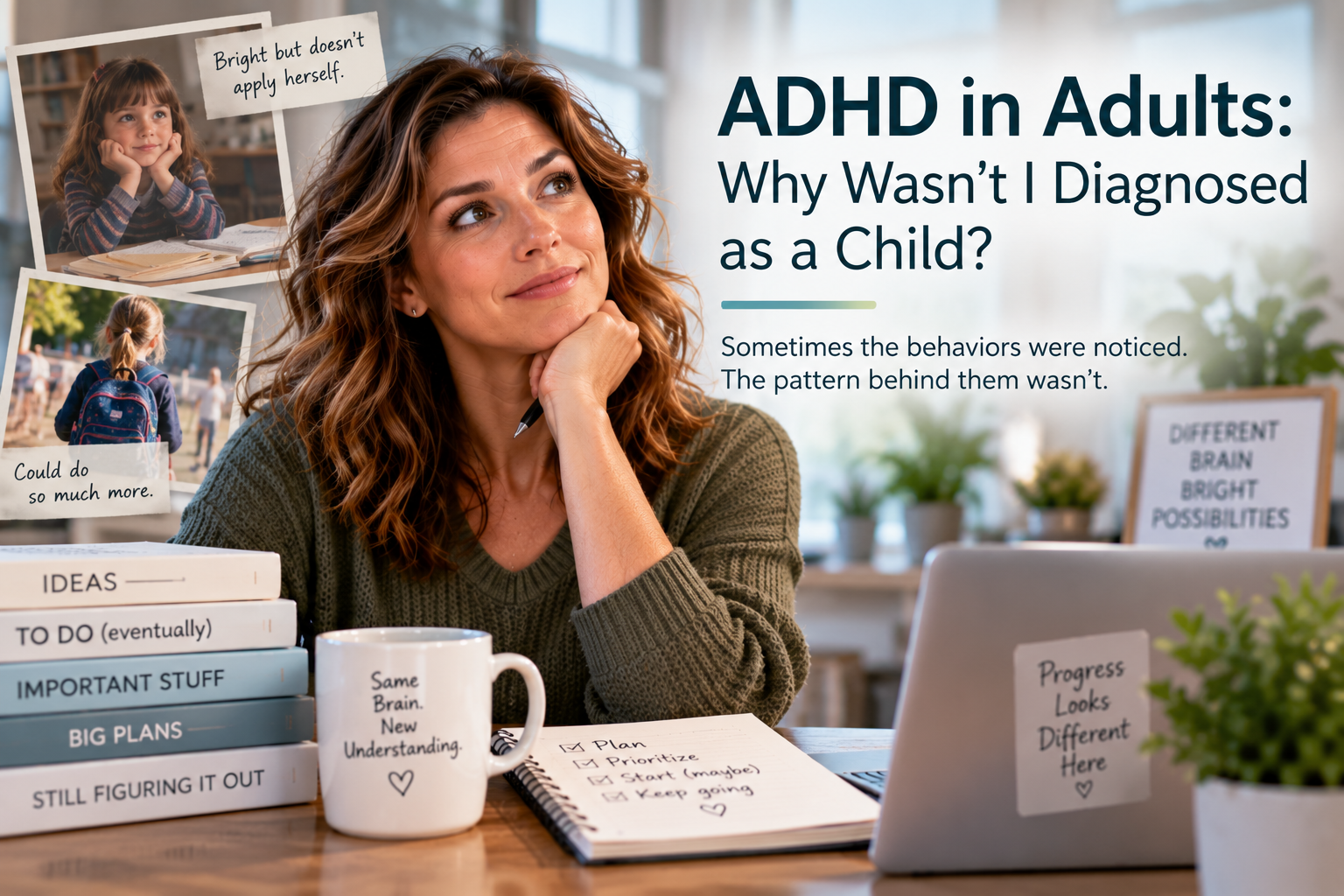
ADHD in Adults: Why Wasn’t I Diagnosed as a Child?
ADHD doesn’t suddenly begin in adulthood, so why do some people reach their 30s, 40s, 50s, or beyond before recognizing the pattern? Explore how good grades, structure, compensation, inattentive symptoms, and years of effective coping strategies can hide ADHD.
Why Do Changes in Plans Throw Me Off So Much? Understanding Cognitive Flexibility in Adults
A small change in plans can sometimes create a surprisingly large reaction. Learn how cognitive flexibility, executive function, mental load, ADHD, autism, and anxiety can influence your ability to shift gears.
Why Do Busy Places Feel So Overwhelming? Understanding Sensory Processing in Adults
Restaurants, stores, workplaces, airports, and other busy environments can place enormous demands on the brain. Explore how sensory processing, attention, movement, and multiple competing inputs can contribute to feeling overwhelmed.