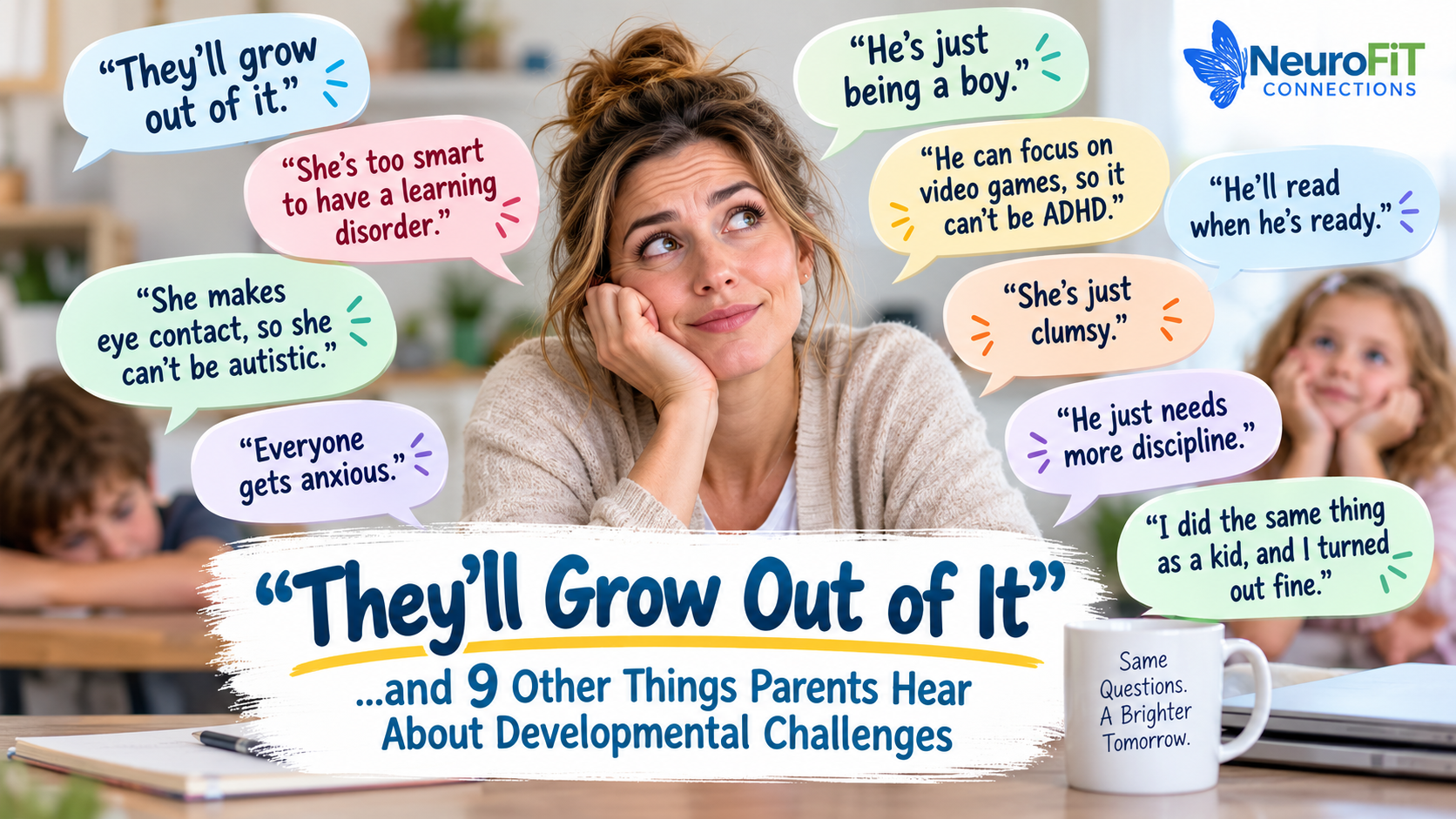


“If I really have ADHD, wouldn’t somebody have noticed when I was a kid?”
It’s a reasonable question. After all, you went to school. You had teachers, parents, coaches, relatives, and maybe a guidance counselor or two. You weren’t raised alone in a cabin somewhere with no adults around to notice what you were doing.
So if you’re now wondering whether ADHD could explain some of the things you’ve struggled with as an adult, it can be difficult to reconcile that possibility with one stubborn fact: nobody said anything.
Or maybe they did. They just didn’t call it ADHD.
Maybe they said things like, “You’re so smart. You just need to apply yourself.” Or perhaps it was, “You need to stop daydreaming,” “You’d do better if you were more organized,” “Why do you always wait until the last minute?” or the perennial favorite, “You’re capable of so much more.”
Those comments may or may not have had anything to do with ADHD. Plenty of children hear some of them and do not have ADHD. But sometimes the behaviors were visible even though the pattern connecting those behaviors wasn’t.
And decades later, an adult may finally begin asking a different question: Was I really lazy, careless, disorganized, unmotivated, or “not living up to my potential”—or was something else making certain things much harder than they appeared?
ADHD Doesn’t Suddenly Begin at 35
This is an important place to start. ADHD is considered a neurodevelopmental disorder, which means its symptoms begin during childhood even when the condition isn’t recognized or diagnosed until adulthood. Current diagnostic criteria require evidence that several symptoms were present before age 12.
That does not mean someone must have received an ADHD diagnosis before age 12. It means the pattern being evaluated in adulthood should have roots in childhood.
That’s also why an adult ADHD evaluation generally involves more than asking, “Are you having trouble concentrating now?” A clinician may look at childhood behavior, school experiences, family recollections, current functioning, and other history while also considering conditions that can produce similar symptoms, including anxiety, depression, sleep problems, and learning disabilities.
So when someone receives an ADHD diagnosis at 32, 47, or 61, it doesn’t necessarily mean ADHD suddenly appeared. Sometimes it means somebody finally recognized a pattern that had been there for a very long time.
What If Nobody Saw the “Hyperactive Kid”?
For a long time, the cultural picture of ADHD was pretty easy to visualize: a child—usually a boy—who couldn’t sit still. He was bouncing out of his chair, interrupting the teacher, talking constantly, getting in trouble, and generally making it impossible for the adults around him not to notice him.
That child certainly can have ADHD. But ADHD doesn’t have only one presentation.
The CDC describes predominantly inattentive, predominantly hyperactive-impulsive, and combined presentations. A child with a predominantly inattentive pattern may have difficulty organizing or finishing tasks, following instructions, remembering everyday details, or maintaining attention without necessarily being the child disrupting the classroom.
Picture another student. She’s sitting quietly at her desk, not climbing anything, interrupting anybody, or launching a pencil across the classroom. She’s even looking directly at the teacher.
She also has absolutely no idea what the teacher said for the last three minutes.
Quiet struggles can be much easier to miss than disruptive ones.
Why Were So Many Girls Missed?
This deserves particular attention because the history of ADHD recognition has not looked the same for boys and girls. Research has long suggested that ADHD can be underrecognized in girls and women, with girls sometimes showing less obvious hyperactive or disruptive behavior and more inattentive or internalized difficulties.
Anxiety, depression, and coping strategies can complicate recognition even further. And importantly, doing well academically does not automatically rule out ADHD.
Think about how differently two struggling children might attract adult attention. One is constantly leaving his seat, interrupting, arguing, and getting sent to the principal. The other is losing assignments, staying up far too late finishing projects, quietly panicking about deadlines, rereading the same paragraph repeatedly, and spending twice as long as everyone else trying to keep up.
Which child is more likely to trigger a referral? Historically, it was often the first one.
The second child might simply be described as “a little scattered.” And if her grades were good, there might have seemed to be even less reason to investigate.
But I Got Good Grades
This may be one of the biggest reasons adults dismiss the possibility of childhood ADHD: “I couldn’t have had ADHD. I got straight A’s.”
Academic achievement is important information, but it is not, by itself, an ADHD test. A bright child may be able to compensate for some difficulties, while a highly structured household may provide systems the child doesn’t even realize they’re relying upon. Parents may keep track of assignments, schedules, lunches, permission slips, and deadlines, while the child becomes extremely conscientious—or anxious—about forgetting things.
And some students discover one of the most effective short-term attention generators available: panic.
The project has been assigned for three weeks, and somehow nothing happens. There was plenty of time Monday. There was still plenty of time Thursday. Even Sunday afternoon didn’t seem particularly urgent.
Then it’s 9:47 p.m. the night before it’s due and suddenly the brain announces:
GOOD NEWS. WE ARE EXTREMELY INTERESTED IN THE CIVIL WAR NOW.

The project gets finished. The grade may even be excellent. From the outside, the system appears to be working.
But grades tell us what the student produced. They don’t necessarily tell us how much effort it took to produce it.
Structure Can Hide a Lot
Childhood can provide an enormous amount of external executive function. The bell tells you when to change activities. The teacher tells you what to work on. Your parents tell you when to wake up, someone prepares dinner, assignments have due dates, sports practices happen at predetermined times, and there are consequences when you don’t show up.
Even the physical environment may be organized around what you’re supposed to do next. You can spend years functioning inside a structure largely designed and maintained by other people without realizing how much that structure is helping you.

Then adulthood arrives, and now you are the structure.
You have to decide what deserves attention, remember appointments, prioritize competing demands, initiate boring tasks, estimate time, pay bills, answer email, manage a household, maintain relationships, plan meals, remember birthdays, and somehow notice that the car registration expired eleven days ago.
The CDC notes that ADHD symptoms may become more problematic when adult demands increase and can affect work, home life, and relationships. The underlying difficulty may not suddenly be new.
The scaffolding may simply be gone.
“But I Can Focus for Hours on Things I Like”
We’ve talked about this before, but it belongs here too. Difficulty regulating attention does not necessarily mean an inability to pay attention to anything.
Adults with ADHD may have particular difficulty completing lengthy tasks unless they are interesting, while attention can vary considerably depending on the task and circumstances. That can create a confusing childhood history because the same child who couldn’t finish twenty minutes of homework might spend three hours building LEGO.
A child might forget what the teacher assigned but remember every statistic about a favorite baseball player. They might be unable to clean their bedroom but become intensely absorbed in drawing, gaming, music, coding, or another interest.
To an adult watching from the outside, that inconsistency can look like a choice: “See? You can focus when you want to.”
But there’s a more useful question. What changes about this child’s attention when something is interesting, novel, rewarding, urgent, challenging, or personally meaningful? That tells us much more than simply asking whether the child can focus.
Maybe You Became Very Good at Compensating
People are remarkably good at developing systems around things that are difficult. You might have become the person who arrives 30 minutes early because being five minutes late terrifies you, or the person who keeps six alarms on a phone because one apparently constitutes only a polite suggestion.
Maybe everything important lives beside the front door because if you put something somewhere “safe,” there’s an excellent chance you’ll never see it again. You might make elaborate lists, double-check everything, keep your calendar obsessively organized, work much longer hours than other people, avoid tasks you aren’t confident you can manage, or rely on urgency to generate the momentum necessary to begin.
And after doing this for years—or decades—something else can happen: you get really good at it.
Some adults with ADHD become extraordinarily resourceful. They know exactly which environments help them work, how much pressure they need before they can get moving, which reminders they can’t afford to ignore, and what systems keep the important pieces of their lives from falling through the cracks. They may build successful careers, businesses, families, and lives using strategies developed through years of trial and error.
For some people, ADHD even becomes part of how they describe themselves. They may talk proudly about thriving under pressure, having twenty ideas at once, needing a deadline to produce their best work, or being able to jump between projects while everyone else wonders how they keep track of any of it. ADHD can become almost a badge of honor—and there can be good reason for some of that pride. You’ve spent years figuring out how to make your brain work for you.

But there’s another question worth asking.
What does it cost you to make all of those systems work?
A coping mechanism can be successful and still be expensive. Getting an excellent project finished at 2:00 a.m. is different from being able to start it comfortably two weeks earlier. Maintaining six reminder systems may prevent you from missing appointments, but that doesn’t necessarily mean remembering appointments has become easy. Thriving in a crisis may be a genuine strength while constantly needing a crisis to activate that strength can be exhausting.
This isn’t about taking away the strategies that work or convincing someone that a part of themselves they value is actually a problem. If you’ve built systems that help you succeed, keep them. The more interesting question is whether those systems are supporting strong underlying skills—or compensating for areas that still require an extraordinary amount of effort.
At NeuroFiT, that’s an important distinction. We’re not interested in taking away someone’s personality, creativity, energy, spontaneity, or the strategies they’ve spent years developing. We’re interested in asking whether some of the functions underneath those strategies can be strengthened so that everyday life doesn’t require quite so much compensation.
Because sometimes the coping mechanism works so well that nobody sees the struggle underneath it.
Including the person using it.
I particularly like this addition because it prevents the article from sending the message that late-diagnosed adults were simply struggling unsuccessfully all those years. Many weren’t. They adapted—sometimes remarkably well. The question NeuroFiT introduces isn’t “How do we get rid of everything you’ve learned to do?” It’s “Could we strengthen what’s underneath it so you don’t have to work quite so hard?”
That feels much closer to what you’ve described seeing in adults over the years.
Then Something Changes
College. Graduate school. A promotion. Marriage. Children. Working from home. A more complicated job. Caring for aging parents. Running a business.
Life gradually adds more moving parts, and suddenly the system that worked for years doesn’t work nearly as well anymore. You didn’t necessarily become less capable; the demands may simply have become greater than your compensation strategies could comfortably handle.
That’s when adults sometimes begin noticing patterns they can trace surprisingly far back. “I’ve always procrastinated.” “I’ve always lost things.” “I’ve always needed pressure to get started.” “I’ve always struggled to estimate how long something will take.” “I’ve always had a hundred ideas and trouble finishing them.”
Or perhaps the realization is even simpler: “I thought everybody’s brain worked like this.”
Sometimes the present doesn’t create the pattern. It reveals it.
Why Didn’t My Parents or Teachers Recognize It?
Because they were interpreting your behavior with the information they had at the time. A teacher might have seen incomplete assignments, while a parent saw a messy bedroom. A coach might have noticed inconsistent follow-through, and decades later a spouse might notice forgotten appointments.
Each person sees a piece. Nobody necessarily sees the entire pattern.
Awareness of ADHD has also changed over time, and we now recognize that symptoms can present differently across people and across the lifespan. Hyperactivity, for example, may become less externally obvious in adulthood and appear more as restlessness.
And sometimes there was an even simpler explanation. The adults around you did the same things.
“Everybody in this family is like that.”
Maybe so. That doesn’t tell us whether the pattern deserves understanding.
Looking Back Is Useful—but It Isn’t a Diagnosis
Once people start learning about ADHD, there’s a temptation to reinterpret every childhood experience through that lens. Lost your lunchbox in fourth grade? ADHD. Forgot a book report? ADHD. Talked too much during algebra? Case closed.
Not quite.
All children are forgetful, distracted, impulsive, or disorganized sometimes. ADHD diagnosis involves a persistent pattern that causes meaningful impairment, occurs across more than one setting, began in childhood, and isn’t better explained by something else. There is also no single test that diagnoses ADHD.
That’s an important distinction because the goal isn’t to search your childhood for enough evidence to prove a conclusion you’ve already reached. The goal is to understand the broader pattern and determine whether ADHD is actually the best explanation for it.
What If I Was Never Diagnosed?
A diagnosis can be valuable. For some adults, finally receiving one provides an explanation for experiences they spent years interpreting as personal shortcomings. Research examining women diagnosed later in life has described how that recognition can significantly affect self-understanding and identity.
But a diagnosis is also not necessarily the end of the investigation. It tells you that your experiences fit a recognized clinical pattern, but it doesn’t automatically tell you why you struggle more with starting tasks while another person struggles more with working memory, timing, organization, sensory overload, or shifting attention.
Two adults can share an ADHD diagnosis and experience everyday life very differently.
That’s where we think individualized assessment becomes particularly useful.
But Is It Too Late?
Learning about something at 40 is different from learning about it at 8. That can leave adults wondering whether they’ve missed some important window of opportunity. If these patterns have been present since childhood—and you’ve spent decades building coping mechanisms around them—is there really anything you can do now besides learn to manage them better?
Fortunately, the adult brain isn’t finished learning.
The brain retains the capacity to change throughout life through neuroplasticity—the ability of neural systems to adapt in response to experience, learning, and repeated practice. Neuroplasticity is especially robust during childhood, when the developing brain is extraordinarily responsive to experience, but it does not simply switch off when we become adults.
That doesn’t mean changing an adult brain is identical to working with a young child’s developing brain. Long-established patterns have had years—sometimes decades—to become practiced and efficient. Building new skills or changing those patterns may require more repetition, consistency, and intentional effort than it would earlier in development.
But harder is not the same thing as too late.
Adults learn new languages. They learn musical instruments, develop new motor skills, recover function following neurological injury, build new habits, and become proficient at things they couldn’t do before. The adult brain continues responding to what we repeatedly ask it to do.
That’s an important distinction when we talk about brain training. Neuroplasticity doesn’t mean that any exercise will change any part of the brain in whatever way we want. Simply saying “the brain can change” isn’t evidence that a particular activity or program will produce a particular result. The training still matters—what is practiced, how it is practiced, how consistently it is practiced, and whether it is appropriately targeted to the individual.
That’s one reason we don’t look at adulthood as a reason to give up on strengthening underlying skills. If an adult has spent years compensating for difficulties with timing, coordination, attention, working memory, visual-motor function, balance, motor planning, or other areas of function, our question isn’t simply, “What coping strategy can we add next?”
We also want to ask:
Is there something underneath the coping strategy that we can train?
The goal isn’t to erase the systems you’ve developed over the years. Some of those systems may be brilliant, and they’ve probably helped you accomplish quite a lot. Keep the planner. Keep the alarms. Keep putting your keys in exactly the same place if that’s what works.
But perhaps those strategies don’t have to do all of the work.
At NeuroFiT Connections, our approach is to identify functional areas that may be contributing to an individual’s challenges and provide repeated, targeted opportunities to work on those areas. An adult may require more repetition or time than a young child whose brain is still moving through rapid developmental change, but adulthood does not mean the brain has lost its ability to learn and adapt.
It’s not too late to ask more of your brain. And it’s not too late to give your brain the opportunity to learn.
What NeuroFiT Looks At
At NeuroFiT Connections, we do not diagnose ADHD. Diagnosis belongs with an appropriately qualified healthcare professional.
Our Brain & Body Assessment asks a different question: How is this particular person’s brain and body functioning across the areas that may be contributing to everyday difficulty?
Depending on the individual, we may look at cognitive and executive skills, visual and oculomotor function, auditory processing, fine motor skills, balance and postural control, coordination and motor planning, timing and rhythm, proprioception and body awareness, primitive reflexes, and the person’s everyday challenges and goals.
We’re not looking for a score that says, “Yep. ADHD.” We’re looking for a pattern. Where are the strengths? Where does performance become less efficient? What requires unusually high effort? What happens when multiple systems have to work together?
Most importantly, how does what we see connect with the person’s actual experience at work, at home, and in everyday life?
The diagnosis may help describe the challenge. Understanding the individual helps us decide what to work on.
From Understanding to Training
When the assessment identifies areas we believe can be strengthened, the findings help guide an individualized Brain & Body Training program. That may include activities targeting cognitive skills, timing, coordination, visual-motor function, balance, motor planning, reflex integration, and other areas identified during the assessment.
The goal isn’t to make someone “less ADHD,” and we aren’t asking an adult to become a different person. We’re trying to identify skills and functional areas that may be making everyday life require more effort than it should, and then provide targeted opportunities to practice and strengthen them.
That distinction matters because two people who arrive with the same diagnosis may have very different patterns of strengths and challenges. Their programs should reflect the person rather than simply the label.
We don’t build programs around diagnoses. We build them around people.
Maybe Nobody Missed You
Maybe that’s the wrong way to think about it.
Your parents may have noticed the forgotten assignments and messy backpack. Your teachers may have noticed the daydreaming, constant talking, unfinished projects, or report cards that said you weren’t working up to your potential. And you may have noticed the procrastination, quiet overwhelm, last-minute panic, or enormous effort required to stay organized.
The pieces may have been there all along.
Nobody realized they might belong to the same puzzle.
Perhaps that’s the more useful way to look back—not searching for someone to blame for missing a diagnosis, but finally having language for experiences that didn’t make much sense at the time.
If you’re wondering whether ADHD could explain your symptoms, a qualified healthcare professional can help determine whether an ADHD evaluation is appropriate. And whether you have a diagnosis or not, there’s another question worth asking:
What is my brain and body having to work harder to do?
Sometimes that question can tell us quite a lot.
Frequently Asked Questions About ADHD Diagnosed in Adulthood
Can you have ADHD even if you weren’t diagnosed as a child?
Yes. ADHD symptoms begin in childhood, but they are not always recognized at the time, and many people receive an ADHD diagnosis as adults. An adult evaluation typically looks for evidence that symptoms were present during childhood.
Can ADHD suddenly develop in adulthood?
Under current diagnostic criteria, ADHD is considered a neurodevelopmental disorder with symptoms beginning in childhood. New attention or executive-function difficulties appearing only in adulthood warrant evaluation because sleep problems, anxiety, depression, and other medical or psychological conditions can produce similar symptoms.
Can you have ADHD if you got good grades?
Yes. Academic success alone does not rule out ADHD. Grades show academic performance, but they may not reveal the amount of structure, compensation, anxiety, or effort involved in producing that performance.
Why is ADHD sometimes missed in girls?
Girls with ADHD may show fewer externally disruptive symptoms and more inattentive or internalized difficulties, making the pattern easier to overlook. Research has identified underrecognition of ADHD among girls and women as an important issue.
Does being able to focus on things I enjoy mean I don’t have ADHD?
No. ADHD isn’t defined as an inability to focus under every circumstance. Attention can vary with interest, novelty, reward, urgency, task demands, and other factors, so the pattern of attention regulation is more informative than simply asking whether someone can ever concentrate.
Why did ADHD become more noticeable when I became an adult?
Adult life often introduces greater demands for independent planning, organization, time management, prioritization, and task completion. Difficulties that were manageable within the structure of childhood can become much more noticeable when that external scaffolding disappears and responsibilities increase.
Is procrastination proof that I have ADHD?
No. Procrastination can occur for many reasons and is not enough to diagnose ADHD. Diagnosis requires a broader, persistent pattern of symptoms and consideration of other possible explanations.
How is adult ADHD diagnosed?
A qualified healthcare professional typically evaluates current symptoms, childhood history, functional impairment, and other possible explanations. There is no single test that determines whether someone has ADHD.
Does NeuroFiT Connections diagnose ADHD?
No. NeuroFiT Connections does not diagnose ADHD. Our Brain & Body Assessment evaluates a range of cognitive, sensory, motor, timing, coordination, and other functional areas to better understand the individual’s strengths and challenges.
Do I need an ADHD diagnosis to have a NeuroFiT Brain & Body Assessment?
No. The assessment is designed to better understand how your brain and body are functioning and how those findings may relate to your everyday challenges and goals. You do not need an ADHD diagnosis to begin that process.
Ready to Better Understand Your Brain & Body?
If you’ve spent years wondering why organization, attention, task initiation, follow-through, or everyday responsibilities seem to require more effort than they should, there may be more worth understanding. A personalized Brain & Body Assessment can help us look beyond the label and better understand your individual pattern of strengths and challenges.