

Understanding numbers may appear simple.
A child sees the number five.
They count five objects.
They recognize that five is greater than three.
They add two more and arrive at seven.
Yet beneath these seemingly ordinary tasks, the brain is coordinating several different forms of information at once.
It must recognize symbols, connect those symbols to quantities, compare relationships, hold information in memory, choose a strategy, monitor progress, and determine whether the final answer makes sense.
Mathematical thinking is not controlled by one isolated “math center.” Research increasingly describes numerical cognition as the product of distributed and interconnected brain networks working together.
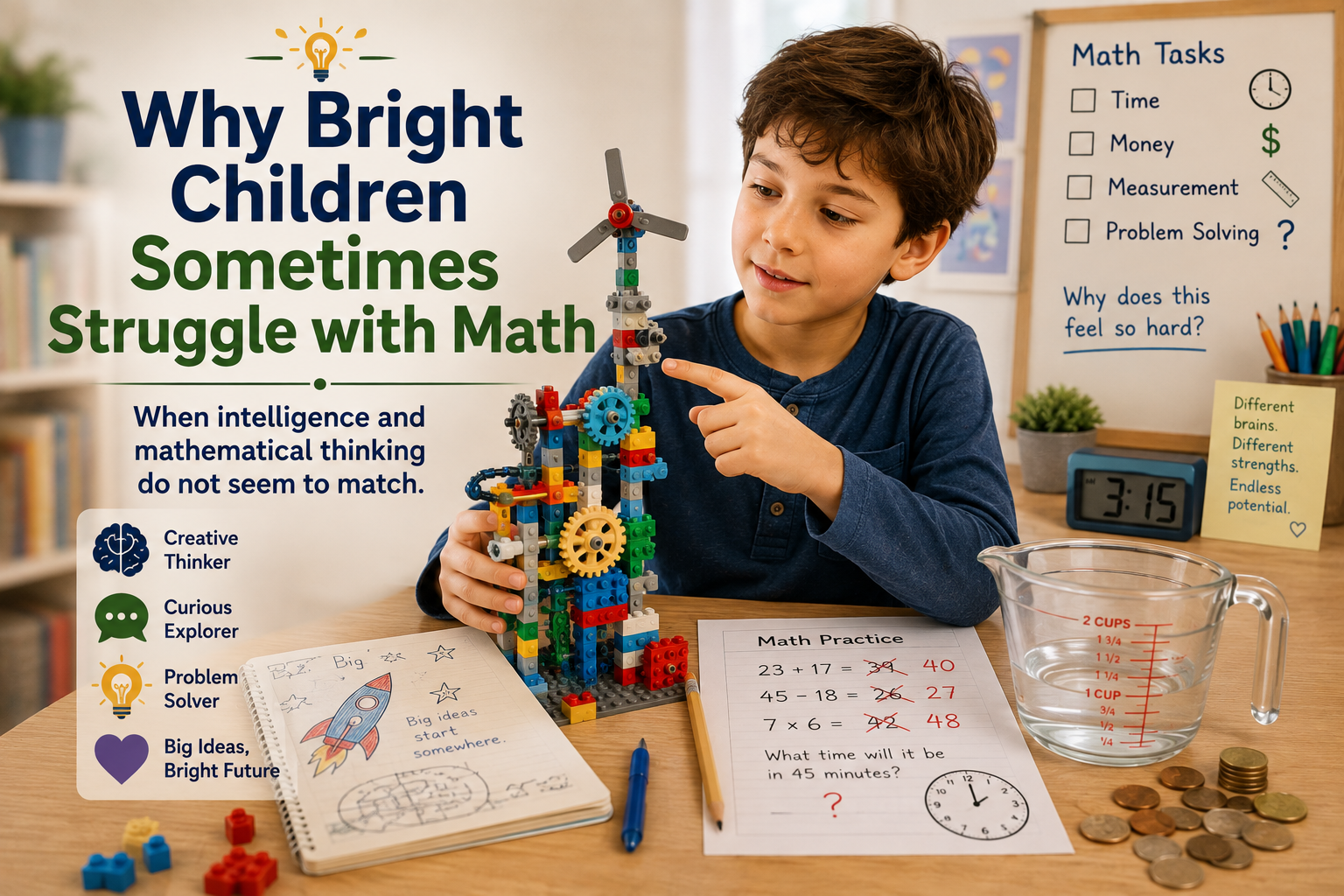
That complexity helps explain why a bright, capable child may understand many subjects with ease yet find numbers unusually confusing.
Number Sense: Understanding What Numbers Mean
Number sense is the ability to understand quantities and the relationships between them.
It helps children recognize that:
- Seven represents a specific quantity.
- Eight is larger than five.
- Ten is close to twelve.
- Two groups of four contain the same quantity as eight.
- A nearly full glass contains more than a nearly empty one.
Number sense is more than counting or recognizing written numerals.
It provides an intuitive feel for magnitude, quantity, comparison, and numerical relationships. Differences in core number processing and in accessing quantities from numerical symbols are among the leading explanations researchers have proposed for dyscalculia.
A child may memorize that 5 + 3 = 8 without developing a strong internal understanding of why that relationship is true.
This can make each new mathematical concept feel disconnected from the last.
Connecting Symbols to Quantities
Written numbers are symbols.
The symbol 6 has meaning only because the brain connects it to a quantity.
For most children, that connection gradually becomes automatic. They see six dots, hear the word six, and recognize the numeral 6 as different representations of the same idea.
For some children with dyscalculia, the connection between numerical symbols and the quantities they represent may be less efficient.
A child may recognize the numeral but still need to count objects individually to understand its value.
They may know that 9 is larger than 6 but struggle to judge the difference intuitively.
This is one reason dyscalculia cannot be reduced to forgetting math facts. The challenge may begin with how numerical information itself is represented or accessed.
Visual-Spatial Processing: Seeing Numerical Relationships
Mathematical thinking frequently involves space.
Children use visual-spatial processing to understand:
- Number lines
- Place value
- Graphs and charts
- Geometry
- Fractions
- Alignment of columns
- Distance and direction
- How quantities relate to one another
Consider the number 307.
Understanding it requires more than recognizing three separate digits. The child must understand that the position of each digit changes its value.
The 3 represents three hundreds because of where it appears.
Visual-spatial processing also helps children judge size, distance, arrangement, alignment, and relationships between parts and wholes.
A systematic review of dyscalculia research identified visuospatial working memory and symbolic number processing among the strongest predictors of mathematical ability in affected children.
Working Memory: Holding the Pieces Together
Working memory is the brain’s temporary workspace.
It allows children to hold information in mind while using it.
To solve 27 + 18, a child may need to:
- Remember the original numbers.
- Add the ones.
- Hold the intermediate result.
- Regroup if necessary.
- Add the tens.
- Combine the results.
- Check the answer.
If information fades before the child completes the process, they may lose their place, repeat steps, omit information, or arrive at an incorrect answer despite understanding the underlying concept.
Working-memory demands become even greater during:
- Word problems
- Mental calculations
- Multi-step equations
- Fractions
- Long division
- Algebra
- Problems that require switching strategies
Research indicates that working-memory differences—particularly visuospatial working memory—can contribute significantly to mathematical difficulties, although dyscalculia is heterogeneous and no single cognitive profile applies to every child.
Executive Function: Planning the Solution
Executive function helps children manage the problem-solving process.
It supports the ability to:
- Decide where to begin.
- Identify relevant information.
- Choose an operation.
- Organize steps.
- Shift strategies when one does not work.
- Monitor progress.
- Check the final answer.
A child may understand addition, subtraction, multiplication, and division individually but still struggle with a word problem because they cannot determine which operation the situation requires.
Another child may begin with the correct strategy but have difficulty organizing the steps or recognizing an error.
Mathematical thinking therefore depends not only on knowing procedures but also on planning how and when to use them.
Attention: Staying Connected to the Problem
Attention allows children to remain engaged while information is processed.
During a math task, the child must notice operation signs, place values, instructions, units, and changing information while filtering out distractions.
A brief lapse in attention can lead to:
- Missing a negative sign
- Skipping a step
- Copying a number incorrectly
- Using the wrong operation
- Losing track of the question
- Failing to check whether the answer is reasonable
Attention does not create number sense, but it helps ensure that numerical information is accurately represented, maintained, and used during problem-solving.
Processing Speed: Working Efficiently Without Becoming Overwhelmed
Processing speed affects how efficiently children recognize, interpret, and respond to information.
A child may understand a concept but require significantly more time to:
- Identify numerical symbols.
- Retrieve a math fact.
- Compare quantities.
- Complete a calculation.
- Interpret a graph.
- Decide which strategy to use.
When each step requires conscious effort, mathematical tasks can become mentally exhausting.
Slow performance does not necessarily mean poor understanding.
Sometimes the child knows what to do but cannot access or coordinate the necessary information quickly enough to keep pace with the classroom.
Pattern Recognition and Mathematical Reasoning
Mathematics is built on patterns.
Children use pattern recognition when they notice:
- Counting sequences
- Repeated groups
- Odd and even numbers
- Relationships in multiplication
- Shapes and symmetry
- Predictable changes
- Cause-and-effect relationships
Recognizing patterns helps children move beyond memorizing isolated answers.
For example, instead of memorizing every multiplication fact separately, a child may recognize relationships between doubles, groups, skip-counting, and place value.
Reasoning allows children to apply what they understand to unfamiliar situations.
It helps answer questions such as:
- Does this answer seem reasonable?
- What information matters?
- What changed?
- What stayed the same?
- Is there another way to solve this?
Mathematical Thinking Is a Team Effort
Each brain skill contributes something different.
Number sense provides meaning.
Visual-spatial processing organizes relationships.
Working memory holds information.
Executive function plans the approach.
Attention keeps the child engaged.
Processing speed supports efficiency.
Pattern recognition reveals connections.
Successful mathematical thinking emerges when these systems work together.

Because the process is interconnected, difficulty in one area can affect the entire task.
A child with good number sense but weaker working memory may understand a concept yet lose track of the steps.
A child with strong memory but weaker number sense may memorize procedures without understanding why they work.
A child with good reasoning but slower processing speed may solve problems accurately but need much more time.
This is why two children with dyscalculia may appear to struggle in completely different ways.
Why Dyscalculia Looks Different in Every Child
Developmental dyscalculia is considered a heterogeneous condition.
Research supports both domain-specific explanations, involving core numerical processing, and domain-general explanations, involving skills such as working memory, attention, cognitive control, and executive function. Different combinations may contribute to different children’s difficulties.
One child may struggle primarily with quantities and magnitude.
Another may understand quantities but have difficulty retrieving arithmetic facts.
Another may be especially challenged by visual-spatial information.
Another may understand concepts but become overwhelmed by multi-step procedures.
A diagnosis gives the challenge a name.
It does not fully explain the child’s individual neurological profile.
Numbers Support Everyday Life
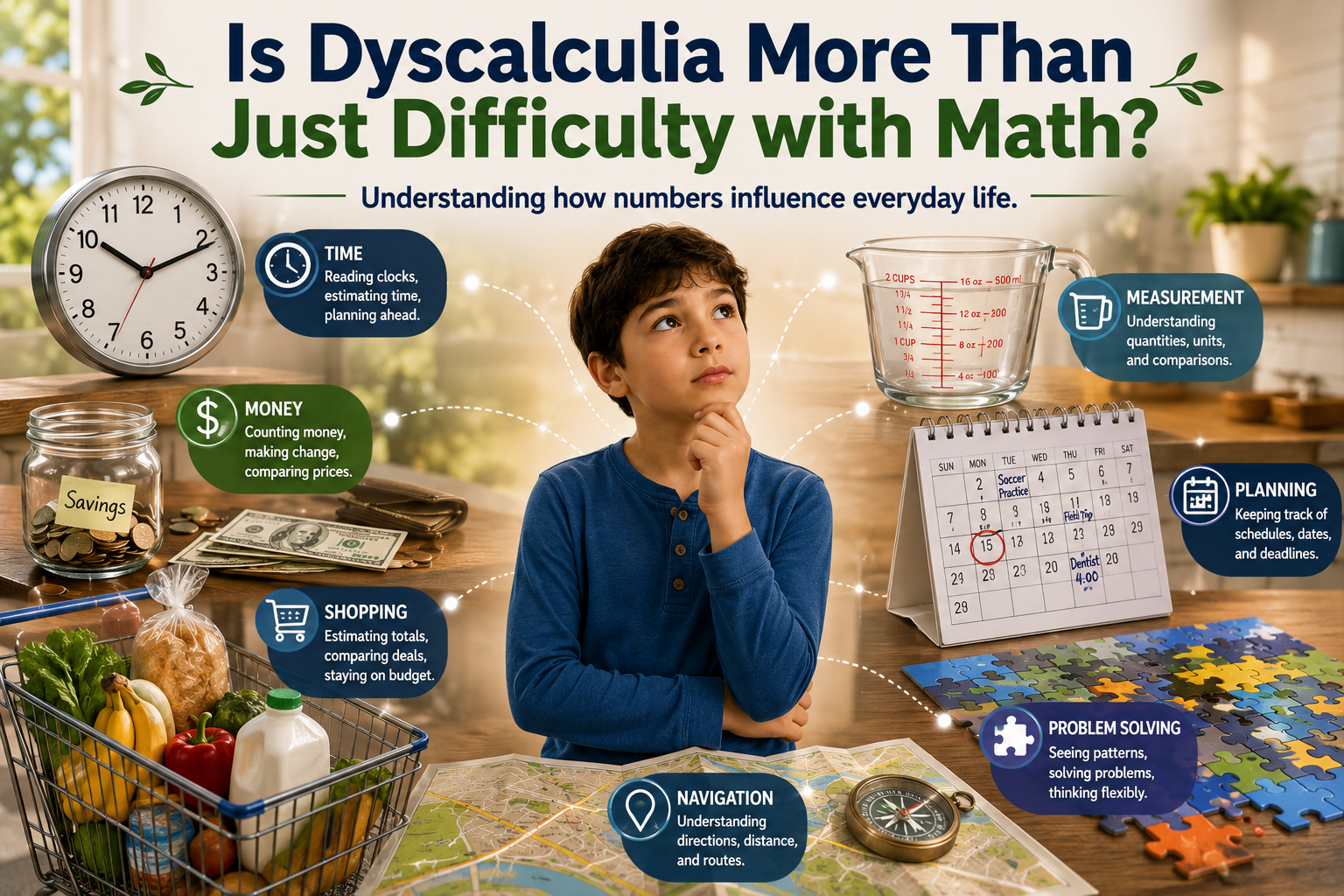
The same systems involved in classroom mathematics also support everyday activities.
Children use mathematical thinking to:
- Read clocks.
- Estimate duration.
- Count money.
- Compare prices.
- Measure ingredients.
- Understand distances.
- Follow maps.
- Plan schedules.
- Play games.
- Make everyday decisions.
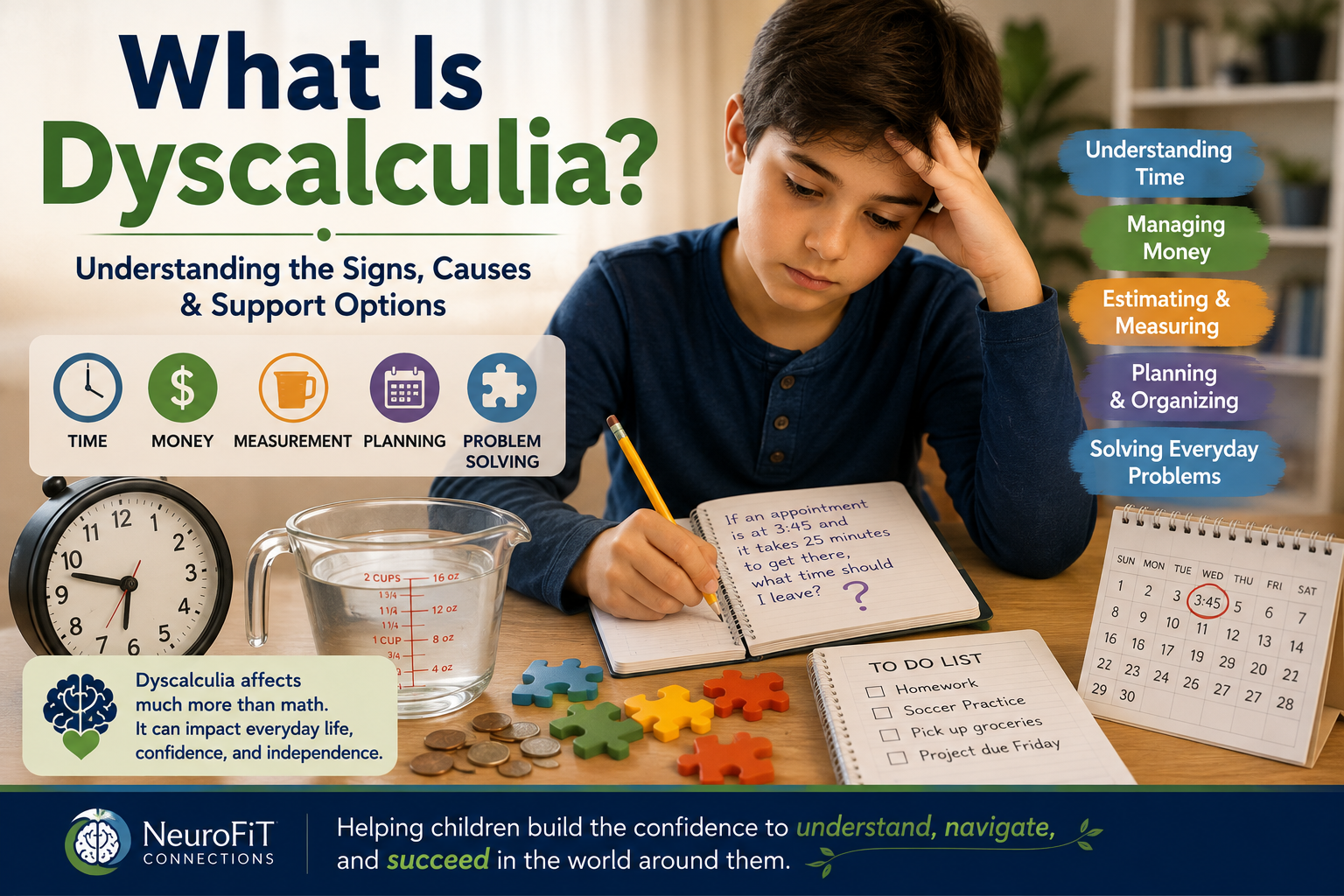
That is why dyscalculia can affect much more than grades.

The goal is not simply faster calculations.
It is helping children understand and use numerical relationships with greater confidence in the situations they encounter each day.
Looking Beyond the Worksheet
A worksheet may reveal that a child is struggling.
It rarely explains why.
At NeuroFiT Connections, every child begins with a comprehensive Brain & Body Assessment designed to help us understand the foundational brain functions that support learning.
Depending on the child, we may examine areas that include:
- Cognitive skills
- Working memory
- Visual and visual-spatial processing
- Attention
- Executive functioning
- Processing efficiency
- Fine and gross motor coordination
- Balance and proprioception
- Primitive reflexes
- Other foundational neurological systems
We then use the assessment findings to develop a personalized brain training program based on the child’s unique strengths and challenges.
Rather than asking only:
“How can this child get better at math?”
we ask:
“What brain skills does this child rely on to understand numbers, and where might additional support be helpful?”

Helping Children Build Stronger Foundations
When mathematical thinking requires less effort, children may have more mental energy available for reasoning, creativity, problem-solving, and learning.
The goal is not to turn every child into the fastest student in the class.
It is to help them develop a stronger foundation for:
- Understanding relationships
- Solving problems
- Making decisions
- Managing everyday responsibilities
- Participating more confidently
- Becoming increasingly independent
Because numbers are not confined to a worksheet.
They are part of how children understand and navigate the world around them.
Final Thoughts
The brain does not understand numbers through one isolated skill or one single region.
Mathematical thinking emerges from a coordinated network involving quantity, memory, space, attention, planning, pattern recognition, and reasoning.
When one or more of these systems is less efficient, math can become confusing and exhausting—even for a bright, capable child.
Understanding that complexity changes the question.
Instead of asking:
“Why can’t my child do this?”
we can begin asking:
“Which parts of this process are making the task so difficult?”
That shift opens the door to more personalized support, greater understanding, and renewed confidence.
Because every child deserves the confidence to understand, navigate, and succeed in the world around them.
Frequently Asked Questions
1. Is there one part of the brain responsible for math?
No. Numerical thinking relies on distributed, interacting brain networks rather than one isolated “math center.” Different networks contribute to magnitude, arithmetic facts, spatial relationships, memory, attention, and problem-solving.
2. What is number sense?
Number sense is an intuitive understanding of quantities, magnitude, comparison, and numerical relationships. It helps children understand what numbers represent rather than only memorizing symbols and procedures.
3. Why does working memory matter in math?
Working memory allows children to hold numbers, instructions, intermediate answers, and steps in mind while solving a problem. When working memory is overloaded, children may lose their place even when they understand the concept.
4. Can a child have strong reasoning skills and still struggle with math?
Yes. A child may reason creatively and understand complex ideas while experiencing difficulty with number sense, retrieval, working memory, spatial processing, attention, or sequencing.
5. Why can two children with dyscalculia have different symptoms?
Dyscalculia is heterogeneous. Children may have different combinations of number-processing and broader cognitive challenges, leading to different patterns of difficulty.
Related Articles
- What Is Dyscalculia? Understanding the Signs, Causes & Support Options
- Is Dyscalculia More Than Just Difficulty with Math?
- Why Bright Children Sometimes Struggle with Math
- Why Telling Time, Counting Money & Planning Can Be So Difficult
- Helping Children Build Confidence with Numbers
- Does Using a Calculator Hurt or Help Children with Dyscalculia?