NeuroFiT Connections Child Wellness Program

Helping Children Build the Brain Skills for Writing, Learning & Lifelong Confidence

No medication. No invasive procedures. Just a personalized, neuroscience-informed approach designed to strengthen the underlying brain functions involved in handwriting, written expression, spelling, fine motor coordination, language processing, executive functioning, attention, learning, and confidence.

Dysgraphia is much more than messy handwriting. It can affect handwriting, spelling, written expression, note-taking, organization, written assignments, and a child’s confidence both inside and outside the classroom. Many children with dysgraphia are bright, creative, and highly intelligent—they simply have difficulty translating their thoughts into written language.

At NeuroFiT Connections, we believe writing challenges are often a symptom—not the root cause. That’s why every program begins with a comprehensive Brain & Body Assessment to better understand how your child’s brain is functioning. Using those results, we develop a personalized brain training program designed to strengthen the neurological systems that support written expression, language development, motor planning, executive functioning, learning, and lifelong success.

Rather than building a program around a diagnosis, we build it around your child. Whether your child has been diagnosed with dysgraphia, a disorder of written expression, or simply struggles with handwriting, spelling, or getting ideas onto paper without a formal diagnosis, our goal is to understand your child’s unique brain, strengthen the foundational skills that support learning, and help them develop the confidence to succeed both in school and in life.

5.0 (100+ parent ratings)
Rated 5 out of 5

Does This Sound Like Your Child?

Your child has wonderful ideas, understands what they’re learning, and often surprises you with how much they know—but when it’s time to write, everything seems to become much harder.

You may hear them say they “hate writing,” watch them avoid homework that requires written answers, or notice that assignments take much longer than they should. They may tell you exactly what they want to say out loud, but struggle to organize those same thoughts on paper.

You may find yourself thinking:

  • “You explained it perfectly—why couldn’t you write it down?”
  • “I know you know the answer.”
  • “Why does writing take so long?”
  • “Your handwriting is so hard to read.”
  • “You have great ideas, but your papers don’t show what you know.”
  • “I wish writing wasn’t such a daily struggle.”

✍️ Handwriting

📝 Written Expression

🔤 Spelling & Language

🎒 School & Confidence

Children with dysgraphia often understand far more than they’re able to demonstrate through writing. What appears to be messy handwriting or poor effort may actually reflect challenges with the brain skills involved in motor planning, language processing, working memory, visual processing, executive functioning, and written expression.

These difficulties do not mean your child isn’t intelligent or isn’t trying hard enough. In fact, many children with dysgraphia are highly capable learners who simply need additional support developing the foundational brain skills required for writing.

At NeuroFiT Connections, we believe writing challenges are often a symptom—not the root cause. Our comprehensive Brain & Body Assessment helps us identify the underlying brain functions that may be contributing to your child’s writing difficulties so we can develop a personalized brain training program designed specifically for their unique strengths and needs.

Continue Learning at Home

Download Your FREE Empower & Enlighten™ Learning Disorders Parent Guide

If your child struggles with reading, writing, spelling, math, organization, or keeping up in school, it can be difficult to know where to turn—or which information to trust.

That’s why we’ve created the Empower & Enlighten™ Learning Disorders Parent Guide—a comprehensive resource designed to help parents better understand learning disorders and the brain functions that influence learning.

Written by Jackie Beck, Co-Founder and Lead Cognitive Coach at NeuroFiT Connections, this guide explains why learning disorders do not define a child’s intelligence or potential and how understanding your child’s unique brain can open the door to greater confidence, success, and independence.

Inside this comprehensive guide, you’ll discover:

✓ The differences between dyslexia, dysgraphia, dyscalculia, and other learning disorders

✓ Common signs and symptoms parents often overlook

✓ The brain-based factors that may contribute to learning challenges, including retained primitive reflexes and processing differences

✓ Current treatment options and support strategies available for children

✓ Practical ways parents and teachers can work together to support learning

✓ How NeuroFiT Connections’ personalized Brain & Body Assessment helps identify the underlying factors affecting your child’s learning

Complete the form below to receive your FREE copy and begin learning how to better understand and support your child’s unique learning journey.

Trusted by parents who want to better understand how their child learns.

Empower and Enlighten

Schedule your assessment today. Dysgraphia Assessments Include:

How Dysgraphia Can Affect Everyday Life

Writing is one of the most important ways children communicate what they know, share their ideas, and participate in school. When writing is difficult, the impact often extends far beyond handwriting assignments.

Children with dysgraphia may spend so much energy forming letters, organizing thoughts, or remembering how to spell words that they have little mental energy left for expressing what they know. As writing demands increase throughout school, these challenges can become even more noticeable.

Many parents tell us that their child seems confident when speaking but becomes frustrated, overwhelmed, or discouraged when asked to write. Over time, writing difficulties can affect academic performance, self-esteem, and a child’s willingness to participate both inside and outside the classroom.

🏫 At School

Writing is woven into nearly every subject. Children with dysgraphia may struggle to:

  • Complete written assignments on time
  • Take notes while listening in class
  • Organize essays and written responses
  • Keep pace with classmates during writing activities
  • Show what they truly know on tests and assignments

As expectations grow from elementary through high school, writing challenges often become more demanding.

🏠 At Home

Homework that should take 20 minutes may stretch into an hour or more. Parents often find themselves acting as scribes, helping organize thoughts, correcting spelling, or encouraging a frustrated child to finish assignments.

Even simple tasks like writing a thank-you note, filling out forms, or keeping a journal can become sources of stress.

💬 Communication

Many children with dysgraphia communicate exceptionally well verbally but struggle to express those same ideas in writing. Their written work may not reflect their true intelligence, creativity, or depth of understanding, leading teachers and others to underestimate what they’re capable of.

❤️ Confidence & Emotional Well-Being

Repeated struggles with writing can gradually erode a child’s confidence. Some children begin avoiding writing altogether, while others become anxious about school or embarrassed when classmates finish assignments more quickly.

Over time, they may begin believing they’re “not good at school,” even though they have the ability to succeed with the right support.

At NeuroFiT Connections, we believe writing difficulties are often a symptom of underlying brain functions that may need additional support—not a reflection of a child’s intelligence, motivation, or potential. By identifying and strengthening the foundational brain skills involved in written expression, handwriting, language processing, executive functioning, and motor planning, we help children develop greater confidence and the ability to express what they know more effectively.

Understanding Dysgraphia: Looking Beyond the Writing Challenges

At first glance, dysgraphia may appear to be nothing more than messy handwriting or poor penmanship. In reality, writing is one of the brain’s most complex tasks, requiring multiple neurological systems to work together seamlessly in fractions of a second.

Every time your child writes a sentence, their brain must generate ideas, organize thoughts, retrieve vocabulary, remember spelling rules, plan precise hand movements, visually monitor letter formation, maintain attention, and hold information in working memory—all while continuing to think about what they want to say next.

When one or more of these foundational brain functions isn’t working as efficiently as it could, writing can become slow, mentally exhausting, and frustrating, even for highly intelligent children.

At NeuroFiT Connections, we believe dysgraphia is often a symptom of underlying brain functions that may need additional support—not a reflection of intelligence, motivation, or effort. Rather than focusing only on handwriting practice or written assignments, our goal is to better understand why writing is difficult in the first place.

Our comprehensive Brain & Body Assessment evaluates a wide range of neurological functions involved in learning, including language processing, visual processing, fine motor coordination, working memory, executive functioning, attention, balance, coordination, and primitive reflex integration. These insights allow us to develop a personalized brain training program designed specifically for your child’s unique strengths and challenges.

Because every child’s brain is different, no two programs are exactly alike. Rather than building a program around a diagnosis, we build it around your child.

How Can NeuroFiT Connections Help?

How can NeuroFiT Connections Help with Dysgraphia

Every child learns differently, and no two children with dysgraphia experience the same challenges. While one child may struggle primarily with handwriting, another may have difficulty organizing thoughts, spelling words, or expressing ideas clearly in writing.

That’s why we don’t believe in one-size-fits-all programs.

At NeuroFiT Connections, every journey begins with a comprehensive Brain & Body Assessment designed to better understand how your child’s brain is functioning. Rather than focusing solely on handwriting or written assignments, we evaluate the foundational brain functions that support written communication, learning, and academic success.

Using those results, we develop a personalized brain training program tailored specifically to your child’s strengths, challenges, and goals. As we work to strengthen the underlying neurological systems involved in writing, many families notice improvements that extend well beyond the classroom—including increased confidence, greater independence, improved organization, and a more positive attitude toward learning.

Our goal isn’t simply to help children write more neatly. Our goal is to help them develop the brain skills needed to communicate their ideas with greater ease, confidence, and success throughout school and life.

Every child deserves the opportunity to discover that they are capable of learning, growing, and succeeding.

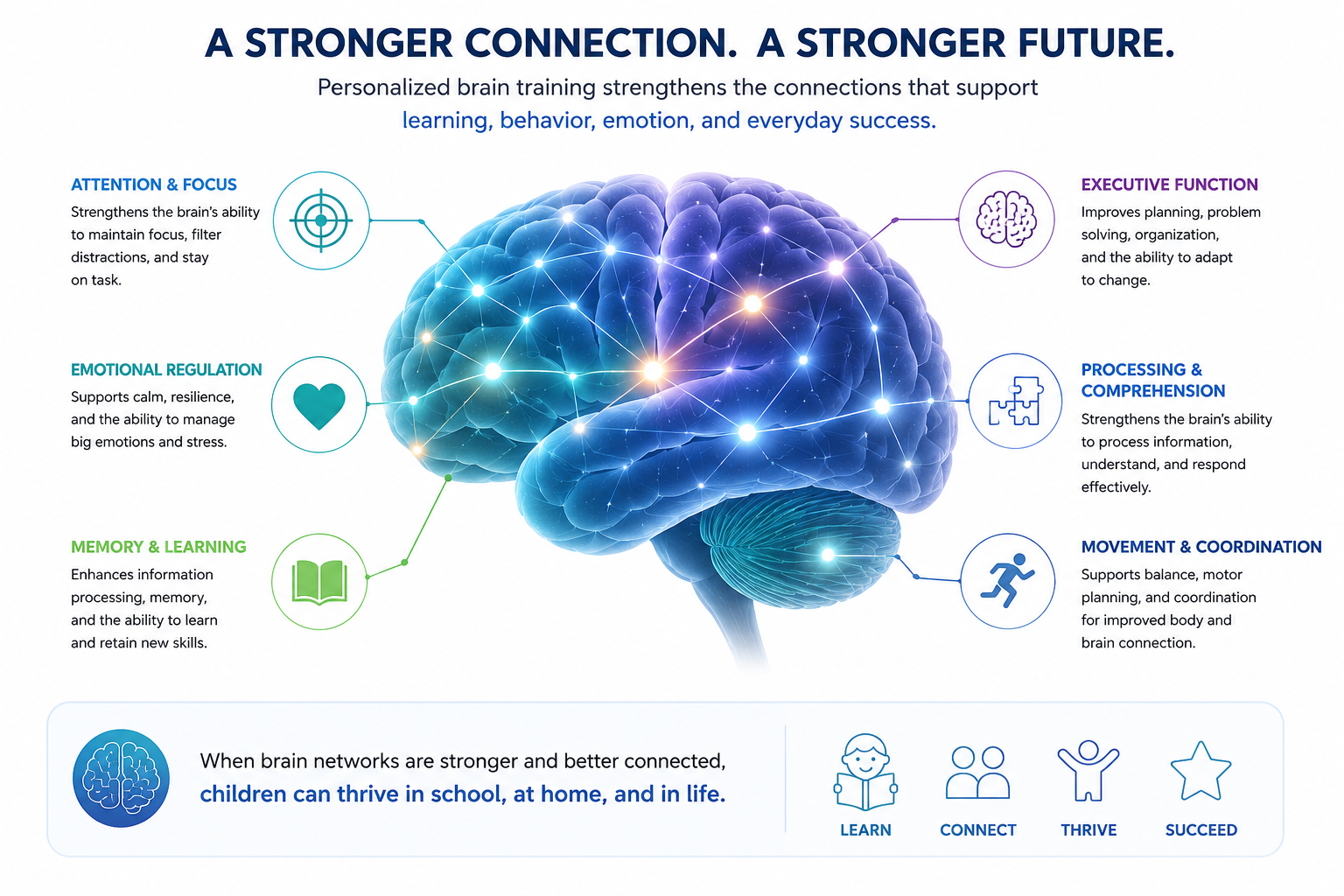
A Stronger Connection, A Stronger Future

Brain Skills We Commonly Strengthen

Writing is one of the brain’s most complex tasks. It requires multiple neurological systems to work together at the same time—from organizing ideas and retrieving words to planning hand movements and maintaining attention.

While every child’s Brain & Body Assessment is unique, these are some of the foundational brain skills that may be evaluated and strengthened as part of a personalized brain training program.

✍️ Fine Motor Coordination & Motor Planning

Writing begins with precise, coordinated hand movements. Children who struggle with fine motor control or motor planning may find handwriting slow, tiring, or difficult to control.

💬 Language Processing

Expressing ideas in writing requires the brain to organize language, retrieve vocabulary, build sentences, and communicate thoughts clearly. Strengthening language processing can help support written expression and communication.

👁️ Visual Processing

Successful writing depends on accurately recognizing letters, spacing words, maintaining alignment on the page, and coordinating visual information with hand movements. Visual processing plays an important role in these everyday writing tasks.

📝 Working Memory

Working memory helps children hold information in mind while writing. It allows them to remember what they want to say, keep track of spelling and punctuation, and organize ideas without losing their train of thought.

🧠 Executive Function

Planning, organizing, prioritizing, self-monitoring, and completing written assignments all rely on executive functioning. These skills help children turn ideas into clear, organized written work.

🎯 Attention & Focus

Writing often requires sustained concentration over extended periods of time. Strengthening attention can help children stay engaged, complete assignments more efficiently, and reduce mental fatigue.

🤸 Balance & Coordination

Balance and whole-body coordination are closely connected to posture, stability, and the motor control needed for writing. A stable foundation allows children to use their hands more efficiently during fine motor tasks.

👶 Primitive Reflex Integration

Retained primitive reflexes may interfere with posture, pencil grip, eye movements, coordination, and other foundational skills involved in handwriting and written expression. When appropriate, they may be addressed as part of a personalized brain training program.

Because every child’s brain is different, no two NeuroFiT programs are exactly alike. Your child’s Brain & Body Assessment helps us understand which foundational brain skills may need additional support so we can develop a personalized brain training program designed specifically for their unique strengths, challenges, and goals.

What Many Families Notice:

Every child is unique, and progress looks different for every family. Because each NeuroFiT program is personalized based on your child’s Brain & Body Assessment, no two children experience exactly the same journey.

As foundational brain skills become stronger, many families tell us they begin noticing positive changes that extend beyond handwriting alone.

✍️ Greater Confidence with Writing

Children often become more willing to write, participate in classroom activities, and tackle assignments they once avoided.

📝 Improved Written Expression

Many families notice that their child’s ideas begin flowing more easily onto paper, making written work feel less overwhelming and more reflective of what they truly know.

📚 Greater Independence

Homework and writing assignments may require less prompting and support, allowing children to complete more work on their own.

🎯 Better Organization & Focus

As underlying brain skills strengthen, some children become better able to organize their thoughts, stay focused during writing tasks, and complete assignments more efficiently.

😊 Increased Self-Confidence

Success with writing often carries over into other areas of learning. As children begin experiencing fewer daily frustrations, many families notice growing confidence both inside and outside the classroom.

🌱 A More Positive Learning Experience

Perhaps most importantly, many parents tell us that school becomes less stressful. Writing no longer feels like an impossible obstacle, allowing children to spend more energy learning, creating, and sharing what they know.

While every child’s journey is different, our goal remains the same: to help children develop the foundational brain skills that support writing, learning, communication, and lifelong confidence. Rather than focusing on handwriting alone, we strive to help children express their ideas more effectively and reach their full potential—both in school and beyond.

The Science Behind Better Writing & Learning

Writing is one of the brain’s most sophisticated activities. Every time your child writes a word, sentence, or paragraph, multiple brain regions and neurological systems must communicate efficiently and in precise coordination.

Within seconds, the brain must generate ideas, organize thoughts, retrieve language, remember spelling patterns, visually guide letter formation, plan precise hand movements, maintain posture, sustain attention, and monitor progress—all while continuing to think about what comes next.

When one or more of these foundational brain functions isn’t working as efficiently as it could, writing can become slow, mentally exhausting, and frustrating—even for children who are bright, creative, and capable learners.

Research continues to show that learning depends on the coordinated function of many interconnected brain systems rather than any single “writing center.” While every child is unique, strengthening the foundational brain skills involved in learning may help support more efficient communication between these networks.

At NeuroFiT Connections, our focus isn’t simply on improving handwriting or practicing written assignments. Our goal is to better understand how your child’s brain is functioning so we can develop a personalized brain training program designed to strengthen the underlying brain skills that support writing, learning, communication, and lifelong confidence.

Writing requires the brain to work as a team
10+ Years of Experience

Discover the unwavering commitments that make NeuroFiT Connections a leading Child Wellness Program, specifically designed to treat and resolve learning disorders in children.

Happy Child Writing in School

Helping Children Write, Learn & Thrive with Confidence

Every child deserves the opportunity to communicate their ideas with confidence. Whether they’re writing a sentence, answering a test question, taking notes in class, or completing an essay, writing should help them express what they know—not become a barrier that hides their abilities.

Children with dysgraphia often have far more knowledge, creativity, and understanding than their written work suggests. When writing feels slow, exhausting, or frustrating, they may begin avoiding assignments, participating less in class, or believing they simply “aren’t good at school.”

At NeuroFiT Connections, we believe every child has unique strengths worth discovering and developing. Our personalized Brain & Body Assessment helps us understand how your child’s brain is functioning so we can create a brain training program designed specifically for their individual needs—not simply their diagnosis.

By strengthening the foundational brain skills that support handwriting, written expression, language processing, executive functioning, attention, and learning, our goal is to help children communicate their ideas more effectively, approach school with greater confidence, and recognize their own potential.

Because when children are better able to express what they know, they’re free to focus less on the mechanics of writing and more on learning, creating, and sharing their ideas with the world.

💡 Express Ideas with Confidence

When writing becomes easier, children are often better able to communicate their thoughts, creativity, and knowledge both in and out of the classroom.

📚 Demonstrate What They Know

Many children with dysgraphia understand far more than they can comfortably express in writing. Strengthening the foundational brain skills that support written communication can help them better demonstrate their true abilities.

🌟 Grow in Confidence

Success with writing often reaches far beyond the classroom. As writing becomes less frustrating, many children begin participating more, taking on new challenges, and believing in themselves again.

🧠 Build Skills for Lifelong Learning

Writing supports learning in nearly every subject and throughout life. By strengthening the foundational brain skills involved in written expression, we’re helping children build skills that can support success well beyond school.

Building a Stronger Foundation for Lifelong Success

Writing is much more than an academic skill—it’s one of the primary ways we communicate, solve problems, share ideas, and demonstrate what we know throughout life.

From writing stories in elementary school to taking notes in high school, completing college applications, sending emails, preparing reports, and communicating in future careers, strong written communication opens doors to learning, relationships, and opportunity.

For children with dysgraphia, these everyday tasks can feel far more difficult than they should. Over time, repeated frustration may lead some children to avoid writing, doubt their abilities, or miss opportunities to fully demonstrate their knowledge and creativity.

At NeuroFiT Connections, we believe every child deserves the opportunity to express themselves with confidence. That’s why our personalized approach focuses on strengthening the foundational brain skills that support written communication—not simply helping children produce neater handwriting.

As children build stronger neurological foundations, many families tell us they see improvements that extend well beyond writing assignments. Greater confidence, increased independence, stronger organization, improved problem-solving, and a more positive attitude toward learning often become just as meaningful as progress in the classroom.

Our goal isn’t simply to help children succeed on tomorrow’s spelling test or writing assignment. It’s to help them develop the brain skills that support communication, learning, and confidence throughout school—and throughout life.

Building skills that last a lifetime

Investing in Your Child's Future

Every parent wants to give their child the opportunity to succeed—not just in school, but throughout life.

When writing feels difficult day after day, children may begin avoiding opportunities to express themselves, participate in class, or demonstrate what they know. Over time, those experiences can influence how they see themselves as learners, communicators, and problem-solvers.

That’s why we believe supporting a child’s development goes far beyond improving handwriting or completing today’s homework assignment. It’s about helping them build the foundational brain skills that support communication, learning, organization, confidence, and lifelong success.

Our personalized Brain & Body Assessment allows us to look beyond symptoms and better understand your child’s unique neurological strengths and challenges. From there, we create a personalized brain training program designed specifically for your child—because no two brains are exactly alike.

The skills children develop today have the potential to influence tomorrow’s opportunities. Whether they’re writing an essay, completing a college application, communicating in the workplace, or simply sharing their ideas with confidence, strong foundational brain skills can support success throughout every stage of life.

Because every child deserves the opportunity to communicate what they know—and every bright idea deserves the chance to be shared.

What You'll Learn During Your Child's Brain & Body Assessment

Your child’s Brain & Body Assessment is designed to provide a comprehensive understanding of how they learn, process information, and interact with the world. Rather than focusing solely on a diagnosis or symptoms, we evaluate the foundational brain and body systems that influence learning, behavior, attention, coordination, and overall development.

During your personalized assessment review, we’ll walk you through the findings in clear, easy-to-understand language and answer any questions you may have. Together, we’ll discuss your child’s unique strengths, identify the areas that may benefit from support, and explain how those findings relate to the challenges you’ve been seeing at home or in school.

You’ll leave with:

Every child is unique, and every assessment is personalized. Our goal is to help you understand not just what your child is experiencing, but why—so you can move forward with confidence and a plan designed specifically for them.

Program FAQs

Dysgraphia is a neurological learning disorder that affects writing and written expression. It may impact handwriting, spelling, organizing thoughts on paper, note-taking, and the ability to communicate ideas through writing. Dysgraphia does not reflect a child's intelligence—many children with dysgraphia are bright, creative, and capable learners.

No. While messy handwriting can be one sign of dysgraphia, the condition often affects much more than penmanship. Children may struggle with organizing ideas, spelling, sentence construction, written expression, fine motor coordination, or completing written assignments efficiently.

There isn't one single cause of dysgraphia. Writing requires many brain systems to work together, including language processing, visual processing, working memory, executive functioning, attention, and fine motor coordination. Challenges in one or more of these areas may contribute to writing difficulties.

Many children develop stronger writing skills over time with the right support. At NeuroFiT Connections, our goal is to strengthen the foundational brain skills that support written communication through personalized brain training based on each child's Brain & Body Assessment.

They are different learning disorders, but they can occur together. Dyslexia primarily affects reading and written language processing, while dysgraphia primarily affects handwriting and written expression. Some children experience one condition, while others experience both.

Some children have both ADHD and dysgraphia, but one does not necessarily cause the other. Difficulties with attention, executive functioning, or working memory may make writing more challenging, which is why our Brain & Body Assessment looks at the whole child rather than focusing on a single diagnosis.

Yes. Although dysgraphia is often identified during childhood, many adults continue to experience challenges with handwriting, note-taking, organization, or written communication. With appropriate support, many people develop strategies that help them succeed in school, college, and the workplace.

Dysgraphia is typically identified through educational or psychological evaluations that assess writing, language, and academic performance. At NeuroFiT Connections, we do not diagnose dysgraphia. Instead, our Brain & Body Assessment helps us better understand the underlying brain functions that may be contributing to your child's writing challenges so we can develop a personalized brain training program.

Helpful Resources for Parents of Children with Dysgraphia

Learning more about dyslexia and how the brain supports reading can help you better understand your child’s unique strengths and challenges. Explore these articles for practical tips, neuroscience-informed insights, and guidance to help your child become a more confident learner.

The Role of Working Memory in Reading and Learning
29Jul

The Role of Working Memory in Reading and Learning

Why Does My Child Forget What They Just Read? Have you ever watched your child finish reading a paragraph, only to ask: “What did you just read?” …and they shrug because they can’t remember? Many parents assume their child simply…

Can Dyslexia Improve? What Parents Should Know
28Jul

Can Dyslexia Improve? What Parents Should Know

Will my child ever get better? One of the first questions many parents ask after learning their child has dyslexia is: “Will my child ever get better?” The answer is encouraging—but it’s also important to understand what “better” really means.…

Understanding Visual Processing and Reading Challenges
27Jul

Understanding Visual Processing and Reading Challenges

My Child Has 20/20 Vision. Why Is Reading Still Difficult? Many parents are surprised when they’re told their child may have visual processing challenges. After all… “They passed their eye exam.” “They can see the board.” “They don’t need glasses.”…