NeuroFiT Connections Child Wellness Program

Helping Children Build the Brain Skills for Reading, Learning & Lifelong Confidence

No medication. No invasive procedures. Just a personalized, neuroscience-informed approach designed to strengthen the underlying brain functions involved in reading, language processing, visual and auditory processing, executive functioning, attention, learning, and confidence.

Dyslexia is more than simply having difficulty reading. It can affect spelling, reading fluency, comprehension, writing, academic performance, and a child’s confidence in the classroom and beyond. Many children with dyslexia are highly intelligent, creative, and capable learners—they simply process written language differently.

At NeuroFiT Connections, we believe reading challenges are often a symptom—not the root cause. That’s why every program begins with a comprehensive Brain & Body Assessment to better understand how your child’s brain is functioning. Using those results, we develop a personalized brain training program designed to strengthen the neurological systems that support reading, language development, attention, learning, and lifelong success.

Rather than building a program around a diagnosis, we build it around your child. Whether your child has been diagnosed with dyslexia, a reading disorder, or simply struggles with reading and spelling without a formal diagnosis, our goal is to understand their unique brain and create a personalized roadmap for growth.

5.0 (100+ parent ratings)
Rated 5 out of 5

Does This Sound Like Your Child?

Children with dyslexia often demonstrate strengths in creativity, curiosity, problem-solving, and big-picture thinking. Yet despite being bright and capable, they may struggle with reading, spelling, writing, or language-based tasks in ways that seem inconsistent with their intelligence or effort.

If any of these sound familiar, your child may be experiencing more than a temporary reading challenge.

📖 Reading & Language Skills

Children with dyslexia often find reading to be slow, effortful, and frustrating despite being bright and capable learners.

✍️ Spelling & Writing

Written language often requires much more effort than verbal communication, making writing assignments especially frustrating.

🎒 School & Learning

Reading difficulties often affect much more than language arts. When reading becomes slow and effortful, it can make learning across many subjects more challenging and leave children feeling like they are constantly trying to catch up.

💙 Confidence & Emotional Well-Being

Many children with dyslexia know they’re working just as hard as their classmates. Repeated struggles can gradually affect confidence, motivation, and a child’s willingness to participate both inside and outside the classroom.

Dyslexia affects far more than reading. It can influence academic performance, confidence, classroom participation, and a child’s willingness to take on new challenges. While every child experiences dyslexia differently, persistent struggles with reading and written language may be a sign that the brain systems supporting language processing, attention, visual processing, auditory processing, and learning need additional support.

If your child experiences several of these challenges on a regular basis, you’re not alone. Understanding why reading is difficult is often the first step toward helping your child build greater confidence, stronger reading skills, and lifelong success.

Continue Learning at Home

Download Your FREE Empower & Enlighten™ Learning Disorders Parent Guide

If your child struggles with reading, writing, spelling, math, organization, or keeping up in school, it can be difficult to know where to turn—or which information to trust.

That’s why we’ve created the Empower & Enlighten™ Learning Disorders Parent Guide—a comprehensive resource designed to help parents better understand learning disorders and the brain functions that influence learning.

Written by Jackie Beck, Co-Founder and Lead Cognitive Coach at NeuroFiT Connections, this guide explains why learning disorders do not define a child’s intelligence or potential and how understanding your child’s unique brain can open the door to greater confidence, success, and independence.

Inside this comprehensive guide, you’ll discover:

✓ The differences between dyslexia, dysgraphia, dyscalculia, and other learning disorders

✓ Common signs and symptoms parents often overlook

✓ The brain-based factors that may contribute to learning challenges, including retained primitive reflexes and processing differences

✓ Current treatment options and support strategies available for children

✓ Practical ways parents and teachers can work together to support learning

✓ How NeuroFiT Connections’ personalized Brain & Body Assessment helps identify the underlying factors affecting your child’s learning

Complete the form below to receive your FREE copy and begin learning how to better understand and support your child’s unique learning journey.

Trusted by parents who want to better understand how their child learns.

Empower and Enlighten

Schedule your assessment today. Dyslexia Assessments Include:

How Dyslexia Can Affect Everyday Life

Reading is part of everyday life—not just school. From following directions and completing homework to reading a menu or enjoying a favorite book, dyslexia can influence many daily experiences. While every child is unique, persistent reading challenges can affect confidence, independence, and a child’s willingness to try new things.

📚 Reading & Academic Success

Reading often requires significantly more time and effort, making classroom assignments and homework feel overwhelming even for bright, capable children.

  • Takes longer to complete reading assignments
  • Has difficulty reading grade-level material fluently
  • Struggles with reading comprehension when decoding requires so much effort
  • Falls behind classmates despite working hard

✍️ Writing & Communication

Expressing ideas on paper may be much more difficult than expressing them verbally, leading to frustration with written assignments.

  • Avoids writing whenever possible
  • Makes frequent spelling errors
  • Has difficulty organizing written thoughts
  • Written work doesn’t reflect their understanding

🏫 Classroom Participation

Children with dyslexia may hesitate to participate because they worry about making mistakes in front of classmates.

  • Avoids reading aloud
  • Hesitates to answer questions involving reading
  • Appears disengaged during language-based activities
  • Participates less as confidence declines

💙 Confidence & Self-Esteem

Repeated struggles can gradually shape how children see themselves, even when they are intelligent, creative, and working incredibly hard.

  • Begins to believe they aren’t smart
  • Compares themselves negatively to classmates
  • Avoids new challenges
  • Loses confidence in school

👨‍👩‍👧 Family Life

Reading challenges often extend beyond school, creating stress during homework, bedtime reading, and other family activities.

  • Homework becomes a nightly struggle
  • Reading together becomes frustrating instead of enjoyable
  • Parents spend extra time helping with assignments
  • Family routines become more stressful

🌟 Future Learning & Independence

As children grow, stronger reading skills support independence, confidence, and lifelong learning. Without the right support, everyday tasks can become increasingly frustrating.

  • Avoids books and recreational reading
  • Relies heavily on others for reading tasks
  • Becomes less willing to try unfamiliar activities
  • Misses opportunities to build confidence through learning

Dyslexia affects much more than reading words on a page. It can influence academic achievement, communication, confidence, relationships, and a child’s willingness to embrace new challenges. With the right support and a personalized understanding of how your child’s brain processes language, it’s possible to strengthen the foundational brain skills that support reading, learning, and lifelong success.

Understanding Dyslexia: Looking Beyond the Reading Challenges

For many families, dyslexia first becomes noticeable when reading doesn’t come as easily as it seems to for other children. A child may work incredibly hard yet continue to struggle with reading fluency, spelling, writing, or understanding written language. These challenges can be confusing—especially when the child is clearly intelligent, curious, and capable in so many other areas.

At NeuroFiT Connections, we believe dyslexia is about much more than reading words on a page. Reading is a complex process that depends on many brain systems working together, including language processing, visual processing, auditory processing, attention, working memory, executive functioning, and eye movement control. When one or more of these foundational systems are less efficient, reading can become slow, effortful, and frustrating.

Rather than focusing solely on a diagnosis or the reading difficulties themselves, our goal is to understand why those challenges are occurring. Through our comprehensive Brain & Body Assessment, we evaluate the underlying brain functions that support reading and learning. This allows us to create a personalized brain training program designed around your child’s unique strengths and areas for growth—not simply their diagnosis.

Every child with dyslexia has a different neurological profile. That’s why we don’t build programs around dyslexia—we build them around children.

How Can NeuroFiT Connections Help?

Every child with dyslexia has a unique combination of strengths and challenges. While one child may struggle primarily with language processing, another may benefit from strengthening visual processing, attention, working memory, executive functioning, or the coordination of multiple brain systems that support reading and learning.

That’s why we begin with a comprehensive Brain & Body Assessment. Rather than making assumptions based solely on a diagnosis, we evaluate how your child’s brain and body are functioning to better understand the underlying factors contributing to their reading difficulties.

Using those assessment results, we create a personalized brain training program designed specifically for your child. By strengthening the foundational brain skills involved in reading and learning, we help children build greater confidence, improve their ability to process information more efficiently, and develop the skills that support lifelong learning.

Every program is personalized because every child deserves an approach that’s built around their unique neurological profile—not simply their diagnosis.

Every child deserves the opportunity to discover that they are capable of learning, growing, and succeeding.

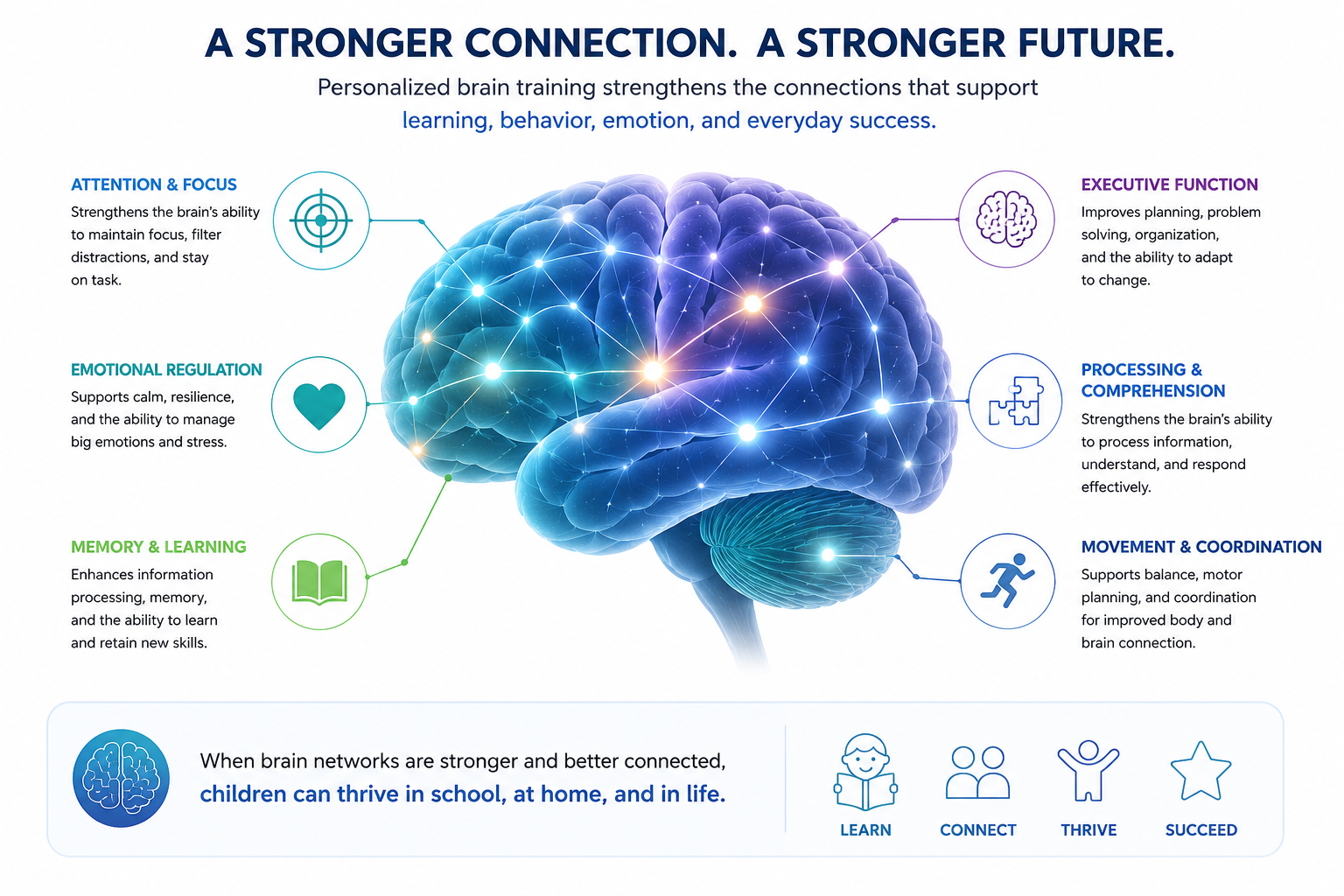
A Stronger Connection, A Stronger Future

Brain Skills We Commonly Strengthen

Every child with dyslexia has a unique pattern of strengths and challenges. While dyslexia is most commonly associated with reading, it often involves multiple brain systems working together, including language processing, visual processing, auditory processing, attention, working memory, executive functioning, and eye movement control. Our goal is to strengthen these foundational brain skills so reading and learning can become more efficient, more confident, and less frustrating.

Following your child’s comprehensive Brain & Body Assessment, we develop a personalized brain training program based on how your child’s brain is functioning—not simply their diagnosis. By identifying the underlying brain skills that may benefit from additional support, we create a customized plan designed to help your child build stronger foundations for reading, learning, and lifelong success.

As those foundational brain skills become more efficient, many families report improvements in areas such as:

🧠 Language Processing

Language processing helps children recognize, understand, and organize spoken and written language. Strengthening these skills can support more efficient decoding, reading fluency, comprehension, and communication.

👁️ Visual Processing & Eye Tracking

Efficient reading depends on the brain’s ability to accurately process visual information while the eyes move smoothly across a page. Strengthening these skills can improve reading comfort, accuracy, and fluency.

👂 Auditory Processing

Reading begins with recognizing and processing the sounds within language. Improving auditory processing can help children better connect sounds with letters, decode unfamiliar words, and develop stronger reading skills.

⚡ Attention & Executive Function

Sustaining attention, planning, organizing, and managing information are all important for successful reading and learning. Strengthening executive function can help children stay engaged and complete academic tasks more efficiently.

🧩 Working Memory

Working memory allows children to temporarily hold and manipulate information while reading, spelling, solving problems, and following directions. Stronger working memory supports comprehension and learning across many subjects.

🌟 Confidence & Independent Learning

As foundational brain skills improve, many children become more willing to read, participate in class, tackle challenging assignments, and develop greater confidence in their own abilities.

Our goal isn’t simply to help children become better readers—it’s to help them become more confident learners. By understanding how your child’s brain processes information and building a personalized program around their unique strengths and needs, we work to strengthen the foundational brain skills that support reading, learning, confidence, and lifelong success.

What Many Families Notice:

Every child’s journey is unique, and progress looks different from one child to the next. As foundational brain skills become stronger and more efficient, many families tell us they begin noticing meaningful changes that extend well beyond reading itself.

While no specific outcome can be guaranteed, parents often report positive changes in areas such as:

📖 Increased Reading Confidence

Children often become more willing to read independently, participate in classroom reading activities, and approach books with greater confidence.

⚡ Improved Reading Fluency

Reading may become smoother and less effortful, allowing children to spend less energy decoding words and more energy understanding what they’re reading.

📝 Stronger Spelling & Written Expression

As language processing and working memory develop, many children become more confident with spelling, writing assignments, and expressing their ideas on paper.

🎯 Better Focus During Learning

Improved attention and executive functioning can help children remain engaged during reading, homework, and other academic activities.

😊 Greater Confidence at School & Home

Success often builds confidence. As children experience fewer frustrations, many become more willing to participate, try new challenges, and believe in their own abilities.

🌱 A More Positive Relationship with Learning

Perhaps the most meaningful change many families describe is watching their child rediscover curiosity, confidence, and a willingness to learn—both inside and outside the classroom.

At NeuroFiT Connections, our goal isn’t simply to help children read more effectively—it’s to help them develop the foundational brain skills that support learning, confidence, independence, and lifelong success. By building a personalized program around your child’s unique neurological profile, we strive to create meaningful, lasting progress that extends far beyond the classroom.

The Science Behind Better Reading & Learning

Learning to read is one of the most complex skills the brain develops. It requires multiple brain systems to work together seamlessly—including language processing, visual processing, auditory processing, attention, working memory, executive functioning, and eye movement control. When one or more of these systems are less efficient, reading can become slow, effortful, and frustrating.

Research in neuroscience has demonstrated that the brain is capable of adapting and changing throughout life through a process known as neuroplasticity. This remarkable ability allows the brain to strengthen neural pathways and develop more efficient patterns of communication in response to targeted, repetitive activities.

At NeuroFiT Connections, our personalized brain training programs are built around this principle of neuroplasticity. Rather than focusing solely on helping children compensate for reading challenges, our approach is designed to strengthen the foundational brain skills that support reading, learning, attention, and academic success. Every program is individualized based on your child’s comprehensive Brain & Body Assessment because no two children have the same neurological profile.

While every child’s progress is unique, strengthening these foundational brain skills can support greater confidence, more efficient learning, and improved participation both in the classroom and in everyday life.

Mother and Daughter Reading together
10+ Years of Experience

Discover the unwavering commitments that make NeuroFiT Connections a leading Child Wellness Program, specifically designed to treat and resolve learning disorders in children.

Happy student working

Helping Children Read, Learn & Thrive with Confidence

Every child deserves the opportunity to discover the joy of learning and the confidence that comes from overcoming challenges. While dyslexia can make reading feel difficult today, it does not define your child’s intelligence, potential, or future.

At NeuroFiT Connections, we believe that confident learners are built by strengthening strong foundations. Through a personalized understanding of how your child’s brain processes information, we create individualized programs designed to strengthen the brain skills that support reading, language, attention, memory, executive functioning, and lifelong learning.

As children begin experiencing success, many families tell us they notice something even more meaningful than improved reading skills. They see children who are more willing to try new things, participate in class, read independently, ask questions, and believe in themselves again. Those moments often become the foundation for greater confidence both in school and in everyday life.

Because when children believe in themselves, they’re often more willing to embrace new opportunities, overcome challenges, and reach their full potential.

📚 A More Confident Reader

As foundational brain skills become stronger, many children become more willing to read independently, participate in classroom activities, and approach books with greater confidence.

🌟 A More Engaged Learner

When learning becomes less frustrating, children are often more willing to ask questions, tackle new challenges, and participate in school with greater enthusiasm and curiosity.

🚀 A Stronger Foundation for the Future

The confidence children build today can influence far more than academics. Strong foundational brain skills can support lifelong learning, independence, resilience, and the confidence to pursue new opportunities.

Every child with dyslexia follows a different path, and every success story begins with understanding how that child’s brain learns best. By looking beyond the diagnosis and identifying the underlying brain skills that need support, we can create a personalized plan designed to help each child build confidence, develop stronger learning foundations, and reach their unique potential.

Building a Stronger Foundation for Lifelong Success

Reading is one of the most important skills a child develops, but it is only one part of a much bigger picture. The foundational brain skills that support reading also play an important role in learning, communication, problem-solving, confidence, and independence throughout life.

At NeuroFiT Connections, our goal is to help children build stronger foundations—not just for the next spelling test or report card, but for the opportunities and challenges they’ll encounter as they grow. By strengthening the brain skills that support learning, we strive to help children become more confident learners, more resilient problem-solvers, and more willing to embrace new experiences.

Every child’s journey is unique, and progress looks different for every family. While no program can guarantee specific outcomes, building stronger foundational brain skills can create new opportunities for growth, greater independence, and increased confidence both in school and beyond.

Because when children have stronger foundations, they’re better prepared to learn, adapt, and thrive—not just today, but for years to come.

Happy graduate

Investing in Your Child's Future

Every child deserves the opportunity to reach their full potential. For children with dyslexia, that often begins with understanding how they learn best and providing the personalized support they need to build stronger foundations for success.

At NeuroFiT Connections, we view our programs as an investment in your child’s future—not simply because of the skills they develop today, but because of the confidence, independence, and resilience those skills can support for years to come. Stronger reading and learning skills can open doors to greater academic success, increased self-confidence, and new opportunities throughout school and beyond.

We also understand that choosing the right program is an important decision for every family. That’s why every child begins with a comprehensive Brain & Body Assessment, giving you a clear understanding of your child’s unique strengths, the underlying brain skills that may benefit from support, and personalized recommendations designed specifically for their needs.

Our goal is to provide families with the knowledge, guidance, and personalized care needed to make informed decisions and help children build a stronger foundation for lifelong learning and success.

What You'll Learn During Your Child's Brain & Body Assessment

Your child’s Brain & Body Assessment is designed to provide a comprehensive understanding of how they learn, process information, and interact with the world. Rather than focusing solely on a diagnosis or symptoms, we evaluate the foundational brain and body systems that influence learning, behavior, attention, coordination, and overall development.

During your personalized assessment review, we’ll walk you through the findings in clear, easy-to-understand language and answer any questions you may have. Together, we’ll discuss your child’s unique strengths, identify the areas that may benefit from support, and explain how those findings relate to the challenges you’ve been seeing at home or in school.

You’ll leave with:
Every child is unique, and every assessment is personalized. Our goal is to help you understand not just what your child is experiencing, but why—so you can move forward with confidence and a plan designed specifically for them.

Program FAQs

Unlike tutoring, which primarily teaches reading strategies and academic skills, NeuroFiT Connections focuses on strengthening the foundational brain skills that support reading and learning. Our personalized programs are designed to improve areas such as language processing, visual processing, attention, working memory, executive functioning, and eye movement control. By addressing these underlying brain skills, we aim to help children become more confident and capable learners.

Every child is unique. Some families choose to continue tutoring, school accommodations, or other educational services while participating in our program, while others find their child's needs change over time. During your Brain & Body Assessment, we'll discuss your child's current support system and provide personalized recommendations based on their individual needs.

Program length varies depending on your child's age, assessment findings, goals, and the level of support needed. As a general rule, your child's personalized Dyslexia program will last between twelve and twenty-four weeks. After completing the Brain & Body Assessment, we'll recommend a personalized program designed specifically for your child and explain what you can expect throughout the process.

Each session is personalized based on your child's program and may include a combination of brain training exercises, cognitive activities, motor and coordination exercises, visual and auditory activities, and other neuroscience-informed interventions designed to strengthen foundational brain skills. Sessions are engaging, interactive, and adapted to your child's progress.

Every child progresses at their own pace, and improvements vary based on their unique neurological profile, age, consistency, and individual goals. Some families notice early changes in attention, confidence, or participation, while other improvements develop gradually over time. Throughout the program, we'll monitor progress and adjust activities to support your child's continued growth.

Yes. Many children with dyslexia also have other diagnoses or challenges, such as ADHD, dysgraphia, dyscalculia, auditory processing difficulties, anxiety, or developmental coordination challenges. Because our programs are personalized based on each child's Brain & Body Assessment rather than a diagnosis alone, we can tailor recommendations to address your child's unique combination of strengths and needs.

Getting started begins with scheduling your child's comprehensive Brain & Body Assessment. This assessment helps us understand how your child's brain is functioning, identify the foundational brain skills that may benefit from support, and develop personalized recommendations designed specifically for your child. From there, we'll review the results together and create a customized plan to help your child build stronger foundations for reading, learning, and lifelong success.

Helpful Resources for Parents of Children with Dyslexia

Learning more about dyslexia and how the brain supports reading can help you better understand your child’s unique strengths and challenges. Explore these articles for practical tips, neuroscience-informed insights, and guidance to help your child become a more confident learner.

What Is Dyslexia? Understanding the Signs, Causes & Support Options
25Jul

What Is Dyslexia? Understanding the Signs, Causes & Support Options

Learn what dyslexia is, common signs by age, what causes it, and the support options available to help children become more confident readers and learners.

Why Does My Child Need Everything Repeated?
10Jul

Why Does My Child Need Everything Repeated?

Why Does My Child Need Everything Repeated? “I just told you that.”  “Why do I have to repeat everything?” “I know you heard me!” If you’ve found yourself saying these phrases over and over, you’re not alone. Many parents become…

Language and the Hemispheres of the Brain
08Apr

Language and the Hemispheres of the Brain

Language and the Hemispheres of the Brain Understanding Speech Development Through the Lens of Brain Function When a child struggles with speech or language, caregivers often find themselves asking the same questions: Why is this happening?Is my child just a…